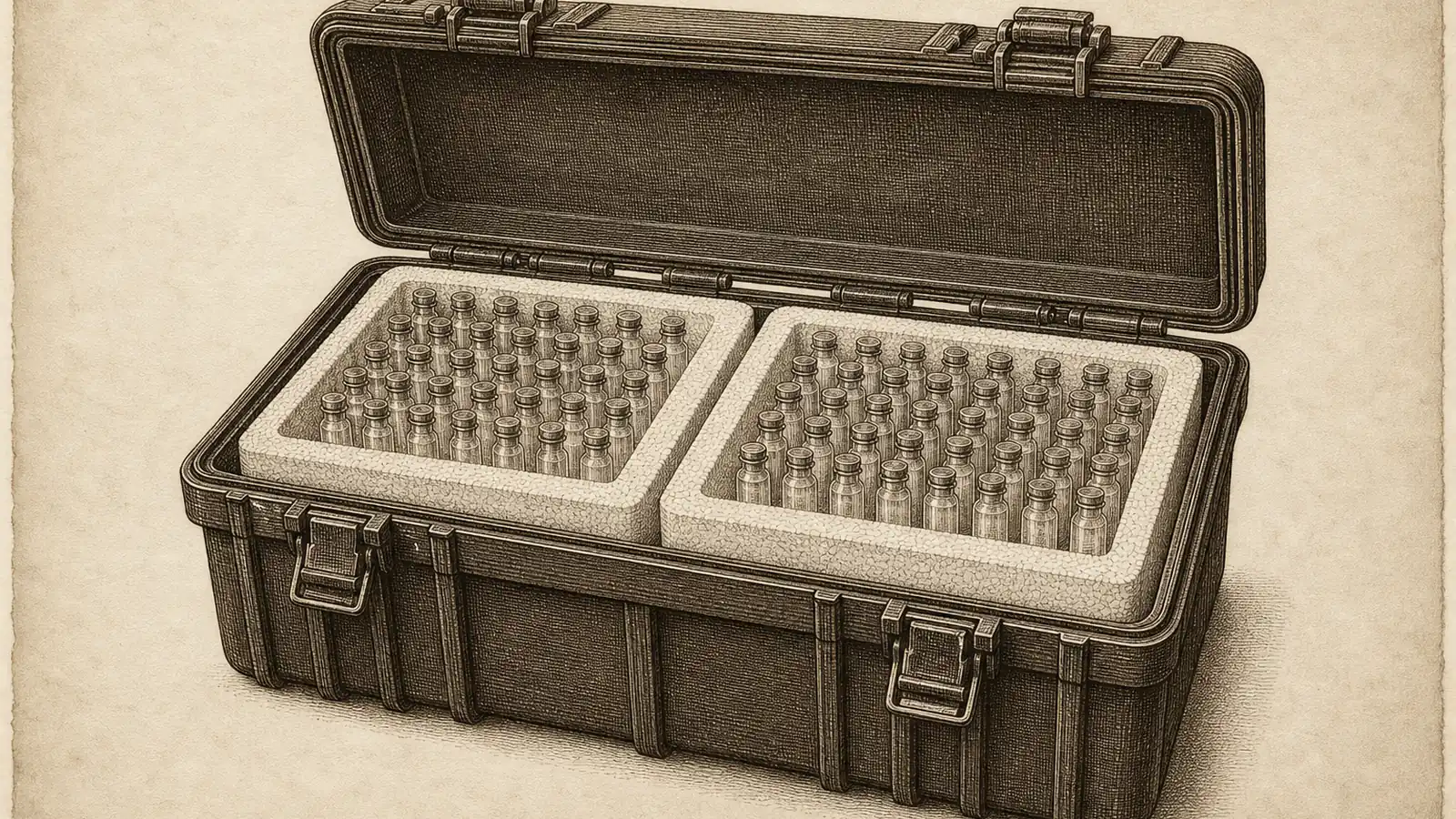
A Customs and Border Protection officer at Detroit Metropolitan Airport’s McNamara Terminal asked a passenger from Brazzaville what was in the large black plastic case. Diagnostic equipment, the passenger said. The officer opened the case anyway. Inside, packed in Styrofoam coolers, were 113 glass vials.
The passenger was Vincent Munster, a 53-year-old Dutch national who serves as chief of the Virus Ecology Section at Rocky Mountain Laboratories, NIAID’s Biosafety Level 4 facility in Hamilton, Montana. The research fellow traveling with him, Claude Kwe, 38, runs samples in the same lab. According to the federal complaint, Munster first told the officer he was not carrying biological material. When the vials were found, he changed course and said his paperwork was in his laptop. Then, in a sentence the complaint records and the country should sit with, he added: “but you don’t need them. I do this all the time.”
Charges came this week: conspiracy to smuggle goods into the United States, plus false statements to federal law enforcement. Each count carries up to five years. The actual airport stop happened more than four months earlier, on January 25, 2026, after Munster’s nine-day trip to the Republic of Congo. Whatever sat in those vials between January and June, while the FBI tested samples and prosecutors drafted the complaint, is the kind of material that has been mishandled before by federal labs, on the public record: the CDC’s 2014 anthrax incident, the long-forgotten vials of smallpox that turned up in an FDA cold-storage room on the NIH Bethesda campus the same year, the 2019 safety shutdown at the Army’s BSL-4 lab at Fort Detrick. The American regulatory regime around infectious or potentially infectious biological material exists because, after each of those costly lessons, the country decided it wanted a chain of custody, a trained shipper, an import authorization, and a name on a permit when those materials cross the border from an outbreak zone. A senior BSL-4 investigator does not get to waive that chain because, in his judgment, the contents were safe enough.
Here is what the case held, according to the complaint. Testing on a sample of 20 of the 113 vials returned 17 positive for deactivated monkeypox virus, one for chickenpox virus, and two for human DNA. A deactivated virus is one whose ability to replicate has been chemically or thermally destroyed, typically by aldehyde fixation or by irradiation, so that what remains is intact viral antigen and nucleic acid without the capacity to infect a cell. If the inactivation was complete and properly documented, the public-health risk to Wayne County was low, and within the boundaries of those 20 tested vials, the framing NIAID and HHS will lean on is partially true. The other 93 vials have not been publicly disclosed as tested. And the regulatory regime around inactivated viral samples from an outbreak zone still requires customs declaration, import authorization, and documented inactivation paperwork, because the country has decided that on-the-spot scientific judgment is not the chain of custody it wants.
The trip itself happened during an active mpox outbreak in the Republic of Congo, where the Virus Ecology Section maintains a field study site. That field site is one of several Munster runs, according to NIAID’s own bio of him: Republic of Congo, Mali, Trinidad and Tobago, Jordan. If “I do this all the time” describes his actual practice, the question is not whether two scientists were sloppy on one trip. The question is how many vials have moved through American airports over the past decade, from which outbreak countries, into which BSL-3 and BSL-4 freezers, without the import paperwork the rest of the field is required to file. An honest audit would start with the Virus Ecology Section’s sample inventory at Rocky Mountain Labs and walk it back, vial by vial, to the corresponding CDC import authorizations and IATA dangerous-goods records. If the numbers reconcile, two scientists had a bad day in Detroit. If they do not, the lab has been running a private import lane for years.
The institutional culture question is the part that will not stay inside one section chief’s office. NIAID is the agency that funded EcoHealth Alliance’s coronavirus surveillance work in Wuhan, that terminated EcoHealth’s grant in 2022 after NIH found the group had failed to provide requested lab notebooks and records from the Wuhan Institute of Virology, then saw HHS suspend its remaining federal funding in 2024 over unmonitored high-risk research, and whose former leadership presided over a long stretch of agency hostility to the lab-leak hypothesis. None of that history is repeated here for litigation. It is repeated because the cultural pattern critics of NIAID have been describing for years is the same pattern that produces a section chief telling a federal officer, on the record, that the rules are optional for him. Two scientists are charged. The institution is the one that owes the country answers.
So a list, in order, of what NIH and HHS should be made to produce, on the record, within sixty days: a suspension of Munster and Kwe pending the criminal case, not a quiet administrative reassignment; the full inactivation testing results for all 113 vials, not the 20 already disclosed; the Virus Ecology Section’s complete CDC import permit history for the last decade, cross-referenced to its sample inventory at Rocky Mountain Labs; the same audit extended to the section’s other foreign field sites in Mali, Trinidad and Tobago, and Jordan; and an HHS Office of Inspector General review broad enough to ask whether other NIAID field-going labs have been operating under the same private understanding of customs law. Most of those records already exist. The only question is whether the public ever sees them.
Sources
- DOJ / USAO-EDMI – Criminal complaint: foreign nationals at NIH charged with smuggling monkeypox (2026)
- STAT News – Senior NIH scientist, research fellow charged with bringing deactivated mpox virus into U.S. (2026)
- WDIV / ClickOnDetroit – FBI: NIH scientists accused of smuggling monkeypox through Detroit Metro Airport (2026)
- NIAID – Vincent J. Munster, Ph.D. bio page
- Bulletin of the Atomic Scientists – NIH to terminate EcoHealth Alliance grant after Wuhan partners refuse to deliver information on coronavirus studies (2022)
- HHS OIG – NIH and EcoHealth Alliance Did Not Effectively Monitor Awards and Subawards (2023)