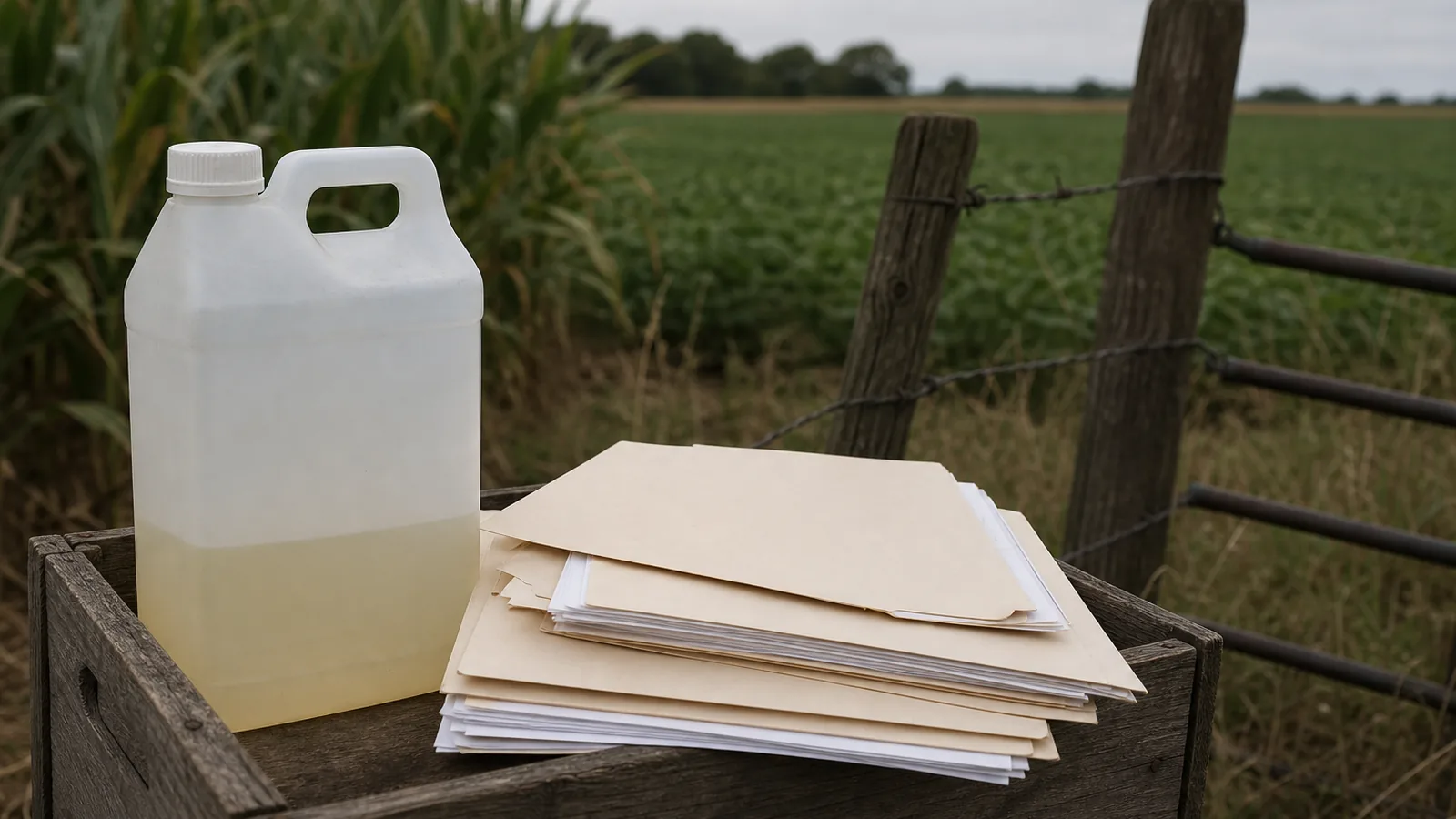
For about twelve months, the granola lobby and the red-hat moms were standing at the same fence pointing at the same molecule, and I almost missed it. By the spring of 2026 the Environmental Working Group and a coalition of MAHA-aligned mothers could not agree on a single other policy on the planet, but they were both demanding the same thing about glyphosate. Why is the active ingredient in Roundup still on roughly 90% of American corn and soy when the epidemiology has been pointing in a direction nobody at EPA or EFSA wants to look for the better part of a decade?
Then on February 18, 2026, President Trump signed an executive order invoking the Defense Production Act on behalf of the glyphosate industry, granted legal immunity to its domestic manufacturers, and called the herbicide “central to American economic and national security.” Ken Cook, who runs EWG, called it “a big middle finger to every MAHA mom” and asked in public whether the whole MAHA project had been “a scam concocted by President Trump and RFK Jr. to rally health-conscious voters in 2024.” Cook spent the Obama and Biden years treated as the gold standard of environmental advocacy by the mainstream press, and he is now saying the quiet part out loud about a Republican president the establishment press is supposed to file as his ideological opposite.
Start with the evidence, because both the establishment dismissal (“studied to death, safe”) and the marketing copy (“Roundup causes every chronic disease in America”) skip the middle ground where the actual data lives. In 2015 the International Agency for Research on Cancer classified glyphosate as a Group 2A “probable human carcinogen,” driven mostly by data showing elevated non-Hodgkin lymphoma in occupationally exposed workers. That has been the source of a decade-long food fight, and EPA and EFSA both declined to follow IARC’s lead. Fine. The underlying epidemiology did not stop in 2015. Zhang and colleagues published a 2019 meta-analysis that pulled in the updated Agricultural Health Study cohort, drew on six studies totaling about 65,000 participants, and found that the highest-exposed individuals had a non-Hodgkin lymphoma meta-relative risk of 1.41 with a 95% confidence interval of 1.13 to 1.75. Translated out of statistics-ese: among people getting hit with the most glyphosate, the lymphoma signal sits well above the noise floor and replicates across study designs. It is not “Roundup gives you cancer.” It is “if you spray this stuff for a living, your lymphoma odds climb in a measurable, reproducible way.” Those are very different sentences, and the policy conversation has been allergic to the middle one.
The mechanism is more interesting than the food fight. The industry line for years was that glyphosate could not possibly hurt humans because it works by blocking the shikimate pathway, an enzymatic route plants use to build aromatic amino acids that mammals lack. Elegant argument. Except your gut microbiome has the shikimate pathway, and your gut microbes are running it constantly. The same molecule that kills weeds by starving them of the precursors to tryptophan, tyrosine, and phenylalanine is, at the doses showing up in human urine samples across the developed world, plausibly remodeling the bacterial population that makes most of your serotonin precursors and trains your immune system from infancy. The human evidence is still early and contested, and most of the strongest mechanism work so far is animal or in vitro. But the argument that glyphosate has “no human target” because we lack the pathway has aged badly. We do not have the pathway. The trillion-cell ecosystem we depend on does.
That science is where a curious mom in a red hat and a curious mom in hiking boots ended up around the same time, by very different routes. The hiking-boots crowd got there through twenty years of pesticide-in-breast-milk studies and the Center for Biological Diversity. The red hats got there through Robert Kennedy Jr. and a wave of state-level legislation. In 2023, three states introduced bills targeting food chemicals or pesticides. By the spring of 2026, according to EWG’s tracker, at least 40 states had. Representative Chellie Pingree, a Democrat from Maine, called it “a convergence of ideas.” Reporters at TIME and Politico started writing pieces about whether Democrats had a problem on their hands.
Then in May 2025 the first MAHA Commission report dropped and named names. It cited the risks of glyphosate and atrazine specifically. It described pesticide exposure in pregnant women and children. The pesticide industry read it and lost its mind.
What happened next reads less like a regulatory process and more like a slow-motion after-school special on lobbying. CropLife America, the trade association for Bayer, Syngenta, the rebadged Monsanto, BASF, and the rest of the agrochemical pipeline, attacked the May draft as “misleading and alarmist” and recommended language emphasizing EPA’s review process instead. Letters to federal departments and White House meetings followed, along with a social-media push asking the commission to take a “fact-based approach,” which in the lobbyist dialect of English means “stop saying the part that costs us money.” By August, a leaked draft showed the commission had quietly abandoned the chemical names. By September, the final MAHA Strategy Report was public, and the words “glyphosate” and “atrazine” had been edited out. The report incorporated CropLife’s recommended language about EPA’s “robust, respected process” and pulled in industry talking points about precision agriculture. PFAS got a gratuitous sentence asking CDC to “update recommendations.” There were no enforcement actions, no rule changes, no bans, no contaminant limits, and the food-dye phase-out stayed voluntary. Zen Honeycutt of Moms Across America, one of the loudest MAHA-aligned voices on pesticides, said she was “deeply disappointed that the committee allowed the chemical companies to influence the report” and called the removal “a tactic to appease the pesticide companies.” George Kimbrell of the Center for Food Safety called the result a “betrayal” of the grassroots with “some crumbs around the edges.”
Then came the February executive order, and any pretense of a “convergence of ideas” inside the administration evaporated. The order confers all immunity provided for in section 707 of 50 U.S.C. 4557, which means domestic glyphosate manufacturers producing under the order get a statutory shield against liability. The legal-immunity piece is doing the actual work here. Bayer has been hemorrhaging in Roundup cancer lawsuits since the Monsanto acquisition in 2018 and recently floated a $7.25 billion settlement, and the company has spent years pushing the courts and Congress to install FIFRA preemption, which would bar state-court failure-to-warn lawsuits altogether. The Supreme Court has a Bayer-related hearing scheduled for April 27 on exactly that question. Preemption language had been inserted and then dropped from the FY2026 appropriations bill. The executive order is, functionally, an end run around the whole fight. Vani Hari, the food activist better known as the Food Babe, said the order “reads like it was drafted in a chemical company boardroom.” Kelly Ryerson called it “a mockery” of the voters who backed the administration on health grounds. Kimbrell, more measured, called it “sound and fury, ultimately signifying nothing,” because an executive order cannot grant immunity Congress has not authorized. He is technically right and politically wrong: the signal to the agencies and the message to the MAHA moms have already done their work.
Glyphosate is not the unique villain in the American food supply, and it is not harmless. The honest read of the literature is roughly this: occupational exposure shows a modest, consistent, reproducible lymphoma signal; population-level dietary exposure shows a plausible microbiome story still being worked out; PFAS, microplastics, ultra-processed food formulation, atrazine, neonicotinoids, and the seed-oil-rancidity question are separate threads with separate evidence bases, and lumping them into “toxins” the way both the marketing and the dismissal camps do is unhelpful. Glyphosate matters here because it is the test case. Two political tribes that distrust each other on everything else looked at the same data, reached roughly the same conclusion, and started pushing for the same regulatory action. The response from a White House that ran on “Make America Healthy Again” was to invoke wartime production authority on behalf of the herbicide manufacturer.
What I am watching now is whether the coalition holds. EWG, Children’s Health Defense, and MAHA Action partnered through 2025 on food and pesticide bills at the state level, and that 40-state surge is what the industry is actually afraid of, because federal capture does not preempt state law unless and until the Supreme Court says it does. If the April 27 Bayer hearing breaks the wrong way, the state-level work becomes much harder. If it breaks the right way, the hiking-boots-and-red-hat alliance suddenly has a runway, and a Republican administration that just immunized Bayer is going to spend the rest of its term explaining itself to the moms it called natural allies. Either way the next ninety days will tell us whether the MAHA brand still means anything outside of campaign-trail decor, or whether Cook’s “scam” line becomes its epitaph.
I came into this assuming the convergence was a media construction, the kind of “strange bedfellows” piece that flatters everybody and means nothing. After working through the legislative tracker, the executive order text, and the redlined CropLife edits to the MAHA report, I changed my mind. The coalition was working. It was winning. The pesticide lobby beat it by the oldest play in the book, which is buying both halves of the political class at once. The mom in the red hat and the mom in the hiking boots are going to figure that out, probably about the time spring planting starts and the Roundup goes in the ground. I would not bet against them in 2028.
Sources
- Zhang et al., Mutation Research – Exposure to Glyphosate-Based Herbicides and Risk for Non-Hodgkin Lymphoma: A Meta-Analysis (2019)
- EWG – Trump’s glyphosate executive order a “big middle finger to every MAHA mom” (2026)
- The New Lede – Trump enrages MAHA with glyphosate order (2026)
- The New Lede – MAHA report draws fire from health advocates (2025)
- EWG – MAHA report parrots pesticide industry playbook, abandoning RFK Jr.’s promises (2025)
- Moms Across America – MAHA Commission Strategy Report Released: Without Mention of Glyphosate and Atrazine (2025) (original page no longer available)
- C&EN / ACS – Farm bill and Trump’s glyphosate order magnify pesticides’ “watershed moment” (2026)
- TrialSite News – The Toxin Wars Have Two Flags: One Movement Wore Hiking Boots; The Other A Red Hat (2026)