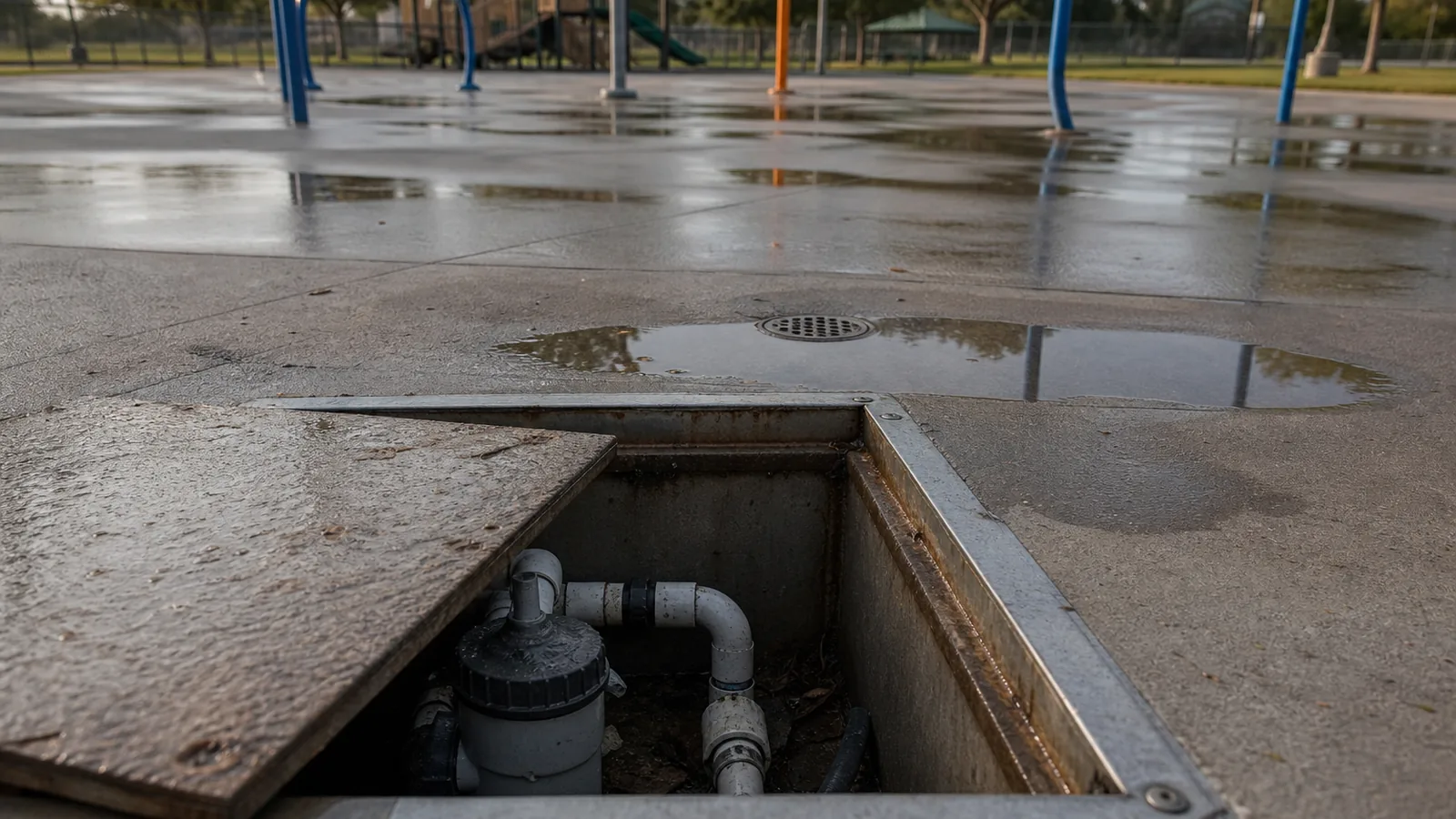
A 16-month-old from Pulaski County, Arkansas spent two August afternoons in 2023 at a local splash pad. Three days after the second visit, the child was febrile and vomiting. Three days after that, the child was dead of Naegleria fowleri primary amebic meningoencephalitis, the brain infection that gets mislabeled “brain-eating amoeba” in headlines. CDC’s investigation, published in MMWR in March 2025, recovered the same genotype III strain from the splash-pad tank that killed the patient. The investigators then asked the question that matters more than the genotype: how did the organism get to live in a chlorinated public water feature long enough to reach a toddler at all? The chlorinator had been nonfunctional for roughly a month. Staff were hand-feeding chlorine. The pH was running above 8.2, well past the 7.8 ceiling where chlorine actually works as a disinfectant. The operator could not produce daily operational records when inspectors asked. By the time anyone caught the problem, a child was on a ventilator.
Amoebae have been on this planet for the better part of two billion years, and they got that far by being patient. When the water dries up or the temperature shifts or the chemistry turns hostile, they retreat into a thick-walled cyst and wait. They wait through droughts, through freezing, through municipal chlorination. Acanthamoeba cysts have been documented surviving chlorine at 100 milligrams per liter for ten minutes, roughly fifty times what a properly run public pool maintains. That is not a failure of disinfection chemistry. It is a feature of the organism.
A new synthesis in Biocontaminant, published online in December 2025 and led by Longfei Shu of Sun Yat-sen University with coauthors at Lawrence Berkeley and George Washington, is the latest argument that water managers in wealthy countries have been treating these organisms as a tropical-exotic problem when their own pipes and pools are the more honest test case. The team catalogued roughly 500 confirmed human cases across more than 33 countries, with case-fatality rates above 98 percent for Naegleria fowleri PAM and above 97 percent for the granulomatous brain infections caused by Acanthamoeba and Balamuthia mandrillaris. Those numbers have not budged in decades.
They have not budged partly because of the cyst, and partly because of what the cyst hosts. Acanthamoeba and its relatives are not just hard to kill. They are, in the paper’s framing, “living shelters.” Legionella pneumophila replicates inside them, meaningfully protected from chlorine while it does. Mycobacterium tuberculosis persists in amoebic hosts. Adenovirus, coxsackievirus, and norovirus survive longer inside amoebae than in open water; Chlamydia species and Cryptococcus neoformans have been recovered from amoebic associations. The authors also describe amoebae as plausible reservoirs and training grounds for antibiotic-resistance genes, while flagging that the actual contribution to resistance spread is poorly quantified. The mechanism that quietly makes Legionnaires’ outbreaks more stubborn than they look on paper is the one the Biocontaminant authors want public-health agencies to take more seriously: the chlorine residual that knocks back free-swimming Legionella often cannot reach the bacteria riding inside an encysted host.
Which brings us back to Arkansas, and to the indictment the case actually supports. The amoeba did not outwit American public health. American public health stopped showing up to its own job. CDC’s Model Aquatic Health Code is unsexy and clearly written: free chlorine of at least 1.0 part per million without cyanuric acid (2.0 with it), pH between 7.0 and 7.8, daily logs, routine biofilm removal. The Arkansas operator could not demonstrate reliable compliance and had core systems out of spec, and the inspection regime that was supposed to catch that did not catch it until a toddler was dying. The Biocontaminant authors warn about climate change pushing thermophilic species into latitudes they did not previously occupy, and the warning is credible. But the lesson of this case is not the climate envelope. It is whether the local operator can keep a chlorinator running for thirty consecutive days.
The harder question is how a country that can sequence every recovered amoeba cannot keep a splash pad in operating spec. Kerala, India recorded 199 confirmed PAM cases and 47 deaths over the course of 2025, an outbreak large enough to break the historical pattern of 0 to 8 US cases a year. American officials watching that data should be asking whether the gap between Kerala’s cluster and the US trickle is the underlying biology or the diagnostic effort. The Biocontaminant synthesis says underdiagnosis and misdiagnosis are the rule, not the exception. CDC’s US surveillance for Naegleria PAM, roughly 180 cases since 1937, covers a tight set of presentations: warm-freshwater exposures in otherwise healthy people. It is not built to catch the Acanthamoeba and Balamuthia infections that present differently and need targeted PCR to identify.
Three things to watch. First, whether any state regulator follows Arkansas and starts forcing splash pads to prove disinfection in real time, with continuous monitoring and electronic logs, instead of trusting handwritten compliance that only surfaces after a child is sick. Second, whether US clinical labs broaden free-living-amoeba PCR panels in the workup of unexplained encephalitis, because the case counts we have are almost certainly an undercount. Third, whether the next federal infrastructure bill actually moves money toward the unglamorous end of the water system: the chlorinators, the pH controllers, the inspection capacity. The biology has been telling us what it needs for forty years. The organism is patient. The question is whether we are still capable of being competent.
Sources
- CDC MMWR – Fatal Case of Splash Pad-Associated Naegleria fowleri Meningoencephalitis, Pulaski County, Arkansas, September 2023 (2025)
- Zheng et al., Biocontaminant – The rising threat of amoebae: a global public health challenge (2025)
- ScienceDaily – Scientists sound the alarm as dangerous amoebas spread globally (2026)
- CDC – Data on Naegleria fowleri Infection, 1937-2025