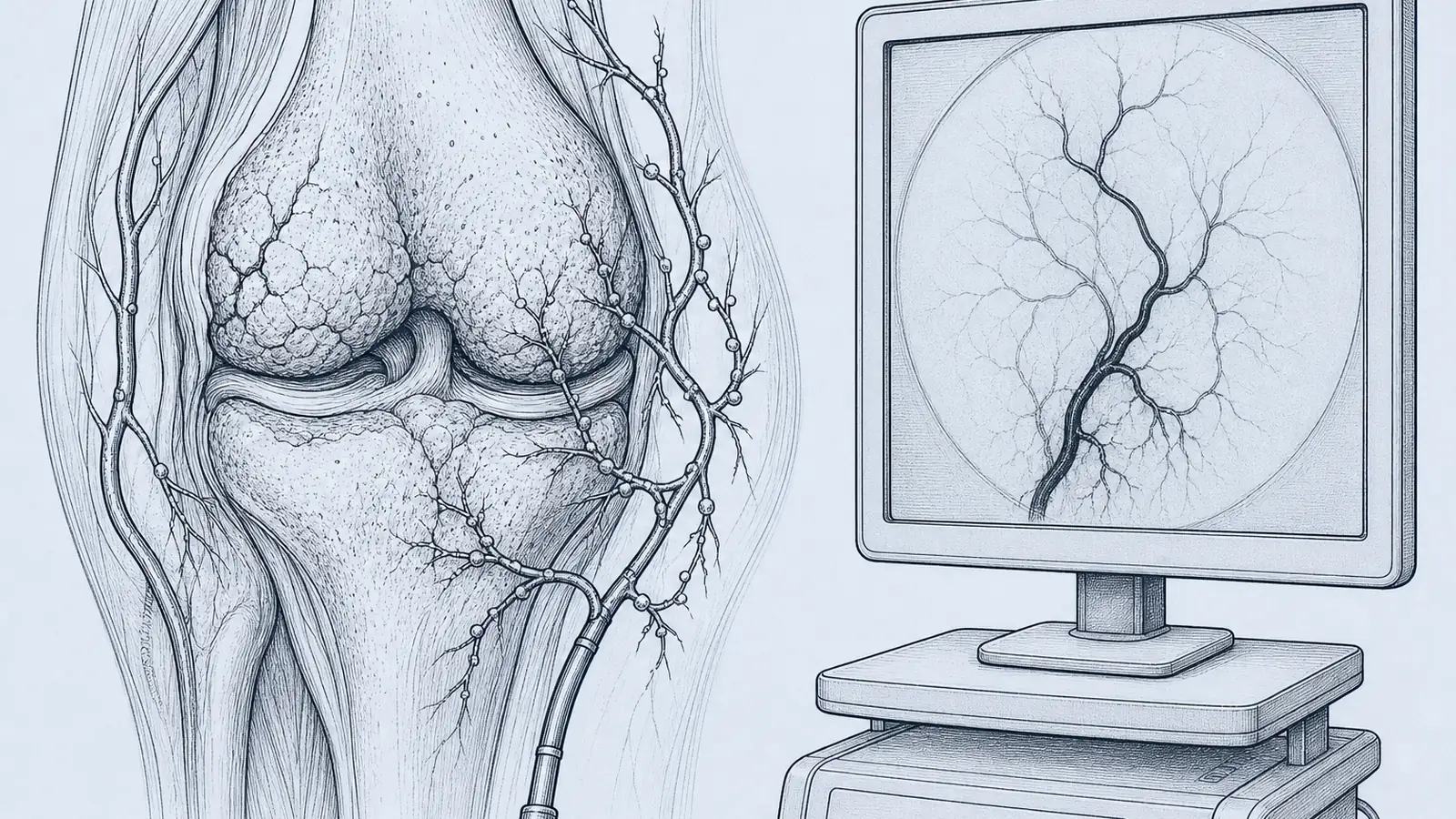
In the trial that should have settled it, twenty-nine people had a catheter threaded up through the artery in their groin, steered to the tangle of small vessels feeding an arthritic knee, and packed with microscopic beads to choke off the blood supply. Thirty more were wheeled into the same room, given the same sedation, and shown a pre-recorded video of an angiogram playing on the monitor while nothing at all was done to their arteries. Twelve months later, both groups felt better. The people who got the real procedure improved 41 percent. The people who watched a video of someone else’s procedure improved 29 percent. The difference between them was not statistically significant.
That is the inconvenient backdrop to this week’s good news, which arrived the way good news in medicine usually does: as a press release from a university. The University of Colorado Anschutz School of Medicine wants you to know about genicular artery embolization, GAE for short, a minimally invasive outpatient procedure that its vascular interventional radiologist, Dr. Leigh Casadaban, describes as a promising option for the millions of people who are too far along for cortisone shots and not yet ready to surrender a joint to the orthopedic saw. Roughly 70 percent of patients, the release says, see their pain cut in half or better. Some report no pain at all. Japanese data show relief lasting four years; American data, two.
It is an appealing pitch, and you can see why a person with a grinding, sleep-stealing knee would want it to be true. An hour or two under conscious sedation, a nick near the leg crease, no implant, no rehab, no general anesthesia, back to the garden by the weekend. Against the alternative, which is a major operation that resurfaces the joint with metal and plastic and takes months to recover from, GAE sounds less like a treatment than a reprieve.
The trouble is the part the press release leaves out, which is what happens when you give some patients the procedure and other patients a careful imitation of it, and don’t tell anyone which is which until the data are in.
That experiment has now been run three times. A systematic review published in July 2025 pulled together every sham-controlled randomized trial of GAE to date: three studies, 138 patients between them. It is not a large literature, and that is worth sitting with, because GAE is already being promoted by interventional radiology programs and written up in glowing institutional bulletins on the strength of it.
The 70-percent figures come from the single-arm studies, the ones with no comparison group. Treat a roomful of people with arthritic knees, ask them a few months later how they feel, and a large majority will tell you they are better. Those people are not lying, and the pattern is exactly what you would expect, because pain is subjective, arthritis waxes and wanes, and a person who has just undergone an impressive high-tech procedure in a hospital is primed to report improvement. Sham controls exist to separate the part of that improvement caused by the beads from the part caused by everything else. When the controls were added, most of the effect went with them.
In the Australian triple-blinded trial that randomized 59 people with early-stage knee arthritis and kept even the statistician in the dark about who got what, the headline result was no result: no significant difference between the embolized knees and the sham knees on the primary pain measure at twelve months, with both groups improving substantially. The Dutch trial, 58 patients, found the GAE group edging out the sham group on pain scores at one and four months by a margin of less than a single point, a gap that did not reach statistical significance (p = 0.31). The American trial, the smallest at 21 patients and the only one single-blinded rather than double, posted the most dramatic early number, a 50-point drop in pain at one month against essentially nothing in the sham arm. By twelve months that effect had faded, which the reviewers read as a sign that GAE delivers, at most, short-term relief.
The reviewers were blunt about what the pattern means. The placebo response, they wrote, “or other nonspecific factors may contribute to the perceived efficacy of the intervention.” Out of journal-speak: the procedure may be working largely because the patient believes it will. Almost half the people in the sham group of the Australian study rated themselves moderately or much better a month after watching a video of an angiogram. The knee did not know it had been deceived.
None of this makes GAE worthless. The skeptical case here is not that the beads do nothing: the Australian authors allowed that complete embolization of all the genicular arteries might produce a benefit above placebo, just not one their trial was powered to catch. And the procedure is strikingly safe in the short run, with the review recording no serious adverse events across all three trials, only some bruising at the catheter site. Safe, plausibly useful, not yet shown to beat belief by much. The problem is not that GAE is dangerous. The problem is that it is being marketed on an efficacy claim its best evidence does not support.
And there is money in the gap. The Colorado release mentions two ongoing trials there, one studying a device called Nexsphere-F, a temporary embolic agent built specifically for this market. An hour-long outpatient procedure billable at interventional-radiology rates, aimed at the enormous and growing population of people who would rather do almost anything than have a knee replaced, is the kind of thing that does well when the impressive open-label numbers travel and the sham-controlled ones stay quiet. The promotional figures come from the studies that had no control group to deflate them.
Worth noticing, too, is who paid for the trial that found the least. The Australian study that came up empty was funded by the Royal Australian and New Zealand College of Radiologists, a professional college rather than a device maker. Independent money asked the hard question and got the deflating answer.
So the honest version of the Colorado announcement reads a little differently from the press release. There is a minimally invasive knee procedure that appears very safe, that helps a large share of the people who get it, and that, in the only trials designed to tell the beads apart from the belief, helps them about as much as a convincing imitation does. For a patient weighing it against a knee replacement, that may still be a bet worth making, especially given the safety record. But it is a bet, made on thin evidence, and it deserves to be presented as one. A procedure that beats sham by a margin too small to measure is not yet the thing that fills the space between the cortisone shot and the saw. It is a promising idea still waiting for the trial that proves it, dressed up as a treatment that already has.
Sources
- ScienceDaily / University of Colorado Anschutz – “This emerging treatment is helping people avoid knee replacement surgery” (June 2026)
- Journal of Clinical Orthopaedics and Trauma – Genicular artery embolization for knee osteoarthritis: a systematic review of sham-controlled randomized trials (2025)
- Bone & Joint Open / Landers et al. – Genicular artery embolization for early-stage knee osteoarthritis: a triple-blind single-centre randomized controlled trial