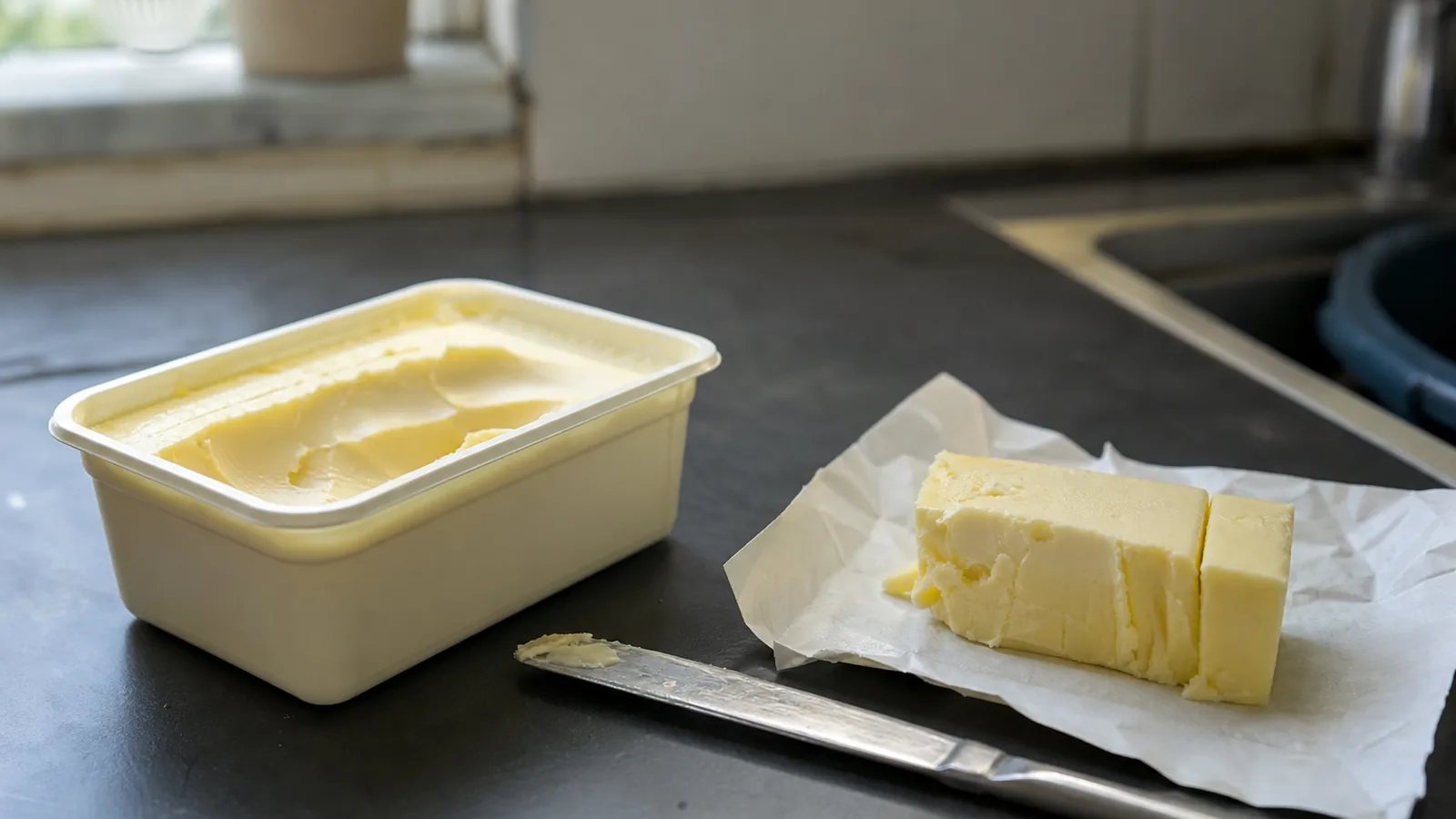
I grew up believing the tub was the responsible choice. My mother kept a yellow plastic container of margarine in the fridge door, soft enough to spread straight from the cold, and the stick of butter sat in the back like a guilty secret you only brought out for holidays. That was the whole moral architecture of the dairy shelf in the 1990s, and I never once questioned it. So when a food-science explainer started making the rounds this month arguing that butter and margarine “look similar but their chemistry changes everything”, I expected a tidy verdict in margarine’s favor. What I found instead was that the old butter-versus-margarine fight was never a morality tale about saturated fat at all. It was a processing story, and the processing does not flatter the tub.
Start with the chemistry, because everything else follows from it. Butter is built mostly from saturated fatty acids, and “saturated” just means the carbon chain carries no double bonds, so the molecules sit straight. Straight chains stack against each other like cordwood, packing tight, which is why butter is firm in the fridge and softens slowly and forgivingly as it warms. Margarine starts from liquid plant oil, where double bonds put a kink in every chain. Kinked molecules cannot stack. Left alone, that oil would never set into something you could spread.
So here is the question I kept circling: if plant oil pours out liquid at room temperature, how do you get it into a stick? You have to force those kinked molecules to behave, and the history of how the food industry did that is a small horror story.
The first answer was hydrogenation. Bubble hydrogen through the oil, saturate some of those double bonds, straighten the kinks, and the liquid sets up solid. The catch is that partial hydrogenation throws off a byproduct: trans fats, the straightened-but-unnatural fatty acids that behave in the body like nothing the human diet had ever seen. And we know exactly what they do. Trans fats raise your LDL, the cholesterol that drives plaque, while dropping your HDL, the kind that helps clear it, and the link to heart disease grew so undeniable that health authorities moved to pull them from the food supply. The World Health Organization now counts 53 countries with best-practice policies banning or capping industrial trans fats, covering 3.7 billion people. For decades, though, the very margarine marketed as the heart-smart alternative to butter was the delivery vehicle for one of the most cardiotoxic fats ever added to what we eat. Sit with that sequence. The establishment told a generation to put down the butter and pick up the tub, and the tub was the thing raising their heart-disease risk.
When the trans-fat reckoning came, the industry needed a new trick, and this is where my curiosity really kicked in. The modern method is interesterification: instead of adding hydrogen, you take fats and enzymatically shuffle the fatty acids around on the glycerol backbone, rearranging which acid sits in which position until you get a solid texture with no trans fats. Cleaner, on paper. No trans fats, less saturated fat than butter. The explainer presents it as the tidy fix, and I wanted to believe it.
But wait, why would simply rearranging the fatty acids, the same atoms just reshuffled, change anything once they are inside you? That is the moment the biology stopped being a textbook diagram for me. Position turns out to matter, and the best human data we have is unsettling. In a randomized crossover trial published in Nutrition & Metabolism, thirty healthy volunteers ate diets identical except for the test fat, four weeks on each. On the interesterified fat, fasting blood glucose climbed 18.7 percent compared with natural palm oil, fasting insulin fell about 22 percent, and the post-meal blood-sugar surge ran 40 percent higher. The reshuffled fat nudged their glucose control in exactly the direction you would sketch if you were drawing the early road to diabetes, and the authors noted some readings reached what they called a prediabetic range after only four weeks.
I will be honest about the asterisk. That trial was funded by the Malaysian Palm Oil Board, which has an obvious stake in palm oil looking good next to a processed rival, and thirty people is small. But the signal is not lonely. A broader review of interesterified lipids in the food supply flagged the same open questions about glucose and metabolism, and Science News raised the alarm years ago under a headline that says it plainly: the trans-fat substitute might carry risks too. We swapped one poorly understood industrial fat for another and called it progress.
There is a second thing the chemistry explainer mentions almost in passing, and it deserves a spotlight. Margarine sits squarely in what nutrition researchers call ultraprocessed food: you cannot make it without industrial reactions, enzymes, and emulsifiers. Butter you can make by shaking cream in a jar, the way people have for thousands of years. One of these is food and one is a manufactured product engineered to imitate food, and as the evidence linking ultraprocessing itself to metabolic disease keeps stacking up, that difference stops looking cosmetic.
So what about the saturated fat in butter, the original sin we were all warned about? The data quietly walked that warning back while nobody updated the advice. When Tufts researchers led by Dariush Mozaffarian pooled the evidence in a 2016 PLOS One analysis with the cheeky title “Is Butter Back?”, they gathered 636,151 people across fifteen cohorts. Per daily serving of butter, the relative risk of dying of any cause was 1.01. For cardiovascular disease, 1.00. For heart disease, 0.99. For stroke, 1.01. Those are statistical noise dressed up as a verdict, and what they say is that butter does essentially nothing to your heart-disease risk in either direction. For type 2 diabetes the relative risk was 0.96, a small but statistically significant association pointing the protective way.
And the randomized evidence is catching up to the cohorts. A 2025 systematic review and meta-analysis of randomized controlled trials, pooling nine trials and 13,532 participants, reached the conclusion the dietary guidelines still will not say out loud: a reduction in saturated fats cannot be recommended at present to prevent cardiovascular disease and mortality.
It helps to understand why this argument is suddenly everywhere again. The fight over animal fats versus industrial plant fats has hardened into a political fault line, with RFK Jr. and the MAHA movement putting beef tallow and butter back on the table and treating seed oils and ultraprocessed spreads as suspects rather than solutions. The establishment nutrition class is pushing back hard, insisting unsaturated plant oils remain the heart-healthy pick, and some of that defense does rest on actual evidence about unsaturated fats. But you will forgive me for not handing the benefit of the doubt to the same expert consensus that spent decades selling trans-fat-laden margarine as the responsible choice and is only now, very softly, conceding the butter point.
The chemistry that “changes everything” turns out to change it in butter’s favor. A short, straight, stackable molecule your grandmother could churn, set against an industrially reshuffled fat that carries a worrying glucose signal and an ultraprocessed pedigree. Me, I threw out the tub years ago and I am not going back. I keep real butter in the dish, I cook in fats that existed before a food chemist invented them, and I would not wait for the dietary guidelines to catch up, because on this one they have been wrong for longer than I have been alive.
Sources
- PLOS One – Pimpin, Wu, Haskelberg, Del Gobbo & Mozaffarian (Tufts), “Is Butter Back? A Systematic Review and Meta-Analysis” (2016)
- Systematic review & meta-analysis of RCTs – saturated-fat restriction for cardiovascular disease prevention (2025)
- Nutrition & Metabolism – Sundram, Karupaiah & Hayes, interesterified fat raises plasma glucose and lowers insulin vs palm olein (2007)
- Advances in Nutrition / NCBI – “The Increasing Use of Interesterified Lipids in the Food Supply and Their Effects on Health Parameters” review
- World Health Organization – Trans fat fact sheet (global elimination policies and country count)
- ScienceDaily / The Conversation – Rosemary Trout (Drexel), “Butter and margarine look similar but their chemistry changes everything” (2026)
- Science News – “A trans fat substitute might have health risks too”
- Sentient Media – RFK Jr.’s stance on ultraprocessed foods, seed oils, and organic food