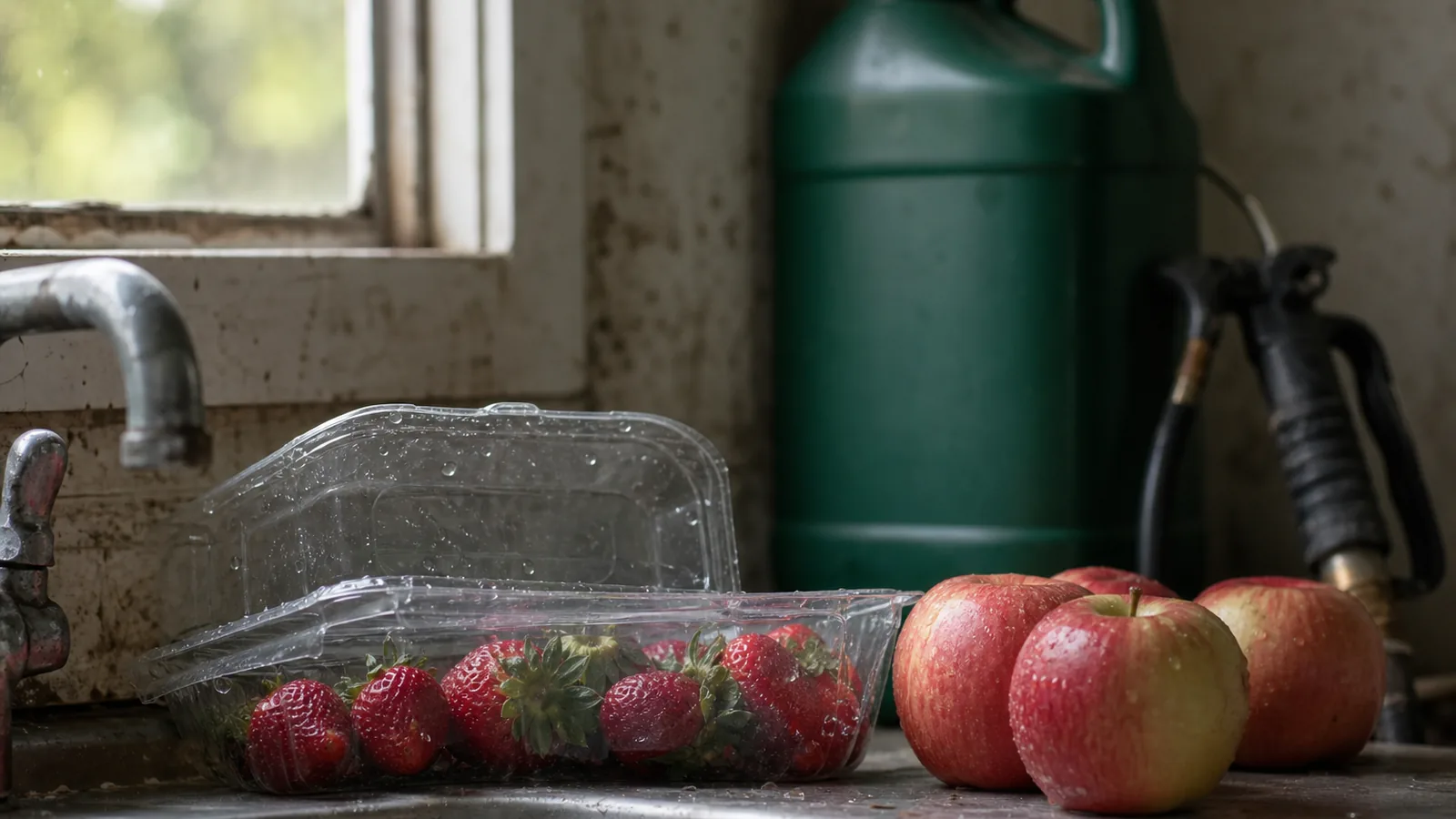
In 2021 the EPA ordered a brain-toxic pesticide off America’s food crops. The manufacturer sued, a federal court threw the ban out, and the chemical is legally sprayable on apples and strawberries again right now. That is the backdrop for what a UCLA team just published about chlorpyrifos, and it is why I can no longer file pesticides under “someone else’s problem.”
That used to be exactly where I kept them. The farmworker in the field with the sprayer, sure. Me, standing at my sink rinsing a clamshell of strawberries? Not my fight. Then I read the new paper, and the thing that moved it out of that drawer was simple: the evidence that this molecule quietly kills the exact brain cells Parkinson’s destroys just got a lot harder to wave away.
The study landed in the journal Molecular Neurodegeneration, and it does something most environmental-risk papers never manage. It pairs human data with a mechanism. On the human side, researchers led by UCLA neurologist Dr. Jeff Bronstein went back to the long-running Parkinson’s Environment and Genes study: 829 people with Parkinson’s and 824 without, all from three farm-heavy counties in California’s Central Valley. They reconstructed each person’s lifetime exposure by geocoding their home and work addresses and matching them against California’s pesticide-use records going back to the 1970s, counting the pounds of chlorpyrifos sprayed nearby. The people with the longest, heaviest workplace exposure carried an odds ratio of 2.74, with a 95 percent confidence interval of 1.55 to 4.89. More than double the odds of Parkinson’s.
Here is the detail that gave me a chill. The exposures that mattered most weren’t the recent ones. The strongest signal came from doses absorbed 10 to 20 years before symptoms began. Whatever this molecule does, it does it slowly, in the dark, and you don’t find out for two decades.
So what is it actually doing in there? This is the part where I had to stop and read twice, because the answer isn’t the one I expected. I assumed a neurotoxin kills a neuron by poisoning it directly, the way cyanide chokes off a cell’s energy. Chlorpyrifos is sneakier than that. In zebrafish, the team found it throttles autophagy, the cell’s recycling crew, the system that hauls away damaged and misfolded proteins before they pile up. Slow that crew down and the garbage accumulates. The specific garbage is alpha-synuclein, the sticky protein that clumps into Lewy bodies inside dying dopamine neurons and is a hallmark of Parkinson’s. The neuron starts to suffocate under its own undisposed trash.
And the cleanest proof that this is the mechanism and not a coincidence: when the researchers restored the cells’ autophagy with a compound called calpeptin, or eliminated the synuclein protein entirely, the neurons survived the chemical. Knock the cleanup crew down on purpose, with no pesticide at all, and you reproduce the damage. Break the cleanup, the neurons die; fix it, they live. That is the kind of switch-it-on, switch-it-off result that turns “associated with” into something much closer to “causes.”
The mice told the same story with a sledgehammer. UCLA put them in chambers and had them breathe aerosolized chlorpyrifos six hours a day, five days a week, for 11 weeks. By the end they struggled on a rotating rod and a wire hang, they had brain inflammation, their phosphorylated alpha-synuclein had climbed, and they had lost 26 percent of the dopamine-producing neurons in the substantia nigra, the brain region that goes dark in Parkinson’s. “By showing the biological mechanism in animal models,” Bronstein said, “we’ve demonstrated that this association is likely causal.” He was careful to keep it specific: this is about chlorpyrifos, “not just pesticides as a general class.”
| Measure | Value |
|---|---|
| of dopamine neurons lost in exposed mice | 26% |
The obvious pushback is dose. Lab animals always get hammered with more than a person ever would, right? Not really, this time. The dose that killed dopamine neurons in the dish was 250 nanomolar, only a little above the roughly 90 nanomolar measured in the blood of human volunteers. The authors land on the same word for it: relevant to human exposures, not a megadose cartoon.
Now for the part that should make you angry. None of this is news to the agencies that are supposed to protect you. Chlorpyrifos was yanked out of American homes back in 2001 over its effect on children’s developing brains. The Obama EPA moved to pull it off food crops too, and in 2017 the Trump administration’s EPA administrator Scott Pruitt withdrew that proposed ban. A federal court eventually forced the issue, and in 2021 the EPA revoked the chemical’s food tolerances, citing the danger to kids’ brains. For a moment it really was off the food supply.
It didn’t stay off. The manufacturer and a coalition of grower groups sued, and in November 2023 the Eighth Circuit vacated the ban, reinstating every chlorpyrifos tolerance the EPA had just revoked. By December 2024 the agency had retreated to a proposed rule that would keep the chemical legal on 11 crops, among them the apples, cherries, citrus, soybeans, sugar beets, strawberries and wheat that fill the produce aisle. So a compound the science has been circling for two decades is, today, legal to spray on food in your refrigerator. Not because anyone proved it safe. Because a chemical company and the farm lobby out-litigated the regulator.
I went looking for the usual catch, the industry money that taints so many environmental-health papers, and the conflict runs the other way. The work was funded by the Levine Foundation and two NIH grants, and the authors report no competing interests. The financial stake here belongs to the manufacturer and the grower groups who sued to keep spraying. The people telling you to be careful are the ones with nothing to sell.
So here is what I am going to do, because a 20-year fuse is a reason to act now, not to shrug. I’m not waiting for the EPA to lose its next lawsuit. For the crops still in play, especially strawberries, apples and cherries, I’m buying organic when I can. It will not zero out my risk and I won’t pretend it does. But I am done treating this molecule as a farmworker’s problem when it has been sitting on my dinner the whole time.
Sources
- Molecular Neurodegeneration – “Chlorpyrifos increases the risk of Parkinson’s disease” (Bronstein et al., UCLA, 2026)
- UCLA Health – “Widely used pesticide linked to more than doubled Parkinson’s risk”
- US EPA – “Frequently Asked Questions about the Current Status of Chlorpyrifos”
- Public Citizen – “Banned by Obama, Revived by Trump, Banned Again by Biden: the Pesticide Chlorpyrifos”
- The Hill – “Court tosses EPA ban on pesticide linked to brain damage in kids”