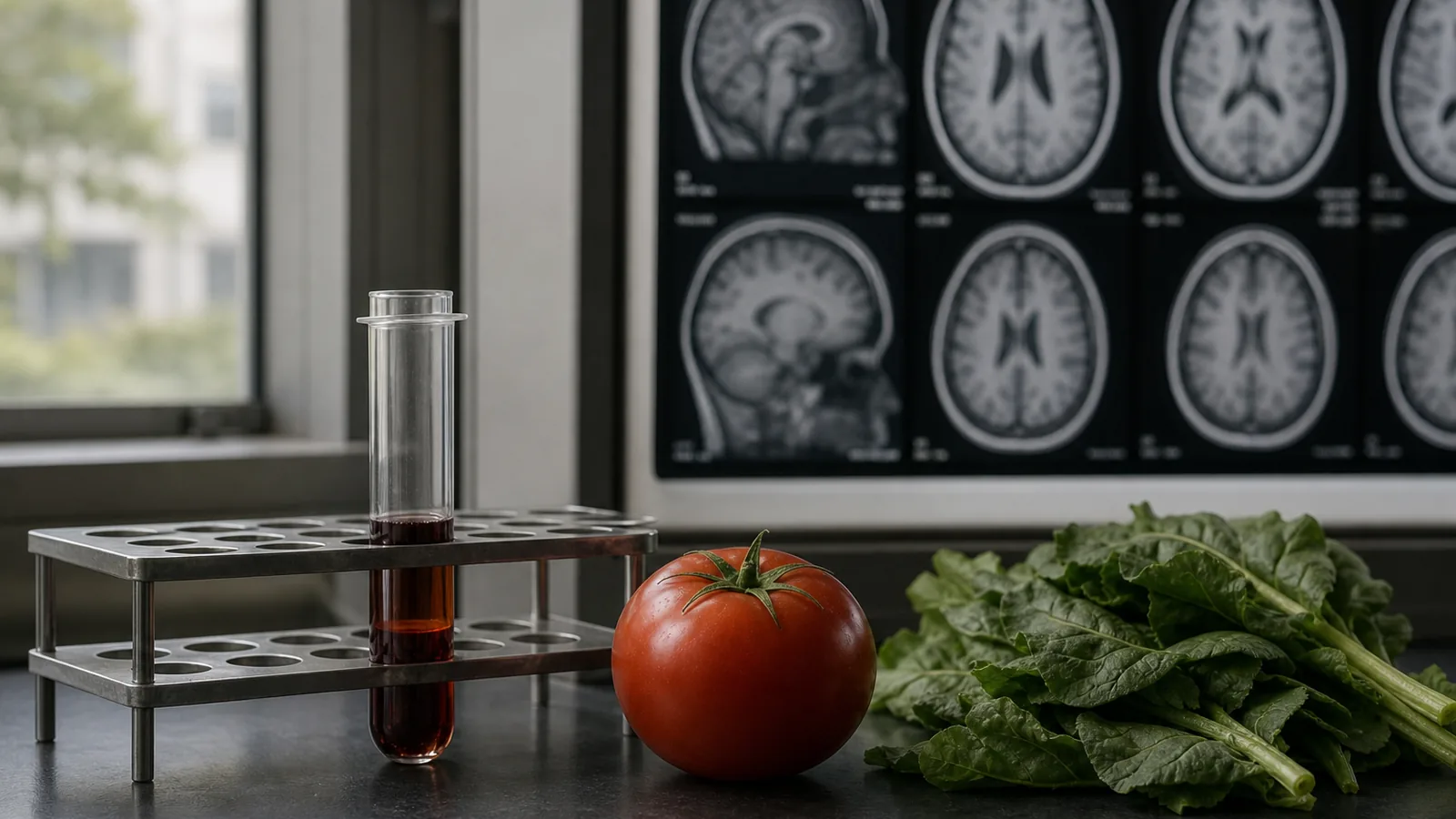
Inside the graduate school of health sciences at Hirosaki University, near the apple orchards of Aomori Prefecture at the northern end of Honshu, there is a department that a vegetable-juice company built. Kagome Co., Ltd., Japan’s largest maker of tomato and vegetable juice, endowed it. Two of the company’s employees carry appointments there, and two of the authors on the study hold Kagome stock. On June 10, from inside that arrangement, came a paper in PLOS One reporting that older people with more vitamin C in their blood tend to have better-preserved brains.
The finding traveled fast and clean. “Scientists discover a surprising link between vitamin C and brain health,” ran the ScienceDaily writeup, the kind of headline that ends up on a supplement label within the quarter. The study underneath it is large and worth reading closely, which is a different thing from believing the headline.
Here is what the researchers actually did. They drew on a long-running community health project in the Iwaki district of Hirosaki City and pulled 2,044 residents, median age sixty-nine, most of them women. Each person gave a single blood sample and sat for a single MRI. The team measured plasma vitamin C once, measured gray-matter volume and the connectivity of the brain’s default mode network once, and looked at whether the two lined up. They did, in the direction the company would have hoped: higher vitamin C, more gray matter.
The correlation between blood vitamin C and gray-matter volume came in at a Spearman coefficient of 0.196. Square it, a rough way to gauge how much two things move together, and vitamin C lines up with under 4 percent of the variation in gray matter. The remaining 96 percent is doing something else. With more than two thousand people in the sample, a correlation that faint still clears statistical significance easily, because significance comes cheap when the crowd is large. Significance does not tell you whether the number matters, and 4 percent is not the kind of number that carries a brain-protection headline.
The default-mode results carry their own complication. The researchers broke the network into sub-components, and some moved the way the press release wants: more vitamin C, stronger connectivity. One moved the other way. In a posterior part of the default-mode network, higher vitamin C was associated with less connectivity, a coefficient of −0.122 pointing in the opposite direction from the headline. A split result like that does not sink the study, but it makes the clean preservation story harder to sell, and it never surfaces in the ScienceDaily version.
Then there is the design, which the authors are honest about in the fine print. This is a cross-sectional snapshot: one blood draw, one scan, taken at the same moment in old age. Nobody was given vitamin C. Nobody was followed over time. So the arrow of cause is unpinned in every direction. Maybe vitamin C protects gray matter. Maybe the people with healthier, more active brains are the ones who shop for and digest fruit and vegetables, and the vitamin C in their blood is a marker of that life rather than the cause of that brain. Higher vitamin C tracked with more gray matter. It did not put it there.
The list of things the researchers adjusted for is long and respectable: age, sex, education, cognitive score, diabetes, hypertension, cholesterol, smoking, drinking, physical activity. The list of things they left out is shorter and louder, and they name it themselves. No body-mass index. No socioeconomic status beyond years of education. In a cohort of relatively well-educated older Japanese, the people eating enough produce to register high vitamin C are plausibly the people with the money, the health literacy, and the intact routines that protect a brain through a dozen other channels. Strip those out and the four percent has room to shrink further.
None of this makes vitamin C bad for you, and none of it makes the study fraudulent. It was disclosed, funded in part by Japan’s public medical-research agency, and its limitations are printed in the paper for anyone who reads to the end. The trouble is who benefits from the reading nobody does. Kagome sells its juice on the nutrition inside the bottle, and it did not merely fund the work. According to the paper’s own competing-interests statement, blood vitamin C levels were measured by Kagome. The firm that profits from the association supplied the instrument that established the association, then employed the hands that wrote it up.
In the version that reaches the reader, science found a link between a vitamin and the aging brain. In the version printed at the bottom of the paper, where the disclosures sit and the traffic dies, a juice company measured its own product in two thousand bloodstreams and, at four percent, reported the link that sells the juice.
Sources
- PLOS One – Nagaya et al., plasma vitamin C, gray-matter volume, and default mode network connectivity in older Japanese adults (June 10, 2026)
- ScienceDaily – “Scientists discover a surprising link between vitamin C and brain health”
- Kagome – 100% tomato juice product and vegetable-nutrition positioning