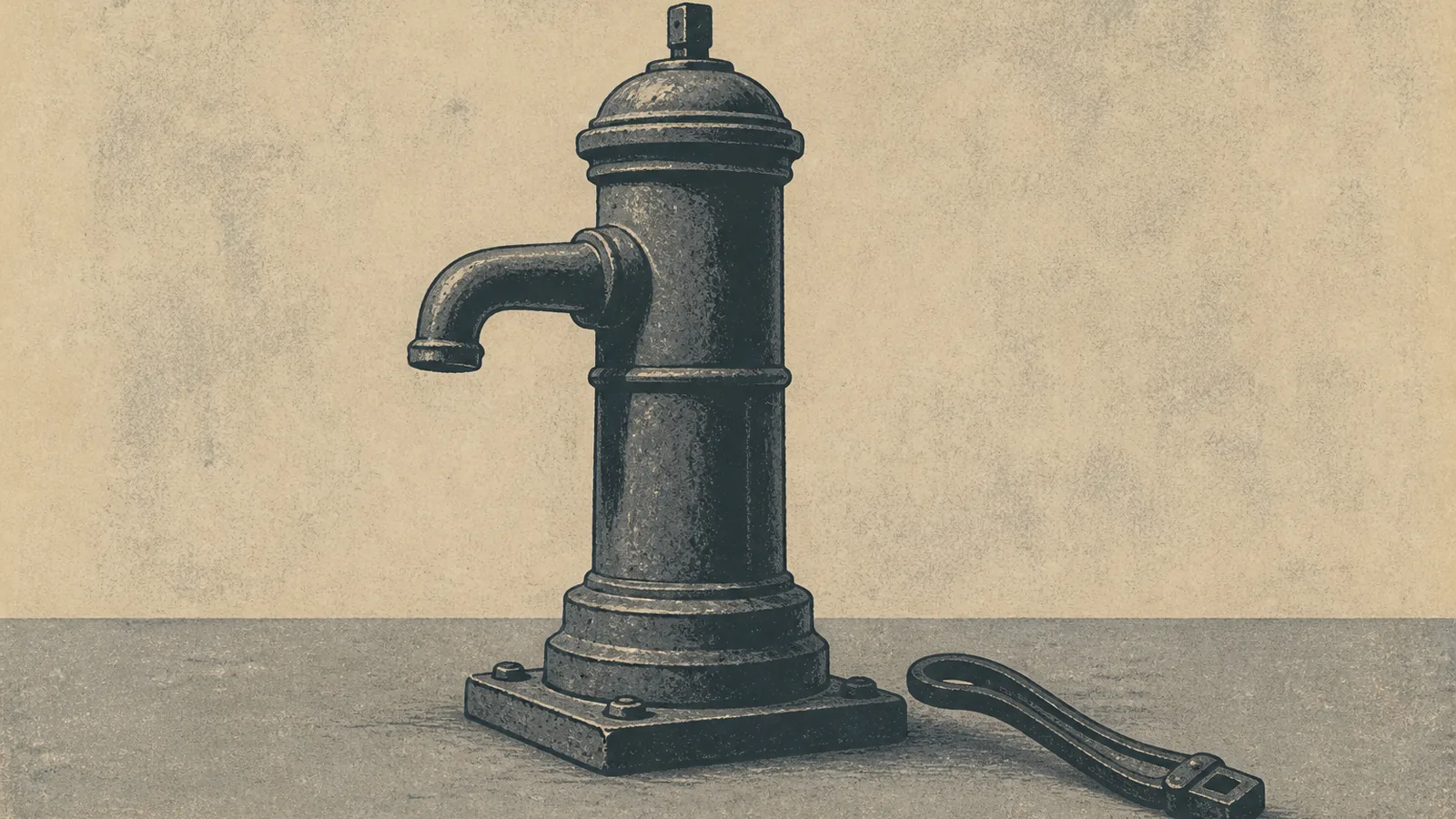
In the late summer of 1854, a London physician named John Snow walked to the Broad Street pump in the middle of a cholera outbreak and took the handle off. He could not have told you what cholera was; the bacterium behind it would not be accepted by science for another three decades. He had no drug, no vaccine, no mechanism, only a map showing that the dead clustered around one contaminated well. So he removed the well. The outbreak was already ebbing by the time the handle came off, and historians still argue how much the missing pump changed the arithmetic, but the logic Snow acted on outlived the quarrel: find the cause, remove the cause, and let the body do the rest.
That is the oldest move in public health, older than germ theory itself, and it won the great battles of the nineteenth century, sewage and clean water and ventilation, long before pharmacology had anything to offer. It is also the move a retired Georgia Tech research scientist named Ronald Kostoff now argues modern medicine has spent a hundred years forgetting. His pitch, stripped of the clinical wording, is almost insultingly simple. The body heals itself once you stop poisoning it. His protocol is not a thing you take. It is a set of things you stop.
Kostoff has spent the back half of his career on an unfashionable thesis: that chronic disease and infectious disease are not two separate problems but two faces of one, and that the pharmaceutical model of one-drug-per-diagnosis has the causal arrow pointed backwards. His latest synthesis, published this week on TrialSite News, calls it a unified endogenous healing protocol. Endogenous means from within. The question is why he thinks one approach could cover both a pneumonia and a case of diabetes, and the answer is not a trial. It is a reading of the literature at industrial scale.
In a 2022 review in Food and Chemical Toxicology, Kostoff and his co-authors identified and validated 80 modifiable contributing factors to severe COVID-19, then sorted them. The largest bucket, 28 of the 80, was occupational and environmental exposure: heavy metals, fine particulate air pollution, pesticides, industrial chemicals. Another 24 were lifestyle, the familiar list of poor diet, inactivity, alcohol, vitamin D deficiency. And 22 were iatrogenic, caused by medicine itself, the category that tends to get the least airtime: chemotherapy, glucocorticoids, proton-pump inhibitors, radiotherapy. In this reading the virus was an opportunist, and the serious outcomes came from what the authors called the effective exploitation of a dysfunctional immune system, one that had been ground down long before SARS-CoV-2 ever arrived.
The argument does not stop at one virus, because Kostoff’s group had run the same exercise across the whole of medicine. An earlier text-mining survey of the biomedical literature, the basis of his chronic-disease protocol, swept roughly 4,000 diseases and pulled out on the order of 8,000 distinct causes, of which about 800 recurred so often, across so many unrelated conditions, that he labeled them pervasive. The same insults keep surfacing under different diagnostic names. Damage the same regulatory machinery enough different ways and it fails in whatever direction a given body is weakest: as heart disease in one person, as autoimmune disease in another, as a fatal pneumonia when a new pathogen finds the opening. Toxicologists already had a word for the running total of everything a body absorbs over a lifetime, the exposome, and a literature in journals as mainstream as Science now treats that cumulative chemical load as a genuine driver of disease rather than background noise.
The protocol that falls out of this is almost aggressively boring, which is part of why it gets ignored. Take a real exposure history. Test the severity of symptoms. Run the labs. Then, in the order that matters, eliminate the ongoing contributing factors first, and only then layer treatment on top. Kostoff states the governing principle plainly: removing the cause is a necessary, though not always sufficient, condition for any restorative treatment to work. You cannot repair a system while the thing breaking it is still switched on.
The obvious objection is that none of this has been tested the way a drug is tested, and that objection is correct. What Kostoff has built is a hypothesis mined from hundreds of thousands of published records, not a randomized trial. Nobody has taken a thousand patients, stripped the contributing factors from half of them, left the other half on standard care, and measured who did better. The interesting part is why that trial does not exist. There is no product at the end of a subtraction protocol, no molecule to patent, no franchise to defend, which makes it precisely the kind of intervention the current research economy is built not to fund. The model it competes with, one diagnosis and one drug, endlessly retrialed, keeps failing on its own terms even as the drug catalogue multiplies and the chronic-disease burden climbs.
And the exposure numbers are not soft. Kostoff’s earlier toxicology work found that OSHA’s permissible exposure limits, the legally enforceable workplace ceilings many people trust, sit 100 to 10,000 times above the exposure levels the biomedical literature shows can already cause damage, and that toxic agents in combination lower the threshold at which each one starts doing harm. A regulatory ceiling set 100 to 10,000 times too high is not a safety standard. It is a permission slip.
This is the inversion COVID handed the country, and the public-health apparatus was quick to file it away. The people the virus killed were overwhelmingly the ones already carrying the heaviest load of the very factors Kostoff had catalogued, and the official shorthand for that was underlying conditions, a phrase built to close a question rather than open one. Kostoff is asking the open version. Where did the underlying conditions come from? Who profited from the exposures that built them? And why does a system with a trillion-dollar treatment arm show almost no interest in the removal arm?
The next real test is not whether Kostoff publishes again, because he will. It is whether a funder with the standing to run a prospective removal-of-cause trial decides the question is worth answering, and the obvious candidate is the NIH’s National Institute of Environmental Health Sciences, the one agency whose mandate is exactly this. Watch who picks up the exposome work and who lets it sit. That choice, more than any new molecule, will tell you whether medicine still remembers how to take the handle off the pump.
Sources
- TrialSite News – Kostoff, “Unified Endogenous Healing Protocol for Comprehensive Chronic and Infectious Disease Risk Reduction” (2026)
- Food and Chemical Toxicology – Kostoff et al., “Modifiable contributing factors to COVID-19: A comprehensive review” (2022, PMC)
- Public Health and Toxicology – Kostoff, “Prevention and reversal of chronic diseases: A Protocol”
- Science – “The exposome and health: Where chemistry meets biology” (2020)
- Georgia Tech repository – Kostoff, toxic-stimuli combinations and OSHA permissible exposure limits