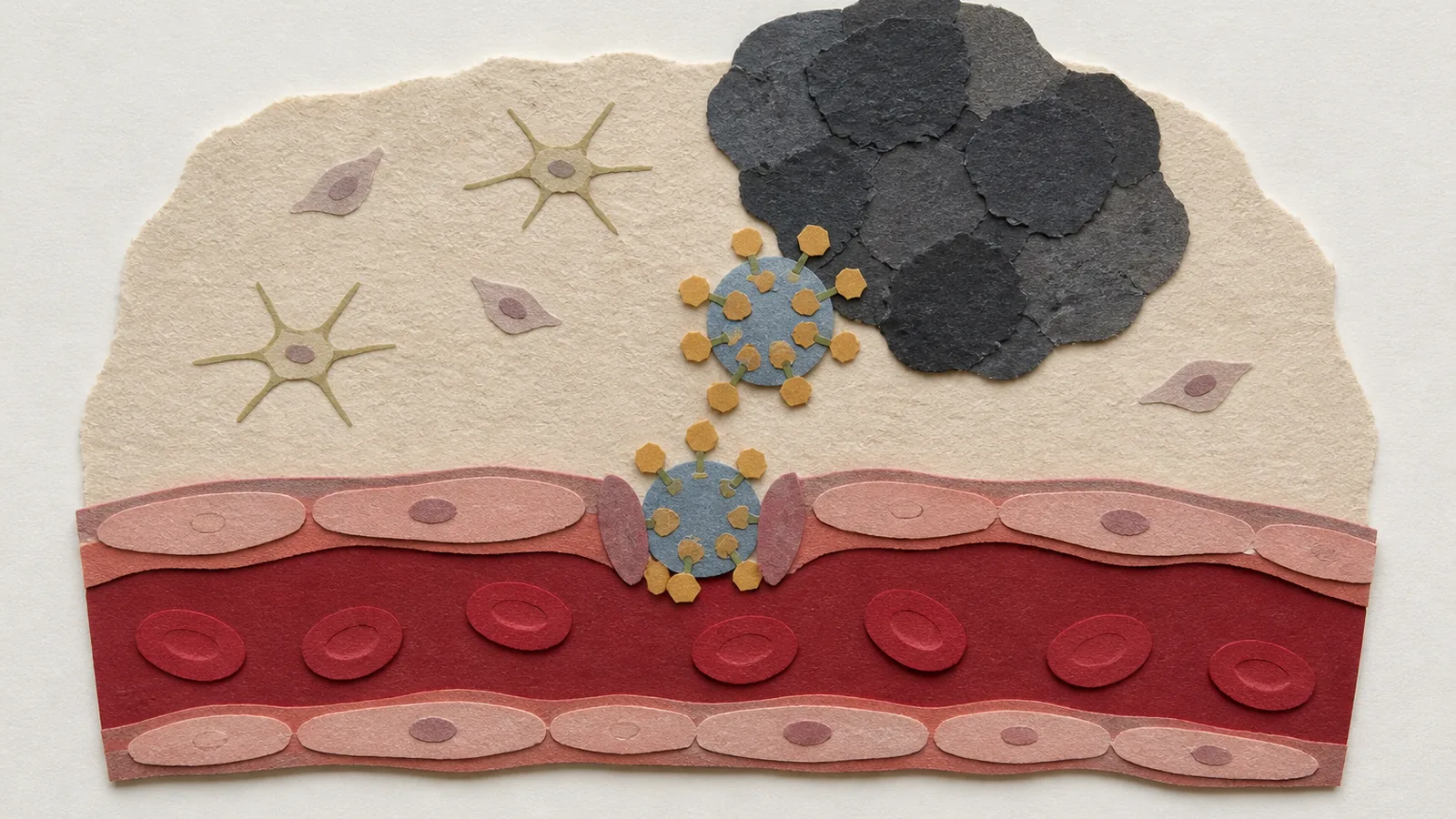
The thing I could never get past about glioblastoma is that the very wall built to protect your brain is what makes this cancer nearly impossible to treat. The blood-brain barrier keeps toxins and pathogens out, and it does that job beautifully. It also keeps almost every drug we have out. So the most aggressive brain cancer we know of sits behind a gate we evolved into our own biology, and the gate holds.
That’s why a paper out of Oregon State University has been rattling around my head all week. The trick isn’t a bigger battering ram. It’s sugar.
Researchers in OSU’s College of Pharmacy, led by Oleh and Olena Taratula, took a lipid nanoparticle, the same delivery class that carried the COVID mRNA vaccines, loaded it with genetic instructions to rebuild a tumor-suppressor protein, and then coated the whole particle in mannose, a simple sugar. In mice with glioblastoma, that sugar coating carried the therapy across the blood-brain barrier and into the tumor, and median survival rose by 50 percent with no measurable organ damage across repeated doses. The work ran in the Journal of Controlled Release.
So here’s the question I stopped to ask: why would a sugar coating open a door that decades of drug chemistry couldn’t force? The answer is a small, gorgeous piece of biological jiu-jitsu.
The cells lining your brain’s blood vessels carry a transporter called GLUT1. Its whole job is to grab glucose out of your bloodstream and hand it across into brain tissue, because your neurons are sugar-hungry and the barrier won’t let glucose just diffuse in. GLUT1 is one of the few things the gate actively ushers through. And it turns out GLUT1 doesn’t only recognize glucose. It recognizes mannose too. So the OSU team essentially disguised their nanoparticle as food, and the barrier’s own delivery service picked it up and carried it inside.
There’s a catch, and it’s the part I keep turning over. Your blood is full of glucose, all of it competing for the same transporter, and a lightly sugared particle would lose that competition every time. “For the nanoparticles to get it, they need a densely coated sugar surface, and that’s our central innovation,” Oleh Taratula told phys.org. The team got there by chemically bolting the mannose onto cholesterol, a structural building block of the nanoparticle itself, which packed the sugar on 6 times more densely than before. Enough coverage to elbow past the glucose and get noticed.
Then the second half of the trick kicks in, and this is where the design gets almost too neat. Cancer cells are metabolic gluttons, and glioblastoma in particular is rewired to inhale sugar. To do that it plasters its surface with extra GLUT1, expressing it at 3 times the level of normal brain tissue, per Olena Taratula. So the exact greed that makes the tumor so aggressive becomes the thing that drags the therapy to its door. The sugar gets you through the barrier, and then the tumor’s own appetite vacuums the particles in ahead of healthy tissue. The cancer helps deliver its own medicine.
What’s inside the package matters as much as how it gets there. The cargo is mRNA coding for PTEN, one of the most important brakes your cells have on runaway growth. When PTEN works, it restrains the PI3K/AKT pathway that keeps telling cells to divide. In glioblastoma that brake is frequently gone: PTEN is mutated or lost in roughly 30 to 40 percent of primary tumors, and in the survey that first pinned this down, 32 percent carried an outright mutation. So the therapy isn’t poisoning the tumor from outside. It’s shipping in the instructions to rebuild a safety mechanism the cancer deleted, and letting the cell make the protein itself.
Now the cold water. This is a mouse study, and that fact matters more than the 50 percent does, because glioblastoma has one of the most heartbreaking translation records in oncology. The graveyard is full of treatments that melted tumors in mice and then did almost nothing in people. CAR-T cell therapy made glioblastomas shrink in early human trials, and the honest headline was “but for how long is unclear,” because the tumors so often came roaring back. A relative improvement of 50 percent also sounds enormous until you sit with what it’s built on. Human patients, even with surgery, radiation, and temozolomide, live a median of about 15 months; the temozolomide that defines standard care lifted median survival from 12.1 months to 14.6, about 2.5 months. A big percentage on a short, brutal baseline is still a short, brutal baseline. And PTEN is one deleted brake in a tumor that usually has several snapped at once.
I also want to be fair about what this is, because the populist reflex is to sneer at press-release science, and this one earns the second look. It is not a cure pitch dressed up as a breakthrough. It is public money attacking a delivery bottleneck that has stumped the field for forty years, backed by the National Cancer Institute and the NIH’s child-health institute, and it worked in the animal. The elegance is in the mechanism, not the marketing. That’s the kind of unglamorous, foundational work tax dollars are supposed to buy, and the payoff shows up years later in exactly moments like this.
So what do I actually do with it? If someone I loved were facing glioblastoma tomorrow, this changes nothing about their options today, and I’d be furious at anyone who implied otherwise. But I’ve watched enough delivery-platform work to know that cracking the blood-brain barrier is the bottleneck sitting under a hundred other stalled brain therapies. If this sugar-coating approach holds up, its payoff may not be PTEN at all. It may be the doorway. I’ll be watching for the first human safety trial, and until one of those reads out, I would not let myself confuse a clever mouse result with a cure.
Sources
- Journal of Controlled Release – Taratula et al., mannose-coated PTEN mRNA nanoparticles for glioblastoma (2026)
- Phys.org – Sugar-coated nanoparticles show promise against the most aggressive brain cancer, with researcher quotes (2026)
- EurekAlert / Oregon State University – study announcement and funding (2026)
- ScienceDaily – Sugar-coated therapy boosted survival against deadly brain cancer by 50% in mice (2026)
- NEJM – Stupp et al., radiotherapy plus temozolomide for glioblastoma (2005)
- PubMed – PTEN (MMAC1) mutations are frequent in primary glioblastomas (1998)
- Nature – Deadly brain cancer shrinks after CAR-T therapy, but for how long is unclear (2024)