For my whole adult life I have filed Lyme disease under “a problem for people in Connecticut.” Ticks in the leaf litter of some Massachusetts summer camp, a bullseye rash on a kid back from the Hamptons, the whole New England iconography. If you had told me the woods around Asheville were now as infected as the woods around Lyme, Connecticut itself, I would have assumed you were exaggerating for effect.
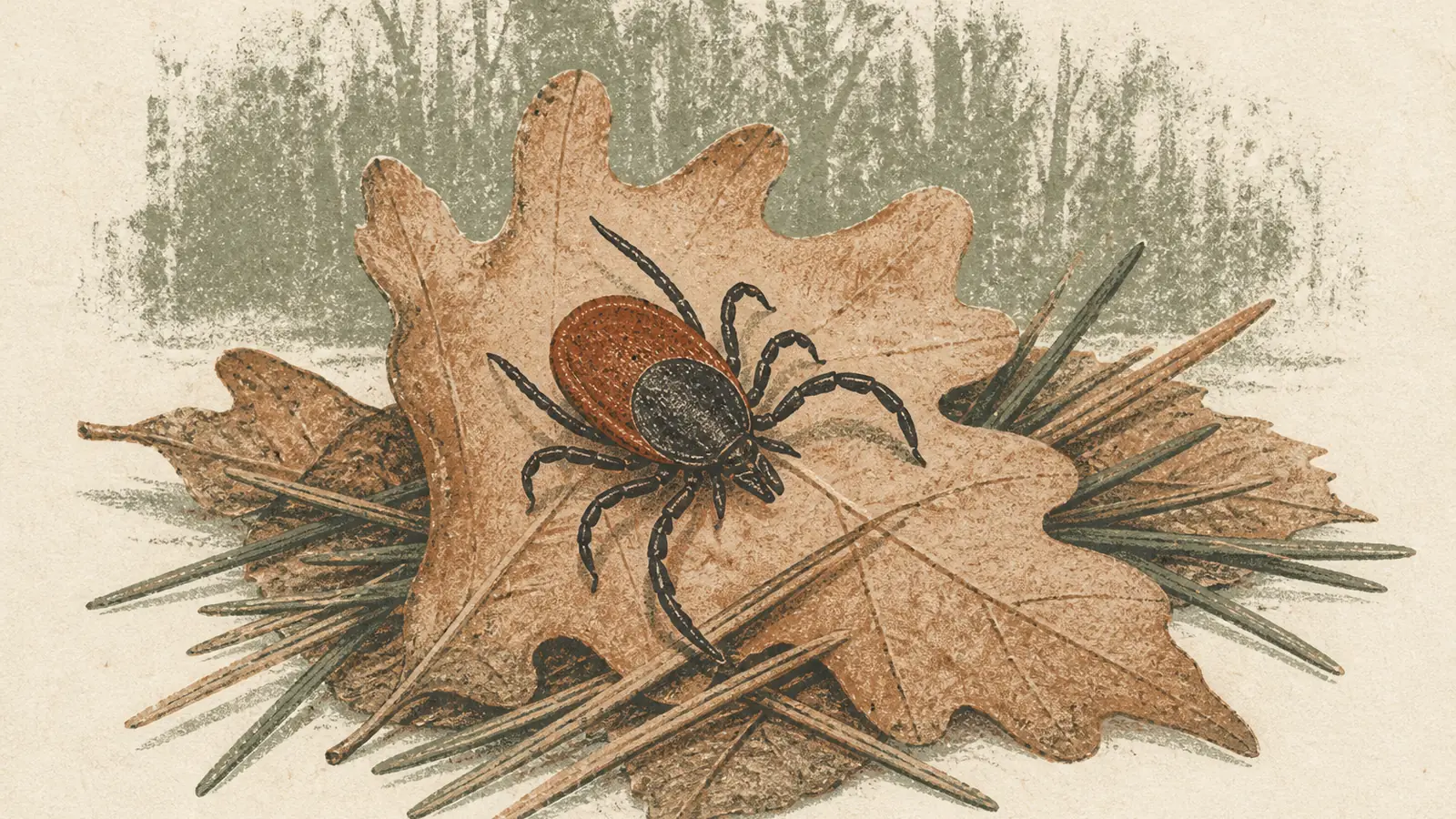
I had the map upside down. From November 2024 through August 2025, a team led by UNC epidemiologist Ross Boyce ran monthly tick surveillance across 25 residential properties in Biltmore Forest, a small town pressed up against Asheville. They pulled 373 ticks out of the yards and the woodline, more than three-quarters of them the blacklegged (deer) tick that carries Lyme, and when they tested the adults, 19 of 48 came back positive for Borrelia burgdorferi, the corkscrew-shaped bacterium behind the disease. That is 39.6 percent. Four in ten. That is not a creeping-edge number. It is the kind of prevalence long associated with the endemic Northeast, showing up in a state whose medical training said the disease was not supposed to be here.
| Measure | Value |
|---|---|
| Count | 19 of 48 positive for Borrelia |
That training was not stupid. It was just old. The CDC drew the endemic zones decades ago, and they ran up the Atlantic seaboard and across the Great Lakes while the American South sat outside the lines. Doctors learned it accordingly. Michael Reiskind, an entomologist at NC State, put the clinical version bluntly to the Asheville Watchdog: “If you find a doctor practicing in western North Carolina who was trained in the mid-90s or earlier, they would’ve been taught that there was no Lyme disease in North Carolina.” That belief runs as a self-fulfilling prophecy. If you are certain a disease is not in your state, you do not test for it, so you do not find it, so the case count stays low, so you stay certain.
So where did four in ten ticks pick up the bacterium? I went back to the methods for this one, because the answer changes what the number means. A tick is not born infected. Borrelia does not pass reliably from a mother tick into her eggs, so a tick has to acquire the spirochete by feeding on an already-infected animal, usually a white-footed mouse or another small mammal, during an earlier stage of its two-year life. So when four in ten adult ticks in Biltmore Forest test positive, the number is not really about the ticks at all. It is a readout of how thoroughly the local mouse-and-mammal community, the reservoir living in those yards, is already carrying the spirochete. Wait, so the infection is not riding in on the ticks, it is already baked into the woods? Yes. The quiet enzootic loop between rodents and ticks, the same loop that keeps Lyme humming in New England, has set up in these western North Carolina yards. The ticks did not import a disease. The neighborhood grew its own.
A reservoir does not pack up and leave. This is not weather blowing through, it is establishment, and Boyce did not hedge about it: “We’ve planted a flag and essentially can say, ‘Lyme is firmly established in western North Carolina,’ in a way that’s not subtle.” The same ticks were also carrying Borrelia miyamotoi and Anaplasma phagocytophilum, the southernmost detection of those two on record.
The cost of the old map gets paid by patients. A case report in the CDC’s own Emerging Infectious Diseases journal follows a woman in her late sixties in the suburbs north of Raleigh who went biking in mid-July and came home with a spreading rash on her neck and a fever. Over the next two months she was worked up for cellulitis, then an ear infection, then Bell’s palsy as the left side of her face drooped. She got a head CT and a spine MRI before anyone ran a Lyme test. When they finally did, her serology lit up and she responded to doxycycline within days. The authors do not call it incompetence, they call it inexperience: North Carolina clinicians “have limited experience diagnosing and managing Lyme disease because few cases occur annually statewide.” The doctors were playing by the map. The bacterium was not.
The official count lagged the biology by years. A 2024 analysis in The Lancet Regional Health – Americas, corrected in 2025, tallied 3,234 reported Lyme cases in North Carolina across 2010 to 2020, with the sharpest increases clustering in the northwestern mountains. By the last two years of that window the high-incidence zip codes had pushed into Watauga, Mitchell, Yancey, and Buncombe counties, and the Blue Ridge Mountains region hit 15.9 cases per 100,000. Buncombe County is where Asheville sits, which is to say the human cases were concentrating in exactly the ground where the ticks would later be caught red-handed. The paper is blunt about the trajectory: those northwestern zip codes now carry incidence “similar to those seen in traditional high transmission areas such as New England,” and the leading edge of that high-transmission zone marched about 100 miles south over the decade. Yet the state did not formally declare Lyme endemic to its ten northwestern counties, Buncombe the southernmost, until 2025. The surveillance apparatus arrived waving a flag at a party the ticks had been throwing for a decade.
So who forced the counting? Not the agencies. A resident named Angela Newnam, sick and undiagnosed for years after a 2015 tick bite, is the one who pushed Biltmore Forest to act. She compiled neighbors’ reports, worked with the town manager, and the town stood up a task force where residents could drop ticks at town hall to be tested. Seventeen residents had already reported Lyme diagnoses. The granular, on-the-ground truth got assembled by a woman the system had already failed, because the official picture told everyone there was nothing to look for.
Let me be clear about what this evidence is. Surveillance and a single case report are not a randomized trial, and a tick survey cannot tell you one hiker’s personal odds of getting sick. But that is the wrong thing to ask it for. For the question that is actually on the table, whether Lyme is established in these woods, tick-infection prevalence is not a weak proxy. It is the direct measurement. Four in ten adult ticks carrying Borrelia is not a maybe. What is still undercounted is the human half of the ledger: how many rashes in the Carolina mountains got waved off this summer as spider bites or shingles by a clinician working from a thirty-year-old assumption.
So this is my conclusion. If I were hiking or gardening in western North Carolina, I would do the boring things: check my skin and my scalp the same night, not the next morning, and pull anything embedded with fine-tipped tweezers. And if I came back from those mountains with a summer fever and an odd, expanding rash, I would not wait for my doctor to arrive at Lyme on their own. I would tell them where I had been, that I had been in tick country, and that I wanted Lyme on the table from the start, and I would bring the tick if I still had it. Early Lyme is often a clinical call made before the blood work turns positive, so the exposure story carries more weight than a single test result. The map in my head is updated now. I am not going to make a clinician catch up to it in real time while I get worse.
Sources
- CDC MMWR – Ixodes scapularis and Tick-Borne Pathogens, Biltmore Forest, Western North Carolina, November 2024–August 2025
- UNC Institute for Global Health and Infectious Diseases – Study shows Lyme disease firmly established in western North Carolina
- The Lancet Regional Health – Americas – Spatiotemporal patterns of Lyme disease in North Carolina: 2010–2020
- The Lancet Regional Health – Americas – Correction to “Spatiotemporal patterns of Lyme disease in North Carolina: 2010–2020”
- Emerging Infectious Diseases – Delayed Diagnosis of Locally Acquired Lyme Disease, Central North Carolina
- Asheville Watchdog – Lyme disease is here: Biltmore Forest’s ticks prove it, scientists say
- Current Issues in Molecular Biology – Interactions Between Ticks and Lyme Disease Spirochetes
- CIDRAP – Lyme disease spreading into southern Appalachia, increasing need for public education