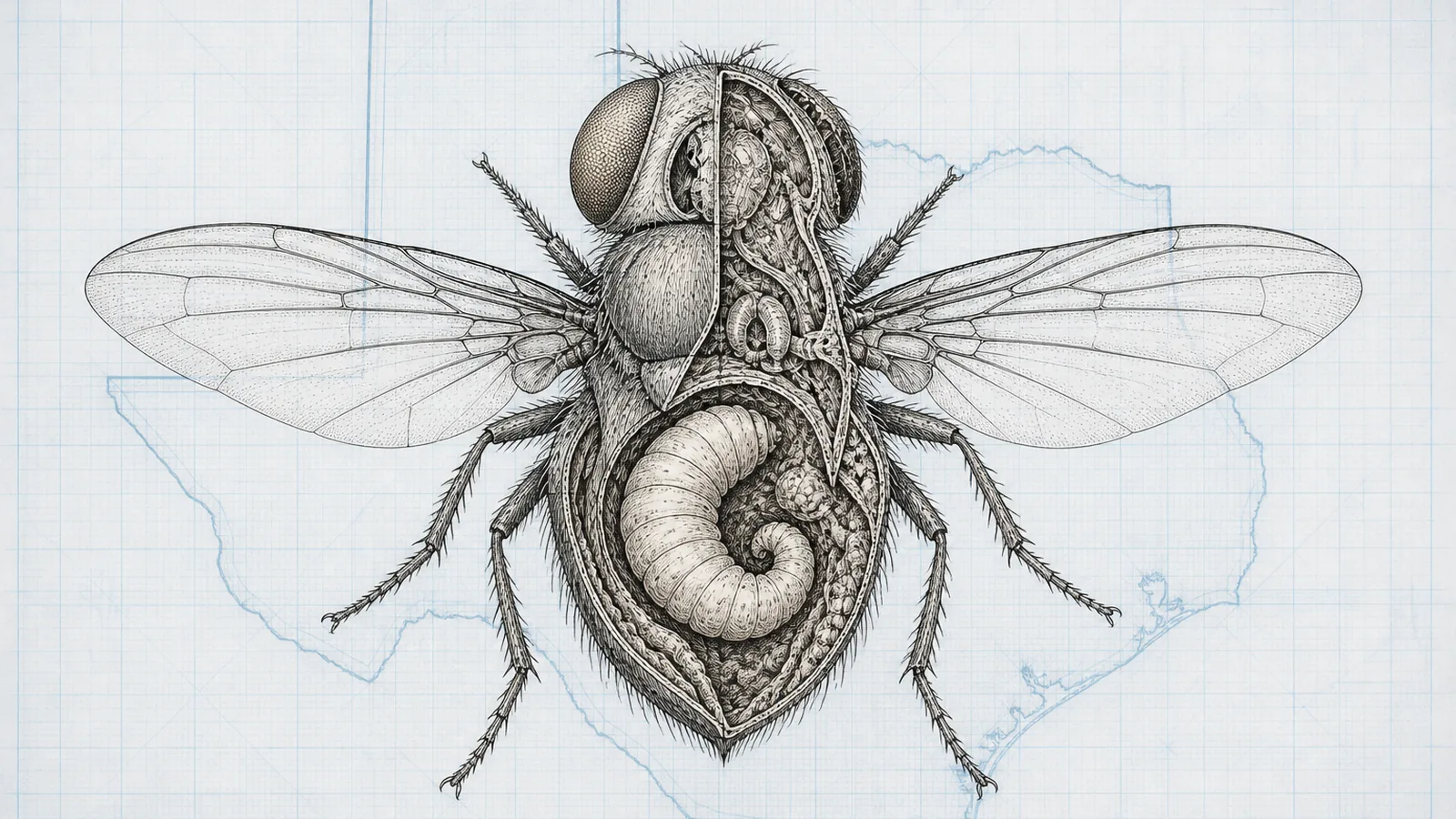
The New World screwworm does not wait for something to die. That is what sets it apart from an ordinary maggot. The female lays her eggs at the edge of an open wound on a living animal, and the larvae burrow inward, feeding on healthy tissue and widening the wound as they go, the smell drawing still more flies. In cattle it can kill in a week or two. In people it is rare, disfiguring, and sometimes fatal. That biology is why the United States once spent decades and a fortune erasing this insect from the continent, and it is why the fly’s return, and the emergency the FDA has now declared over it, is worth your attention rather than just your disgust.
The erasing was one of the quiet masterpieces of twentieth-century biology. Working in a USDA lab in Texas, two entomologists, Edward Knipling and Raymond Bushland, figured out that you could beat an insect with arithmetic instead of chemistry: flood the wild population with millions of sterilized males, let the females mate with duds, and the next generation simply fails to arrive. The first real field trial, on the Caribbean island of Curaçao in 1954, wiped the screwworm out in four months. By 1966 the fly was gone from the continental United States, and the two men later shared the 1992 World Food Prize for the idea. For the decades after, the country’s last line of defense was a living wall of sterile flies dropped from aircraft over the rainforest of Panama’s Darién Gap, a natural chokepoint in a nation declared screwworm-free in 2006.
- 1954Curaçao cleared in four months
- 1966eradicated from the US
- 2006Panama declared free
- 2023the sterile-fly barrier breaks
- 2026confirmed in a Texas calf
That wall broke in 2023. Overwhelmed, the barrier let the fly work its way north again through Central America and Mexico. Mexico has since logged 204 confirmed human cases of screwworm myiasis between April 2025 and March 2026, concentrated in the country’s south, with six deaths recorded among them, though officials attributed only one directly to the infestation. A travel-linked human case surfaced in Maryland in August 2025, the first in the US in nearly a decade. Then, on June 3, 2026, the USDA confirmed the fly in a three-week-old Texas calf in Zavala County, its first detection on US soil since eradication, and within days more animals tested positive, including a dog across the line in Lea County, New Mexico. We have watched this pattern before: a hard-won eradication holds for a generation, surveillance and production slip, and the thing you thought you had beaten comes back through the softest part of the perimeter.
So the alarm underneath the FDA’s move is warranted. What deserves a closer read is the tool the agency reached for, and the product it happened to land on. On August 13, 2026 the FDA issued an Emergency Use Authorization for Simparica TRIO, a chewable tablet combining sarolaner, moxidectin, and pyrantel, to treat active screwworm infestations in dogs and puppies. The authorization is narrower than the headline. It covers treating an infestation, not preventing one; it is prescription-only, dispensed by a veterinarian; and the agency itself notes that most US dogs are at low risk unless they live in, travel to, or return from an affected area.
An EUA is not an approval, and that distinction rewards a longer memory. It is the same fast-track instrument, section 564 of the Food, Drug, and Cosmetic Act, that the country came to know during COVID, when it put vaccines into arms and cleared monoclonal-antibody drugs on emergency footing ahead of full review. The machinery here is identical in kind. In August 2025 the HHS Secretary declared that the screwworm’s potential threat justified emergency authorizations of animal drugs, and the FDA has been issuing them in a steady stream since: two animal drugs in December 2025, four more in April 2026, and now the dog and puppy tablet. COVID should have taught everyone to ask two plain questions when the emergency label appears: what evidence stands behind the use, and who benefits from the shortcut.
On the first, an EUA lowers the bar by design. The statutory standard is only that a product “may be effective,” not that a trial has shown it is, and the screwworm authorizations rest on the reasonable expectation that drugs already approved to kill other parasites will kill this one too, rather than on a study in infested dogs. That may well be a sound bet with a compound this widely used. It is still a bet placed under emergency rules, not a conclusion earned through the normal review.
On the second, the beneficiary is not hard to find. Simparica TRIO is made by Zoetis, the world’s largest animal-health company, and the tablet sits at the center of its best-selling franchise: the top-selling canine parasiticide on the planet, a line that booked roughly $1.5 billion in sales in 2025. An emergency authorization does not just add a use. It hands a blockbuster brand a public-health halo, government-blessed and news-covered, for a product already dominating its category. None of that makes the pill the wrong call for a dog with maggots in a wound. It does mean the enthusiasm should be metered, because the commercial upside of an emergency label is exactly what the emergency framework was never built to reward.
And it is worth being clear about what a chewable tablet is and is not in this fight. Treating an infested dog is triage. It is not how you beat a screwworm, because the insect does not respect a prescription pad. The eradication tool is the one Knipling and Bushland built: sterile flies, produced by the tens of millions and dropped along the advancing front. The USDA has reopened that arsenal, running dispersal out of facilities in Mexico and South Texas and shifting aircraft to reinforce coverage inside the Texas border, with a far larger plant at Moore Air Base near Edinburg, Texas, that broke ground in 2026 and is expected to turn out 300 million sterile flies a week once it comes online in 2027. This is a sovereignty problem before it is a pharmacy problem: a pest crossing the southern border, met at that border by a barrier the country let weaken and is now scrambling to rebuild.
The dog pill will help the animals that get bitten. Whether the screwworm is pushed back below the Rio Grande or settles in for good gets decided somewhere else entirely, in the weekly output of those sterile-fly plants and in whether Washington funds the barrier back to the strength it had before 2023. Watch the Texas case count through the fall, and watch whether the Moore Air Base factory hits the scale the USDA has promised. That number, not the number of prescriptions written, is the one that tells you who is winning.
Sources
- FDA – Emergency Use Authorization for a drug to treat New World Screwworm in dogs and puppies (Aug 13, 2026)
- USDA APHIS – First US confirmation of New World Screwworm, Zavala County, Texas
- USDA APHIS – First screwworm case in a dog, Lea County, New Mexico; fourth Texas case
- Federal Register – HHS declaration of emergency under the FD&C Act for New World Screwworm (Aug 20, 2025)
- Federal Register – Emergency use authorization for two animal drugs for NWS treatment (Dec 29, 2025)
- Federal Register – Emergency use authorization for four animal drugs for NWS treatment (Apr 17, 2026)
- CDC Emerging Infectious Diseases – Human myiasis from reemergent Cochliomyia hominivorax, Mexico, 2025–2026
- ASM – New World Screwworm: Rise, Fall and Resurgence
- Zoetis Q4 2025 earnings call transcript – Simparica franchise sales and market position
- USDA APHIS – Sterile fly dispersal shifted to defend the US border