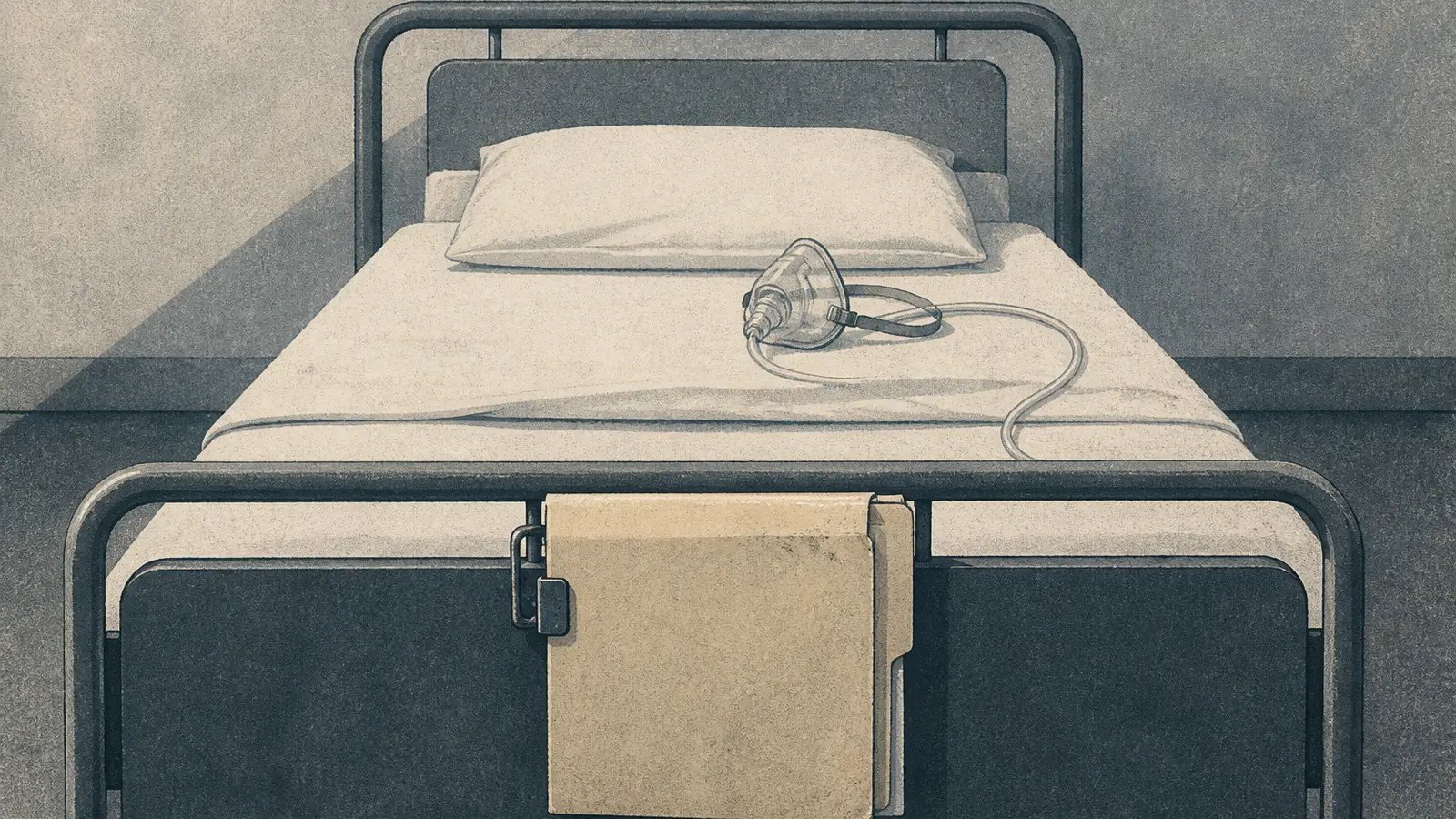
By the time the diagnosis comes, it comes in a hospital bed.
A person spends months tired, or short of breath, or quietly losing weight, is told it is probably nothing, and then one day the body forces the matter: a collapse, an ambulance, an admission. Somewhere inside that unplanned crisis a clinician finally names the disease. For a great many patients in England, that is the moment they learn they have chronic obstructive pulmonary disease, or Parkinson’s, or coeliac disease, or multiple sclerosis. A population study of 1.7 million people, published August 25 in PLOS Medicine, now puts a number on what that late, frightening route costs them.
The team, led by Emma Whitfield and Georgios Lyratzopoulos at University College London, linked primary-care records, hospital admissions and death registrations for 1,701,154 patients diagnosed between 1999 and 2019, across thirteen non-cancer conditions. The question was blunt: how many people are diagnosed only in an emergency, and what happens to them in the year that follows.
The emergency route is not some rare misfortune. Across nine of the thirteen conditions, more than one in five patients were diagnosed that way; for Parkinson’s it ran above 30 percent, and for COPD it was 35 percent, meaning a third of patients learned they had a progressive, well-understood lung disease only after it had already put them in a hospital. Subacute bacterial endocarditis reached 83 percent, which at least makes grim sense, since nobody catches an infection of the heart’s lining at a routine appointment. Most of the others are not like that. They are the conditions a functioning system is supposed to notice early.
| Measure | Value |
|---|---|
| of COPD patients | 35% |
The second answer is the one that lingers. After adjusting for age, deprivation, existing comorbidities and the setting of care, patients diagnosed in an emergency faced sharply higher odds of dying within a year, with adjusted odds ratios stretching from a barely-there 1.04 to more than seven. Coeliac disease, of all things, sat near the top: roughly seven times the odds of one-year death for emergency-diagnosed patients, 7.16 in men (95% CI 5.28 to 9.76) and 7.53 in women (5.64 to 10.1). Coeliac disease does not, as a rule, kill people. When it turns up in an emergency, something has gone badly wrong, or gone unseen for years. The absolute numbers ran the same direction: as many as 40 percent of men whose Parkinson’s was found through an emergency were dead within twelve months, and emergency-diagnosed patients stayed in hospital far longer, mean stays reaching 47.5 days where planned diagnoses were measured in ordinary days.
You can reach for the obvious objection, and the authors reach for it first. Sicker people, the ones already circling the drain, are the ones who arrive by ambulance, so of course they die sooner. But the model already swallowed age, deprivation, comorbidity and care setting, and the association held. The researchers deliberately defined “emergency” by the route to diagnosis rather than the drama of any single episode, precisely to separate a genuinely catastrophic presentation from a chronic disease that simply went unrecognised until a crisis surfaced it. Their one honest caveat is that this can sweep in the occasional incidental finding, a disease noticed by accident during an admission for something else. They say so plainly, and it is the only loose thread in an otherwise tight piece of work.
None of this would surprise an oncologist. The emergency-presentation penalty in cancer has been documented for years: a pancreatic tumour first caught in the emergency department carries a worse outlook than the same tumour caught along a planned pathway, and the “routes to diagnosis” literature that Lyratzopoulos helped build has said as much across the malignancies. What this study does is drag that finding out of oncology and set it down in the middle of ordinary chronic disease, where the same brutal arithmetic turns out to apply. Diagnosed in a crisis, you do worse. Diagnosed before one, you do better.
Which raises the question the paper is too disciplined to ask directly. These are, for the most part, catchable illnesses. A cough that will not clear, a tremor, a decade of unexplained gut trouble: the tissue of primary care exists to notice exactly these things and to act before the ambulance is called. A health service organised around universal early access, the safety net sold as catching you before you fall, did not catch a third of its COPD patients. The 1.7 million case files sat in the National Health Service’s own databases for twenty years, documenting in fine detail who was being found too late, until a Wellcome-funded doctoral programme finally linked them and asked.
It is worth reading the funding line closely, because it points at where this goes next. The work was underwritten by Cancer Research UK and a Health Data Research UK and Alan Turing Wellcome programme, and among the authors’ declared interests, one has consulted for GRAIL, the company marketing a multi-cancer early-detection blood test built on precisely this moral, that finding disease early is worth a great deal of money. The conflict is disclosed and the finding is almost certainly sound. Note only how neatly the two fit together: a study proving late diagnosis is deadly is exactly the evidence base an early-detection market runs on, and the trap closes quietly, with the receipts on the table and everyone’s name attached.
Whitfield and her colleagues have handed the health service a mirror assembled from its own records. What it shows, in a million and a half case files, is a system that already knew who it was catching too late, and had known for two decades.
Sources
- PLOS Medicine – Whitfield E, White B, Barclay ME, et al. “Frequency and prognostic outcomes of emergency diagnosis in 13 non-neoplastic conditions in England,” population-based cohort study of 1.7 million patients (2026)
- Digestive Diseases and Sciences – “Emergency Presentations Predict Worse Outcomes Among Patients with Pancreatic Cancer” (2023)
- News-Medical – “Emergency diagnoses of medical conditions predict worse patient survival” (2026)