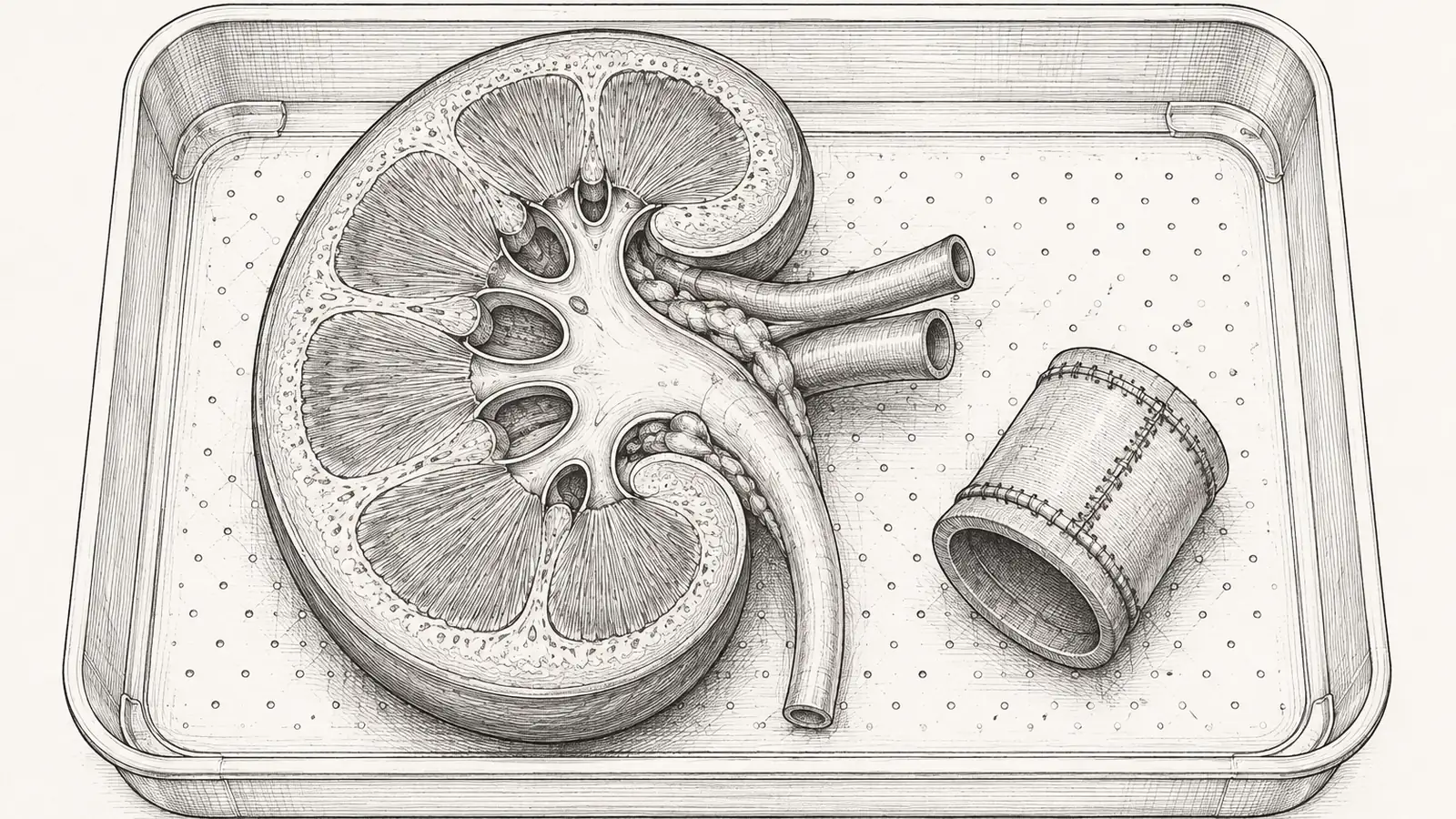
I always assumed the whole selling point of a pig kidney was that you got to keep it. That is the fantasy the field keeps dangling: a limitless supply of organs grown to order in a barn, so nobody dies waiting on a list again. So when the biotech eGenesis announced this week that two of its first pig-kidney recipients had gone on to receive human kidneys, my honest first reaction was a little deflated. Wait, the pig organs came out? Wasn’t the pig organ supposed to be the answer?
Then I read what actually happened, and I had it backwards. The pig kidney was never built to stay. It was a bridge: something to carry a patient across the dialysis years until a human organ shows up, then come out. The question was whether crossing it would cost him the far bank.
Start with Tim Andrews, a 66-year-old from Concord, New Hampshire, whose blood type was so hard to match that a compatible human kidney could have been years off. In January 2025 he took a gamble almost nobody had taken: a kidney from a pig that eGenesis had rewritten with 69 CRISPR edits, knocking out the pig sugars our immune systems attack on sight, adding human genes to soften the response, and silencing the pig’s own retroviruses. That kidney kept him off dialysis for 271 days, the longest anyone has lived dialysis-free on a pig organ, nearly doubling the previous record of 130 days held by Towana Looney of Alabama, whose body rejected the graft.
Then, in October 2025, it came out. The failure, when it came, was almost mundane. About six months in, an infection forced Andrews’ doctors to dial back the immunosuppression that was keeping his body from turning on the graft. With the guardrails lowered, inflammation and microvascular injury crept into the kidney, its function slid, and surgeons removed it. Andrews went back on dialysis. “Wilma and I had to give up the fight,” he said. Nine months of freedom from the machine, and then back on it.
None of that surprised the transplant doctors. A first-generation pig kidney lasting a year was never the promise; the point was to buy time. But buying time is only worth it if the bridge does not wreck the far bank. And that was the question I did not know to ask until I understood what your immune system does after nearly a year fighting a pig.
You would expect that long a low-grade war with pig tissue to leave the immune system armored, bristling, primed to attack anything foreign that came next. There is a name for that state, sensitization, and it is the quiet tragedy of the transplant world. Pregnancy can do it, so can a blood transfusion or an earlier transplant; each exposure teaches your body to build antibodies against other people’s tissue, and every antibody you make shrinks the pool of donors who can ever match you. For someone like Andrews, already nearly unmatchable, getting sensitized by the pig kidney could have slammed the human door shut. So why didn’t it?
Because the immune system, at least in these two cases, fought a specific enemy rather than foreignness in the abstract. The war Andrews’ body waged against the pig was aimed at pig-specific targets: the alpha-gal sugar and the other porcine antigens eGenesis had engineered the organ to hide. Those are not the molecules that decide human-to-human matching. What narrows your human donor pool is anti-HLA antibody, the antibody against human tissue-type markers, and living with a pig kidney did not teach his body to make it. So when a deceased-donor human kidney came available in January 2026, it worked immediately, with no sign of sensitization, and the detailed immune profiling confirmed it. I did not expect the body to draw that line so cleanly. The bridge held. The far bank was intact.
Two patients is two patients. This is a company announcing its own milestone, on a Thursday evening, about its own product, and the immune profiling that lets scientists say “no sensitization” with a straight face is early, case-level work, not a trial. As of a 2025 review, every living human ever given a gene-edited pig organ still fit inside one paper. Nobody has run the randomized study that would tell us how often the bridge holds and how often it quietly burns. When the marketing arrives promising pig organs that end the shortage outright, remember that the data in front of us describes a nine-month rental that failed and had to be surgically undone. That is worth a great deal. It is not a barn full of spare parts.
But it reframes what this technology is honestly for, and the honest version is more compelling than the hype. More than 100,000 Americans are on the transplant list, most of them waiting for kidneys, and thousands die waiting. Dialysis keeps you alive while it slowly wears you down. If a pig kidney can buy a hard-to-match patient a year of freedom from that machine and then hand them back to the human list no worse off than when they started, that is not a consolation prize. That is a lifeline for exactly the people the current system fails.
So here is my conclusion. If I were Tim Andrews, my blood type matching almost no one, staring down years of dialysis, I would not hold out for the perfect permanent pig organ that may never come. I would take the bridge, walk across it, and get in line for the human kidney on the other side. And I would spend the whole wait telling everyone I know to become a donor, because the far bank still runs on human generosity.
Sources
- STAT – Recipients of gene-edited pig kidneys successfully receive human organs (Sept 3, 2026)
- Medical Xpress – Pig kidney xenotransplant successfully bridges patient to human transplant
- Nature Medicine – Immune profiling in a living human recipient of a gene-edited pig kidney
- Smithsonian – Pig kidney removed after a record-breaking 271 days
- WBUR – New Hampshire man resumes dialysis after record 271 days with a pig kidney
- Medicine Bulletin – Clinical Xenotransplantation of Gene-Edited Pig Organs: Experiments in Living Humans Since 2022