Dr. Alexis Barr calls them “very dangerous,” which is a strange thing to say about cells that, by definition, are not doing anything at all.
We found cells that resemble therapy-resistant cells already residing in the tumor before we give any treatment
Barr runs the Cell Cycle Control group at the MRC Laboratory of Medical Sciences, and the cells she means are the quiet ones: quiescent breast-cancer cells that have dropped out of the division cycle and gone still. They do not grow or spread, which is exactly the problem, because almost everything we throw at a tumor is built to kill cells that are busy dividing. “These cells can hide from chemotherapy and then remain in this dormant quiescent state in the tumor, and then later reactivate to drive proliferation,” Barr told News-Medical. Most patients know that last event by a gentler name. Recurrence.
Barr’s group teamed with the computational-biology lab of Dr. Maria Secrier at UCL to find where those sleeping cells hide. They found them, and they found something the standard account of relapse does not predict: cells that already looked resistant to therapy, sitting in the tumor before any drug had been given. “We found cells that resemble therapy-resistant cells already residing in the tumor before we give any treatment,” Secrier said. The survivors, in other words, may not be survivors at all. They may be cells that were never in the fight.
The tumor turned out to have neighborhoods
Start with what the study is, because most of the coverage skipped it. Nobody dosed a patient. There was no trial and no experiment on a living tumor. Celik, Secrier, Barr and their colleagues took existing single-cell sequencing data, which reads out the genes each individual cell is running, and laid it over spatial transcriptomics, which records where each cell physically sits relative to its neighbors. Out of publicly available tumor datasets they drew a floor plan, and it ran in Genome Medicine under a title no press office would print on a poster: “Spatial ecology of breast cancer reveals co-evolution of proliferative and dormant niches.”
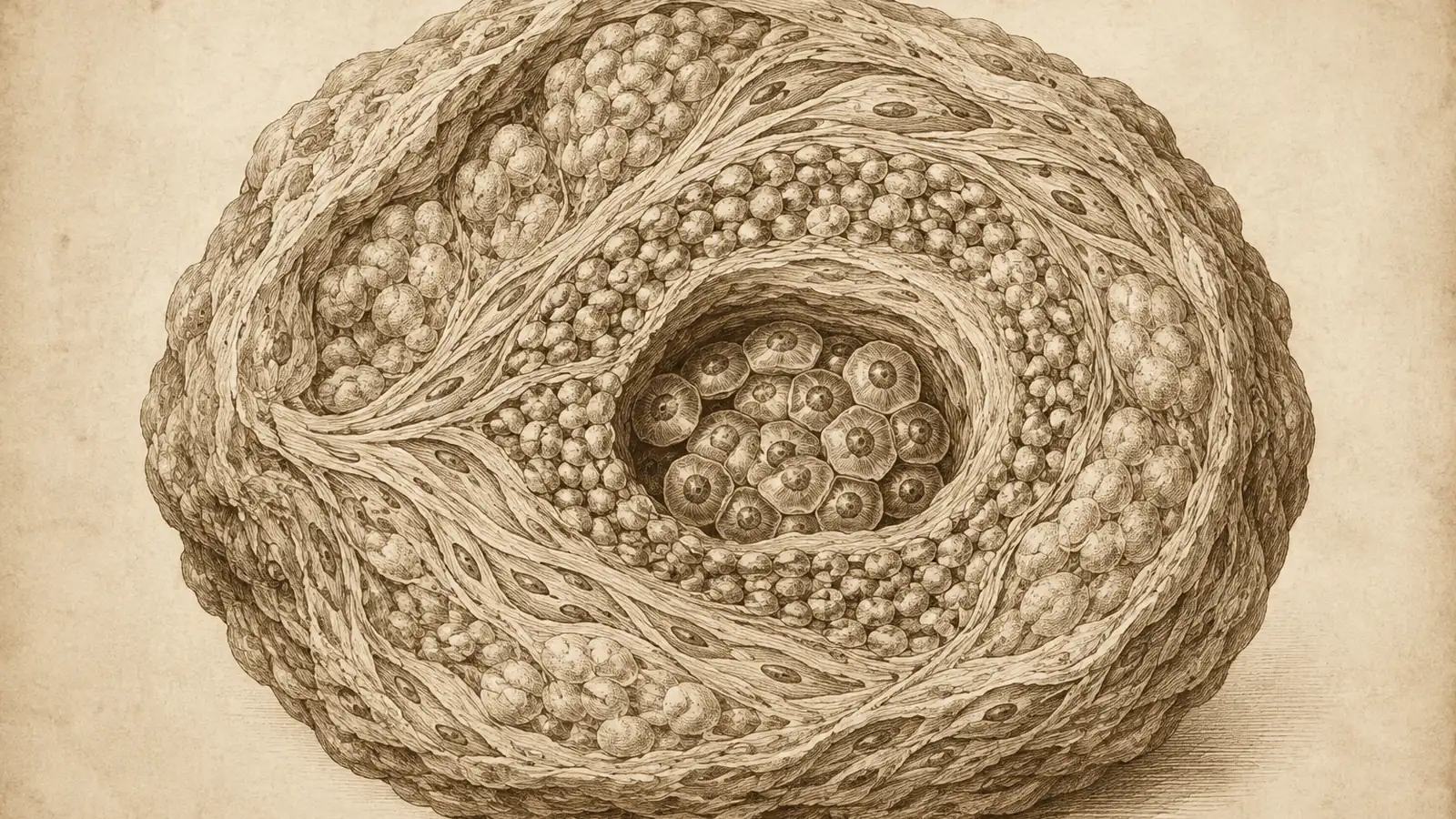
The neighborhoods were startlingly organized. The dormant cells, arrested in the cell-cycle stage biologists call G0, clustered inside what the authors call protective niches: pockets lit up by the complement pathway and ringed by CXCL10-positive macrophages and myofibroblastic cancer-associated fibroblasts. The busy, proliferating districts carried a different immune signature and, on paper, answered to different drugs. Two neighborhoods in one tumor, two populations, two sets of weaknesses. “The cancer cells are really encapsulated within these areas of macrophages and fibroblasts that we think act as shields for these dormant cancer cells,” Secrier said.
The line that should unsettle oncology
Read Secrier’s sentence again, because it turns the usual story inside out. The comfortable version of resistance goes like this: chemotherapy works, it clears the tumor, and over time a few surviving cells evolve their way around the drug, so the disease comes back harder to kill. This data points somewhere colder. The resistant-looking cells were there at the start, parked in a sheltered pocket, waiting out a storm they were never exposed to. The tumor did not learn to survive treatment. Part of it was built to ignore it.
Keep the caveat in front of you: these cells resemble resistant cells, and the study maps them, it does not dose them. But if the resemblance holds, some relapses were written into the tumor before the first infusion, and no amount of clearing the visible disease was ever going to reach them.
This did not come from a fringe skeptic or a drug company with a product to move. The money was public British research funding, a UKRI Future Leaders Fellowship, the Medical Research Council, and the BBSRC, with no compound in the pipeline waiting on a flattering result. Worth saying plainly, because it means the oversell here is not an investor deck. It is the press-release ecosystem that reflexively converts a map into a cure. By early September the same finding was re-running under a “protective shields” headline, roughly six weeks after the first wave of coverage at the end of July, with nothing new in the science and a good deal more drama in the framing.
What it changes, which is not yet what the headlines imply
For a woman finishing chemotherapy this week, none of this changes her treatment. There is no complement-pathway inhibitor being handed out to clear dormant niches, no niche-targeting combination on any pharmacy shelf. What the work hands drug developers is a hypothesis with an address: that preventing relapse may mean attacking the shield, the local crowd of immune and connective cells, and not only the cancer cell hiding inside it. “If we understand what drug combinations we can use to target both the proliferative and the dormant areas, potentially that could be more successful than current therapies,” Secrier said. Potentially is doing a lot of work in that sentence.
The predictions still have to be tested in the lab, and the direction of cause is unknown: nobody yet knows whether the macrophages and fibroblasts enforce the dormancy, or whether the cancer cells recruit and reshape the neighbors that end up sheltering them. Dormancy itself is old news, since oncologists have understood for decades that some cells sleep through treatment. What is new is the floor plan.
The field has drawn a great many beautiful maps of cancer that never became a single therapy, and this one earns its interest by refusing the cure language the coverage reached for anyway. Secrier and Barr were careful about what they had: a prediction, untested, about where the danger sits. Somewhere between their lab and the September headlines, the word prediction quietly went missing.
Sources
- Genome Medicine – Celik et al., “Spatial ecology of breast cancer reveals co-evolution of proliferative and dormant niches” (2026)
- News-Medical – Scientists map protective cell networks hiding dormant breast tumor cells (Jul 31, 2026), with researcher quotes
- ScienceDaily – Scientists find breast cancer cells hiding behind protective “shields” (Sep 6, 2026), funding detail
- MedicalXpress – Scientists map dormant cancer cells’ hideouts, opening new targets for treatment (Aug 2026)
- PubMed record for the Genome Medicine paper (secondary)