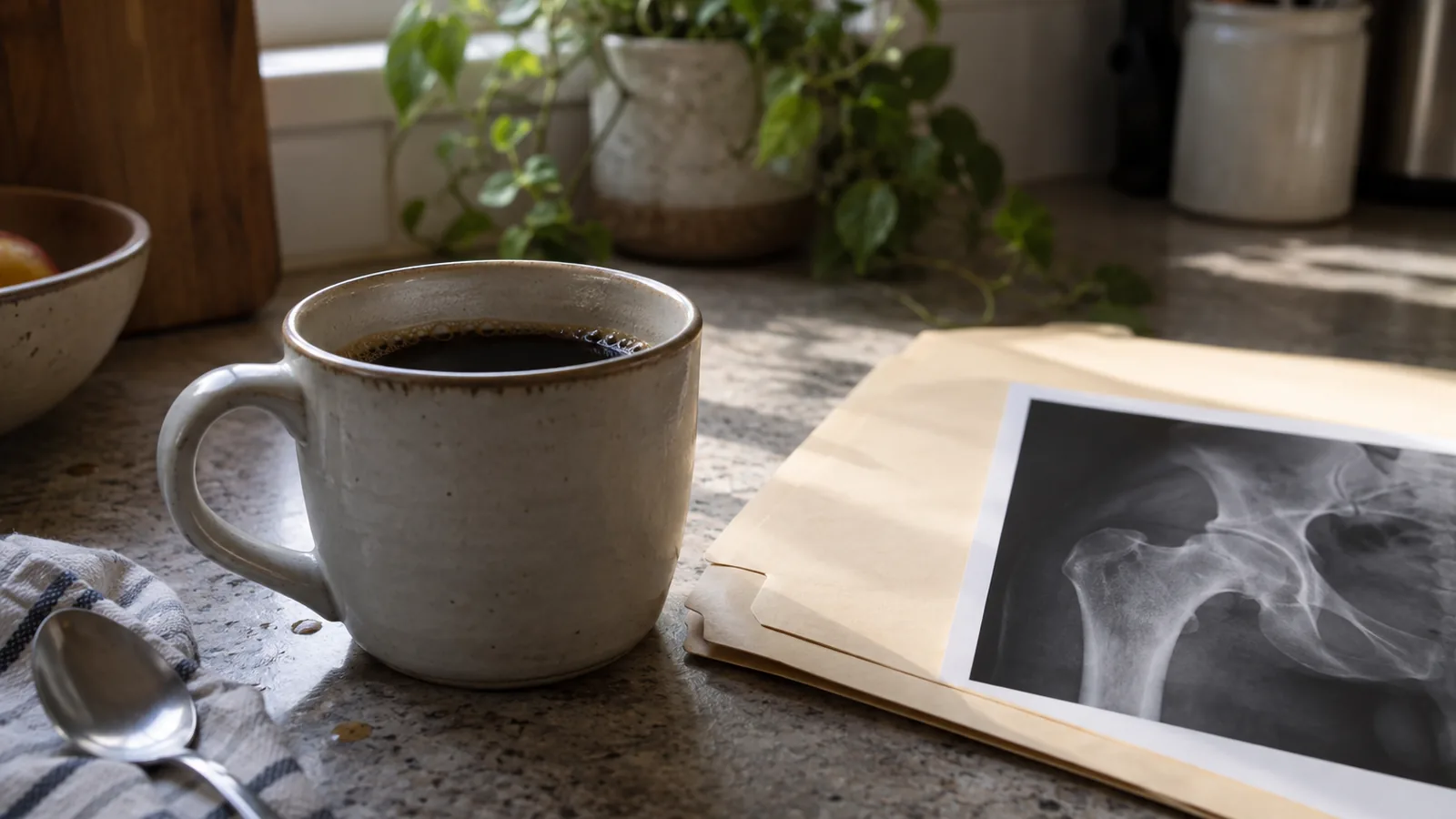
I felt the little jolt of guilt before I’d read a single line of the actual paper. “Too much coffee may weaken bones,” the headline said, and I did the thing every coffee drinker does, which is a fast mental tally of how many cups I’d already had that morning. Then I went and read the study underneath it, and the guilt evaporated. What sat under the scary framing was a small, careful analysis that found almost nothing. The panic was in the packaging, not the paper.
This is what happened. Two researchers at Flinders University, Ryan Liu and Enwu Liu, took the Study of Osteoporotic Fractures, a long-running cohort of 9,704 American women aged 65 and up, and tracked their hip and femoral-neck bone density across roughly a decade, more than 24,000 measurements in all. They asked the question a lot of us quietly worry about: does the coffee habit cost you bone? They published in Nutrients in late 2025, and this month the science feeds ran with the coffee-weakens-bones framing, while the university’s own press release went with “coffee may pose risks.”
The coffee result was the part the headline skipped, because the coffee result wasn’t significant. A spline analysis hinted that the heaviest drinkers, more than five cups a day, might sit a little lower on bone density. But when the authors put that impression to an actual statistical test, the likelihood ratio test came back with a p-value above 0.05. In plain terms, the wiggle in the picture could not be told apart from noise. There is no clean “five cups a day wrecks your bones” finding here. There is a shape someone eyeballed on a graph.
And the tea benefit, the good-news half of the coverage? It cleared significance, and it is almost comically tiny. Tea drinkers had higher total-hip bone density by 0.003 grams per square centimeter (95% CI 0.000 to 0.005, p=0.026). The authors write that this difference is “below the threshold typically considered clinically meaningful for individual patient management.” They flagged their own finding as too small to change what any single woman should do. The lead author put it plainly to the press: the results “don’t mean you need to give up coffee or start drinking tea by the gallon.” That honesty didn’t survive the trip to the headline.
I did come in curious about the biology, because the mechanism is the part I actually care about, and it’s more physical than the abstract “interferes with bone metabolism” language suggests. Caffeine gets in the way of how efficiently your body takes up calcium and keeps bone maintained, but the effect is so small that, per the researchers, a tablespoon or two of milk in the cup roughly cancels it out, because you’re just handing the calcium back. Tea runs the other way: its catechins, a family of plant flavonoids, appear to nudge the bone-building cells to work and quiet the bone-dissolving ones. Wait, why would a leafy plant compound care which way your skeleton is remodeling? That’s the genuinely intriguing thread, and it’s exactly the one this study can’t pull, because it measured cups per day on a questionnaire, not catechins in a bloodstream.
The two flashiest sub-findings deserve the same cold water. Yes, the negative coffee signal looked stronger in women who also drank more alcohol (interaction p=0.0147), and yes, tea’s benefit looked bigger in women with obesity (p=0.0175). Those make for great pull-quotes. But the authors explicitly warn that these slices “are likely underpowered and may be susceptible to type I error,” meaning false positives, and are “primarily hypothesis-generating.” When the people who ran the numbers tell you a result is hypothesis-generating, they are telling you not to build a lifestyle around it.
I want to be fair to the study, because it isn’t a bad one. It’s modest and transparent, and it got dressed up by everyone downstream. The honest limitations are stacked right there in the paper. Intake was self-reported, with no record of cup size or brew strength, so a thimble of espresso and a bucket of drip counted the same. The cohort was, in the authors’ words, “almost entirely” White older women, which they concede “severely restricts the applicability” to anyone else. And nobody measured fractures. Bone density is a proxy; the thing that actually breaks a hip and lands a 78-year-old in the hospital was never the endpoint, which is why the authors call for future work with fracture as a primary endpoint. A 0.003 g/cm² difference that never gets tested against a real broken bone is a statistical curiosity, not a health warning.
So who benefits from turning that into “coffee may weaken bones”? Not you. The incentive here isn’t pharmaceutical, at least not the way I read it; it’s attentional. A null result and a trivially small one are hard to sell, and “your morning habit is hurting you” writes its own clicks. The science-press machine reliably launders a modest cohort association into a personal threat, and the reader walks away vaguely guilty about a cup of coffee over a finding the researchers themselves called too small to act on.
This is my position. I’m keeping my coffee, all of it, and I’m not switching to tea for my skeleton, because the study that supposedly recommends it says in writing that it shouldn’t change what I do. If I want to actually protect my bones as I age, I’ll spend the effort on the things with real evidence behind them, the basics the researchers themselves keep pointing back to: enough calcium and vitamin D, and lifting something heavy on a regular basis. When a headline tells me to fear my mug, I’m reading the p-value first.
Sources
- Nutrients – Liu & Liu, longitudinal coffee/tea and bone mineral density analysis in the Study of Osteoporotic Fractures (2025), full text via PubMed Central
- ScienceDaily – “Too much coffee may weaken bones, study finds” (2026)
- EurekAlert! – Flinders University release, “Tea linked to stronger bones in older women, while coffee may pose risks”