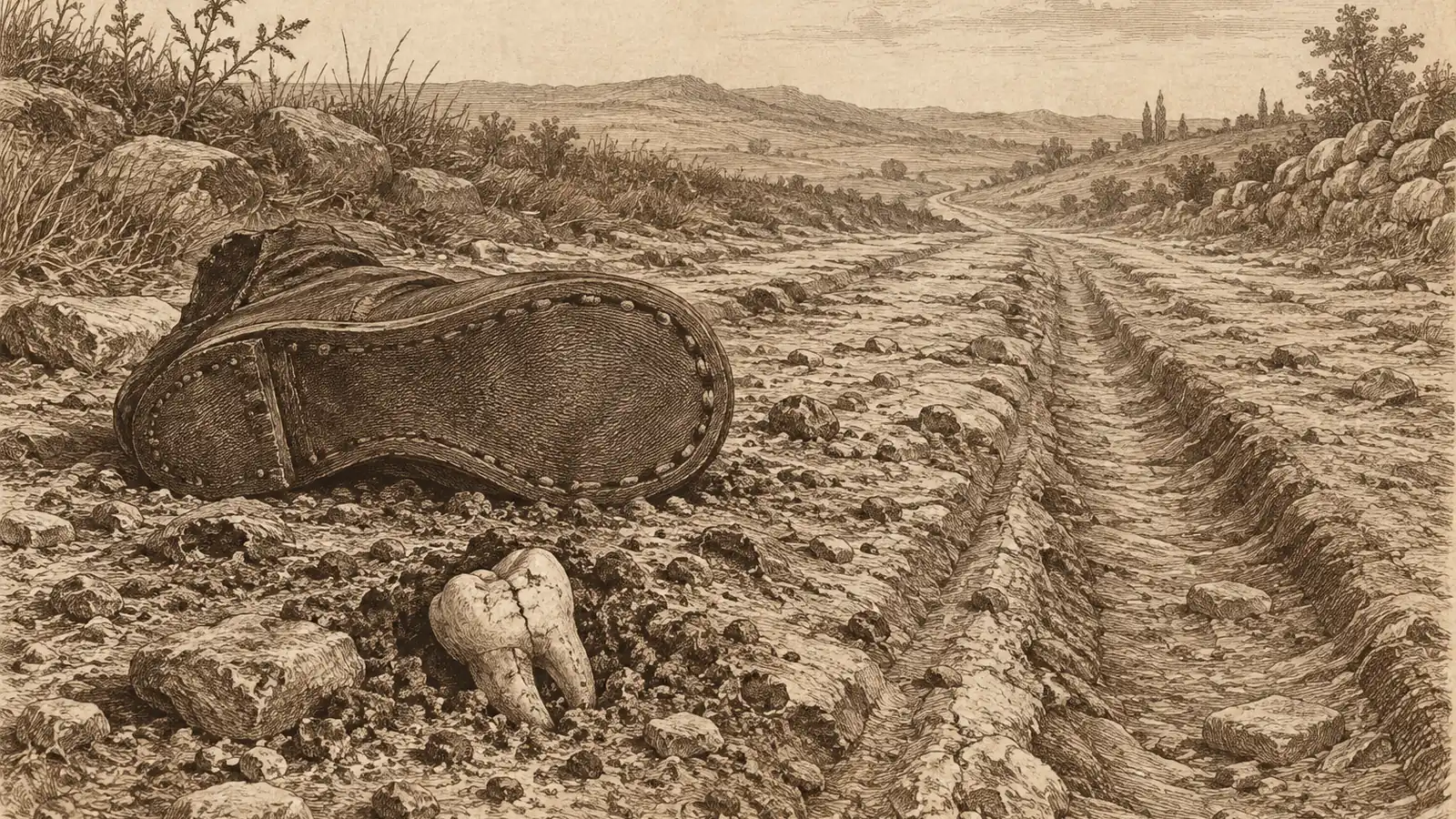
I always filed the Black Death under “over.” One monstrous wave in the 1300s, a third of Europe gone, then a slow fade into history books and horror-movie set dressing. A team of geneticists reading DNA out of centuries-old teeth just corrected me, and the correction is the unsettling kind: the plague did not fade after the 1300s. It came back for another 400 years, wave after wave, and the DNA says it kept coming back because armies and displaced people kept carrying it in.
That is the finding at the center of a study in the Proceedings of the National Academy of Sciences, led by researchers at the University of Tartu with collaborators in Cambridge, the Netherlands, and Switzerland. They reconstructed 26 new genomes of Yersinia pestis, the bacterium behind plague, from human remains at 11 archaeological sites across Estonia, Russia, England, the Netherlands, and Switzerland. Set alongside 64 genomes other teams had already published, the samples stretch from 1349 to 1710, most of the long, grinding stretch historians call the Second Plague Pandemic.
For centuries, one comfortable story was that plague simply went quiet in some local corner, a damp reservoir under a European city, flaring up now and then like an ember. This DNA tells a messier story. Estonia alone got hit with repeated fresh introductions of plague starting in the late 14th century, each one a distinct genetic lineage, showing up in both crowded towns and quiet farm villages. “We found evidence for repeated introductions of plague into Estonia starting already in the late 14th century and identified several previously unknown genetic lineages, both in urban and rural settings,” said senior author Kristiina Tambets. This was not one thing hiding. It was the same killer, walking back in the front door again and again.
Here is the trick that makes the whole thing work, and the reason I trust it despite the obvious limits. This is archaeogenomics, not a clinical trial. You cannot run a controlled experiment on the 15th century, and if you dig up a body and radiocarbon-date it, you often get a window more than 100 years wide, useless for connecting a specific corpse to a specific outbreak. Teeth can only tell you so much. But the bacterium sealed inside them can still redraw the map. So the team built a method they call Phylogenetically Informed Radiocarbon Modeling, and wait, this is the bit I love: instead of dating only the bones, they date the bacterium. Yersinia pestis picks up mutations at a roughly steady tick, so its genome works like a molecular clock. Read how far out on the evolutionary branch a given strain sits, count the mutations that have piled up, and the position on the tree becomes a timestamp all by itself. Fold that into the radiocarbon range and the window snaps from a century down to something you can actually pin to a plague wave. “We were able to improve dating intervals for many samples, which allowed us to connect them to specific plague waves,” said historian Philip Slavin. The mutations themselves are the calendar. I find that quietly astonishing.
Once you can date the branches, the shape of the outbreak appears. Around 1450 to 1500 the bacterium underwent a major expansion and split into three main branches, some of which may have settled into new reservoirs in wild rodent populations. And the branches move the way armies move. The genomes carry the fingerprints of the Thirty Years’ War (1618 to 1648) and the Great Northern War (around 1700 to 1721). “We see how Yersinia pestis splits into new branches during periods of conflict and spreads along the routes travelled by troops and displaced populations,” said Christiana L. Scheib. War produces exactly what a pathogen wants: hungry people, crowded camps, broken sanitation, and a constant churn of bodies crossing borders. From the genomic pattern, the plague did not need to invent new tricks so much as ride the traffic that war created, multiplying during the fighting and following the roads the troops and refugees traveled. Europe kept supplying both.
So which is it, re-importation or a hidden local reservoir? The answer is both. Fresh lineages kept arriving from outside, and some of those lineages then dug in and established themselves, possibly in local rodents, ready to surface again. It reads less like one ember that never died and more like a fire repeatedly re-lit, occasionally leaving embers of its own behind.
And this is where the medieval teeth reach into the present. Yersinia pestis never actually left the planet. It still lives in wild rodents, and the CDC calls plague “a rare but persistent cause of illness in rural areas in the western United States”, curable with antibiotics if you catch it fast. The bacterium that emptied medieval villages is still out there, in prairie dogs and ground squirrels across the American West. It is quiet. Quiet is not the same as gone.
Lead author Marcel Keller drew the comparison that has stuck with me. With COVID-19, he noted, scientists could reconstruct the spread of individual strains extremely well because the genome data came stamped with precise dates. For historical pandemics, “those timestamps are often missing or may cover more than 100 years.” What this team did, in effect, is manufacture the timestamps that history forgot to write down, and use them to watch a pandemic breathe over four centuries. The same genomic tracking we suddenly decided we cared about in 2020 turns out to work on a bacterium that has been killing people since long before the printing press.
It also connects to a thread I find hard to let go of. The plague did not just kill people; it edited us. Earlier work found signs of rapid natural selection on immune genes during the Black Death, and the strain that started it has been traced to Central Asia in the 1330s. Four hundred years of recurring waves is four hundred years of that pressure grinding on human genomes, in your ancestors and mine, favoring whoever’s immune system happened to hold the line.
So here is what I am taking home from a box of medieval teeth. I am going to stop treating “gone” and “quiet” as the same word. When the next outbreak map lights up somewhere, I will not assume the pathogen finally left. I will ask where it came from this time, because this team showed you can trace that, branch by branch, in the DNA of the dead, at least when the dead left their teeth behind. That is the practice I am keeping.
Sources
- PNAS – Keller et al., “A sharper picture of a pandemic: the plague after the Black Death” (2026)
- EurekAlert (University of Stirling) – study press release (2026)
- ScienceDaily – “Ancient DNA reveals how plague kept returning for 400 years after the Black Death” (2026)
- Archaeology Magazine – “Plague after the Black Death returned in waves across Europe for centuries” (2026)
- CDC – About Plague (Yersinia pestis persistence, western US, antibiotic treatment)
- Science – Spyrou et al., “Ancient DNA reveals Black Death source” (2022)
- Nature – “Ancient DNA reveals rapid natural selection during the Black Death” (2022)