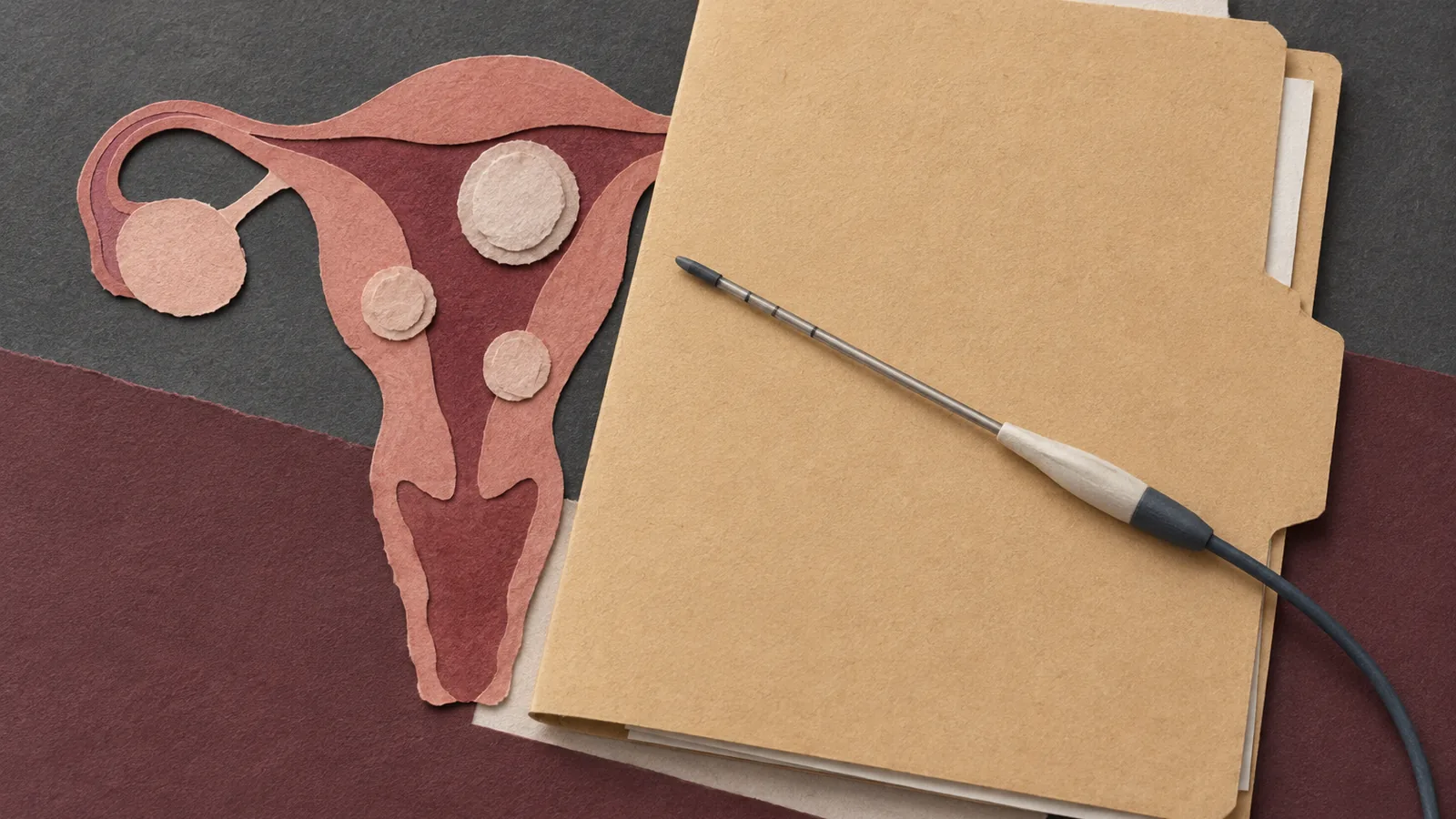
For most of the last century, the medical answer to a uterus full of fibroids was to remove the uterus. Hysterectomy was the fix, and for generations it was very nearly the only durable one a symptomatic woman was offered: the price of relief was the organ itself. Every uterus-sparing option that came after, the drugs and the artery embolizations and now the heat probes, is a rebellion against that arrangement. This week the newest of them got a favorable headline, and it deserves the scrutiny that favorable headlines about company-tested devices rarely get, because the cleanest evidence that it works as well as surgery was paid for by the company that makes it.
The device is laparoscopic radiofrequency ablation, and the news is a two-year comparison against myomectomy, reported by MedPage Today, which found both procedures produced significant and sustained improvements in symptoms and quality of life over 24 months. To see why that matters, start with the mechanism, because it is genuinely different from cutting. Myomectomy is excision: the surgeon finds each fibroid, removes it, and reconstructs the uterine wall, which is why it bleeds and why it takes weeks to heal. Ablation leaves the fibroid where it is and cooks it. A needle electrode, guided by laparoscopic ultrasound, delivers heat into the center of the tumor until the tissue dies, and the body reabsorbs the dead mass over the following months. In the laparoscopic approach, the surgeon never opens the uterine wall. That is the entire pitch, and on the near-term numbers it holds up.
Those near-term numbers come mostly from one lineage of research, and the cleanest piece of it is the TRUST trial, a Canadian randomized study that split 45 women between ablation and myomectomy. On recovery, ablation won cleanly: intraoperative blood loss of 25 milliliters versus 82 for surgery, a median procedure time of 70 minutes versus 86, and a hospital stay under seven hours versus nearly ten. On the outcomes a patient actually feels, the two were a near tie, with both groups reporting an identical 44.8 percent drop in symptom severity. That is the kind of result that should change how women get counseled.
| Measure | Value |
|---|---|
| Ablation | 25 |
| Myomectomy | 82 |
It also came with a funder. Acessa Health, the company that makes the ablation system, “provided funding for research, independent data collection and management” for TRUST. Two of the trial’s authors, Darrien Rattray and John Thiel, take fees as proctors for Acessa Health. That does not make the findings wrong; randomization is randomization, and the recovery advantage of not opening the uterus is mechanically obvious. But we have watched this pattern run through device medicine for decades: the manufacturer funds the pivotal trials, the trials are small, they measure the endpoints the device is built to win, and the independent long-term comparisons arrive years later, if they arrive at all. The AAGL practice committee’s 2024 review built its recommendation from a body of evidence that was overwhelmingly single-arm and short-term, with only a handful of randomized comparisons in it. When most of what a field knows about a procedure traces back to the company selling it, the burden of proof has not been met. It has been deferred.
The deferred question is durability, and it is where “similar to surgery” quietly oversells, because myomectomy removes the tumor while ablation kills it and leaves it to shrink, and a shrinking fibroid is not a removed one. One meta-analysis put the pooled reintervention rate near 4 percent, which sounds reassuring until you follow the same patients out year by year: the cumulative need for a second procedure reaches 4.2 percent at year 1, 8.2 percent at year 2, and 11.5 percent by year 3, as fibroids that were cooked but not removed reassert themselves or new ones grow. Move to the transvaginal version of the technology and a 2026 observational study reported a two-year reintervention rate near 25 percent, part of it planned as a staged strategy but most of it not. A two-year symptom score cannot see any of this. A two-year symptom score is what made this week’s headline.
| Year | Needed a second procedure |
|---|---|
| 1 | 4.2% |
| 2 | 8.2% |
| 3 | 11.5% |
None of this is an argument for the scalpel. It is an argument for honest accounting, and honest accounting cuts in the patient’s favor more often than industry spin admits. The larger scandal in fibroid care is not that ablation is oversold; it is who never gets offered anything but the oldest and most invasive option. By age 50, cumulative fibroid incidence runs near 70 percent in white women and above 80 percent in Black women, who, as the 2024 JAMA review lays out, develop fibroids younger, grow them larger, and carry worse symptoms, yet are pushed toward hysterectomy at more than twice the rate of white women and toward minimally invasive surgery at lower rates, a gap that persists after accounting for the larger uteruses they present with. A uterus-sparing heat probe that lets a woman go home the same day is exactly the kind of option that disparity has kept out of reach. The technology is not the problem. The distribution is.
So the real test is not the two-year symptom curve, which we can already read. It is a head-to-head trial funded by someone other than the device maker, one that follows ablation and myomectomy patients out to five and ten years and reports reintervention and hysterectomy avoidance as its primary endpoints rather than its footnotes. Until that trial reports, the honest counseling is the version the manufacturer’s own data supports and not one sentence further: ablation offers a faster recovery and comparable near-term relief, at the cost of a durability question no one has yet answered for the women who most need the answer.
Sources
- MedPage Today – Two Procedures May Yield Similar Symptom Relief for Uterine Fibroids (2026)
- TRUST trial – randomized comparison of laparoscopic radiofrequency ablation and myomectomy, funded by Acessa Health (PMC)
- AAGL Practice Committee – Radiofrequency Ablation for Uterine Fibroids: Systematic Review and Meta-Analysis (JMIG, 2024)
- Quality of Life, Adverse Events, and Reintervention After Laparoscopic Radiofrequency Ablation: A Meta-Analysis (PubMed)
- Two-Year Clinical Outcomes of Transvaginal Radiofrequency Ablation for Symptomatic Uterine Fibroids (PMC, 2026)
- JAMA – Uterine Fibroids review, Marsh et al. (2024)
- High cumulative incidence of uterine leiomyoma in Black and white women: ultrasound evidence (PubMed)