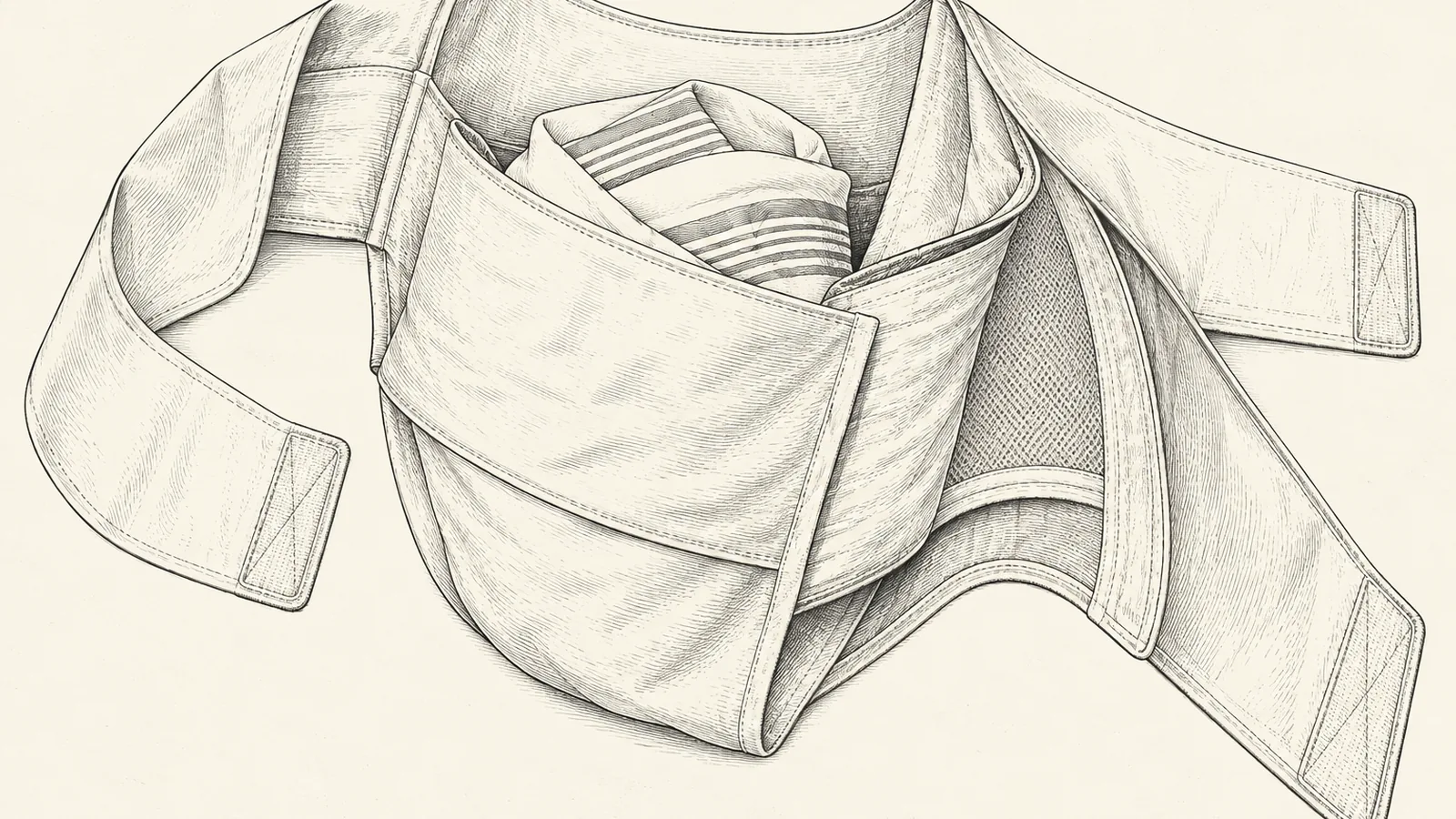
I always filed skin-to-skin contact under nice-but-optional. The photo every new parent posts, the baby curled bare against a mother’s chest, read to me as a bonding ritual: warm, sweet, and medically beside the point. The real medicine, I figured, was for the babies in trouble, the preemies under warming lamps, the one-kilogram fighters. And that split turns out to be exactly the problem. Medicine has proven, hard, that bare skin on a mother’s chest keeps the smallest babies alive, and then it simply never bothered to ask whether an ordinary newborn gets anything out of it at all.
Researchers at three public health facilities in and around Lucknow, in India’s Uttar Pradesh state, have launched a randomized trial to put that question to the test. Published as a protocol in BMJ Open (DOI 10.1136/bmjopen-2026-116601), the study will enroll 516 healthy, full-term singletons, every one of them at least 2,500 grams, and randomly assign half to at least eight hours a day of skin-to-skin contact across the first three days of life, encouraged out to 28 days. The other half get standard newborn care. Bare chest, cap and socks, a blanket over the top, and the clock running.
For the fragile babies, none of this is in question. The landmark, WHO-led trial of immediate kangaroo care found that among newborns weighing 1,000 to 1,800 grams, starting skin-to-skin contact right away cut the risk of death in the first month to 12.0 percent from 15.7 percent, a 25 percent drop, no drug, no device, just a mother’s body doing what it was built to do. That result, run across hospitals in India, Ghana, Nigeria, Malawi and Tanzania and reported by the Karolinska Institutet team behind it, was strong enough to send the WHO back to review its 2015 kangaroo-care guidance, and the trial showed the benefit held even when contact began immediately, before a baby had been stabilized. Settled, proven, cheap.
Which is what I could not stop turning over. If bare skin on a mother’s chest keeps the smallest babies alive, what is it actually doing down at the level of the tissue, and why would that machinery politely switch off the moment a baby crosses some arbitrary line on the scale?
A mother’s chest is not a passive warm surface. It is a live thermostat. Skin sensors pick up the baby’s temperature and the tissue warms or cools to hold the infant in range, and the oxytocin system does the controlling, in slow pulses, triggered by the contact itself. I had to reread this part to believe it: put twins on the chest at once and the two breasts will run at different temperatures, one cooling the baby who is too warm while the other warms the one who is too cold. Lay a single baby there and its heart rate steadies, its breathing settles, its cortisol drops. That same oxytocin surge in the mother is the signal that triggers milk letdown, so the feeding that so often stumbles in the frantic first days gets a biochemical nudge instead of a fight. Newborns normally shed 5 to 10 percent of their body weight in that first week as they learn to feed. The hypothesis here is that a baby held for eight hours loses less of it and claws it back faster, because the whole feeding-and-warming loop is running the way biology wired it rather than the way a hospital ward interrupts it.
So the trial measures the plain, physical stuff. Its primary endpoints are mean percentage weight change at 48 hours, weight-gain velocity over the first 28 days, and breastfeeding quality at day seven, scored on the Bristol Breastfeeding Assessment Tool, where anything below 7 out of 8 counts as moderate-to-poor. The team is betting the extra contact cuts early weight loss by 25 percent, speeds weight gain by 20 percent, and halves poor feeding scores by 50 percent. Downstream they will track exclusive breastfeeding rates, the mother’s confidence in feeding, serious bacterial infections, maternal depression and mother-infant bonding. It is, in other words, testing whether an intervention we reserve for the sickest babies is quietly leaving benefit on the table for everyone else.
I want to be honest about how much of this is still a bet the trial has not earned. It is a protocol, a plan for a study that has not reported a single number, and the researchers’ own line, that a win “could challenge the prevailing paradigm” that kangaroo care is only for vulnerable small babies, is a hypothesis in a press release’s clothing, not a finding. There are real ways it could fall apart. The design is open-label, so nobody is blinded and expectation can leak into a soft outcome like a feeding score. Eligibility runs on birthweight rather than gestational age, which means a clean result would speak most confidently to vaginally delivered, uncomplicated, normal-weight singletons and not necessarily to anyone else. And eight hours a day is a genuine ask of an exhausted new mother, so adherence, not biology, may be the thing that decides whether the numbers move at all.
But notice what is not in this story: a patent, a compound, a company with a stake in the outcome. Nobody books quarterly earnings off a mother holding her baby. My read is that the absence is exactly why a question this obvious sat unasked this long. The apparatus that funds and fast-tracks research is tuned to what can be sold, and a free intervention with no supplier has to wait for a public health team in Uttar Pradesh to care enough to run the trial that no pharmaceutical budget ever would. That the smallest babies got studied first and the healthy majority got skipped tells you less about the biology than about who writes the checks.
I will watch for the readout, and I am genuinely curious whether the effect holds when the baby is not fragile. But I am not waiting on a p-value to decide what I would do. If I have a baby, I already know I am doing the eight hours. The downside is a blanket and a sore back. The upside might be the best-evidenced free thing modern medicine has spent decades reserving only for the babies it decided needed it most.
Sources
- News-Medical: kangaroo care for normal-birthweight babies, new randomized trial (BMJ Open protocol, 2026)
- PubMed: WHO Immediate Kangaroo Mother Care Study Group, low-birth-weight survival trial (2021)
- Karolinska Institutet: immediate skin-to-skin contact after birth improves newborn survival
- Frontiers in Psychology: skin-to-skin contact and the oxytocin system (2024)