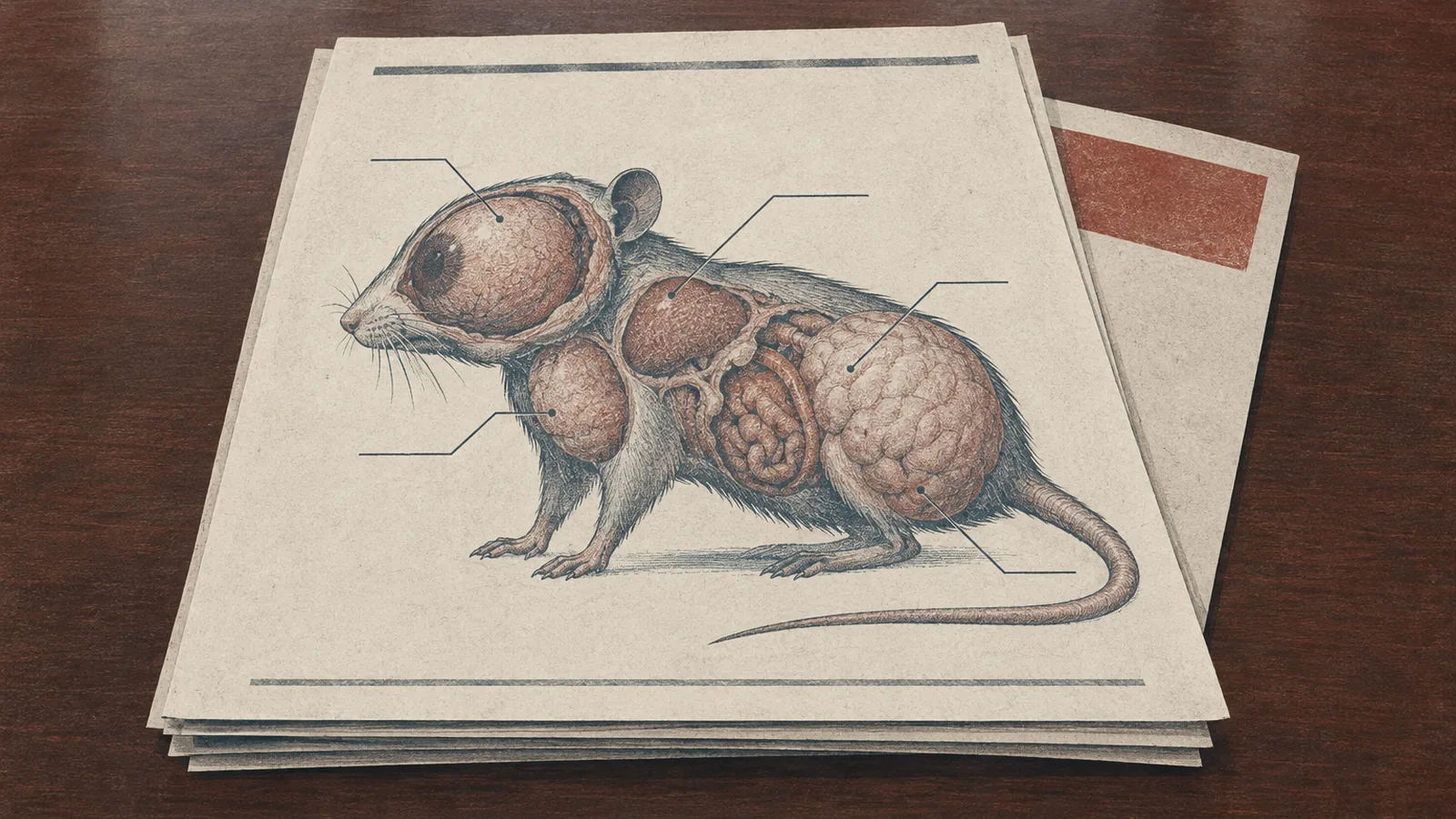
In February 2024, a paper appeared in Frontiers in Cell and Developmental Biology with a diagram of a rat. The animal sat facing the reader, equipped with a set of genitals larger than the rest of it, rendered in the soft, over-lit gloss of an image generator. The labels pointing to its anatomy were not words. They read “dissilced,” “testtomcels,” “iollotte sserotgomar.” A cell-signaling figure elsewhere in the paper was a smear of arrows connecting nothing to nothing. The authors had disclosed that the images came from Midjourney. Reviewers at a journal that markets itself on rigor passed it anyway. The study survived contact with the internet for three days before Elisabeth Bik and other researchers flagged it and Frontiers retracted it.
The rat was funny. That was the problem. It was funny because it was obvious, and the obvious fakes are the last generation, not the next. Bik, a Dutch microbiologist who left the lab a decade ago to spend her days staring at published images until the duplicated pixels and cloned Western blots give themselves away, built a global reputation on catching fraud with nothing but her eyes and a monitor. This week she put it plainly. “We are at a point now,” she told an audience, in a line MedPage Today ran as its quote of the week, “that we cannot distinguish fake from real.”
The guarantee is the entire product
Here is the framing everyone absorbs by osmosis: peer-reviewed research is the gold standard. When a public-health official tells you to trust the science, when a journal wraps a finding in the authority of Nature or Cell or a Wiley imprint, the implied guarantee is that qualified strangers checked the work before it entered the permanent record. That guarantee is the entire product. It is what universities buy, what governments cite, what the establishment invokes when it wants to end an argument.
The record shows the guarantee is failing, and the people closest to it have stopped pretending otherwise.
Start with the raw count. In 2023, journals retracted more than 10,000 papers, a single-year record that shattered every prior mark, and biomedical retractions have roughly quadrupled over two decades. Retraction is the system’s immune response, and a spiking count can mean the immune system is finally working. It can also mean the infection is outrunning it. Bik’s read is the second one. She has warned that generative AI is now fabricating research data “on an industrial scale,” growing faster than anyone’s ability to flag it.
The fakes beat the experts two times in three
The strongest evidence for that claim is not an opinion. It is a test. A team led by Rongshan Yu at Xiamen University generated deepfake versions of the images that underpin cancer and molecular-biology papers, the Western blots and cancer-tissue panels reviewers are supposed to scrutinize, then showed them to specialists. 2 of every 3 biomedical experts could not tell the AI-generated images from authentic ones. These were not casual readers. They were the people whose expertise is the last line of defense. The fakes walked past them.
| Measure | Part | Whole |
|---|---|---|
| experts | 2 | 3 |
That is the mechanism behind Bik’s own summary, posted with a bluntness that has not aged in the wrong direction: “AI can be used to make convincing looking fake data. There is no way we can distinguish real from fake anymore. It is safe to assume that genAI has already resulted in many fake papers. Scientific publishing is not prepared for this.”
The demonstration does not estimate how many published papers are fakes. No one has that number, because the whole problem is that they are, by design, unmeasurable. What it shows is narrower and worse: the human check the system sells as its safeguard failed most of the time, against a tool that only keeps improving.
Who profits from the assembly line
The fakes did not need AI to get inside. They were invited. For years the growth engine of scholarly publishing has been volume, and the paper mill, an operation that sells authorship on fabricated studies the way a print shop sells business cards, met that demand precisely.
Consider Hindawi, the open-access publisher Wiley acquired in 2021. Its “special issues,” lightly supervised collections that could be spun up at speed, became a conduit for mill-produced papers on a scale that eventually forced Wiley to retract more than 11,300 articles and shut 19 journals, then retire the Hindawi name entirely. The mills exploited the system. The system had been built to be exploited, because volume was the business model and scrutiny was the cost center.
The “trust the science” reflex never accounts for this. The literature is not a neutral archive kept by disinterested monks. It is a commercial product sold at enormous margin by a handful of conglomerates, and for two decades their incentive has run one way: publish more, faster, with peer review supplied free by unpaid academics who have less time every year. Into that machine walks a technology that manufactures plausible fraud at no marginal cost.
The reviewers were supposed to be the wall. They turned out to be a turnstile.
None of this means every study is suspect, or that a reader should throw out the finding along with the fraud. It means the burden of proof has quietly shifted, and no one announced it. The presumption that “peer-reviewed” equals “checked by someone competent” was always carrying more than it could bear, and AI has removed the floor beneath it. When the next official pronouncement arrives dressed in the authority of the published record, the honest question is no longer whether the science says so. It is whether anyone actually looked, and whether they could have told the difference if they had.
Bik does this work on her own, outside any lab or publisher. Wiley, tallying the damage from the papers it had sold the world as authoritative, measured it the way institutions measure the losses they truly feel: it reported an $18 million decline in research-publishing revenue and pinned it on the Hindawi disruption. The retractions, it did not measure in trust.
Sources
- Chemistry World: AI-generated images could make it almost impossible to detect fake papers
- Nature: More than 10,000 research papers were retracted in 2023, a new record
- MedPage Today: “We Cannot Distinguish Fake From Real”
- Elisabeth Bik (@MicrobiomDigest): there is no way we can distinguish real from fake anymore
- The Register: Wiley shuts 19 journals amid AI paper mill problems
- Katina Magazine: what the collapse of Hindawi reveals about systemic risk
- Nature: biomedical paper retractions have quadrupled in 20 years
- Science Integrity Digest: the rat with botched AI-generated images, and how Frontiers published it
- STAT: Elisabeth Bik tackles research misconduct