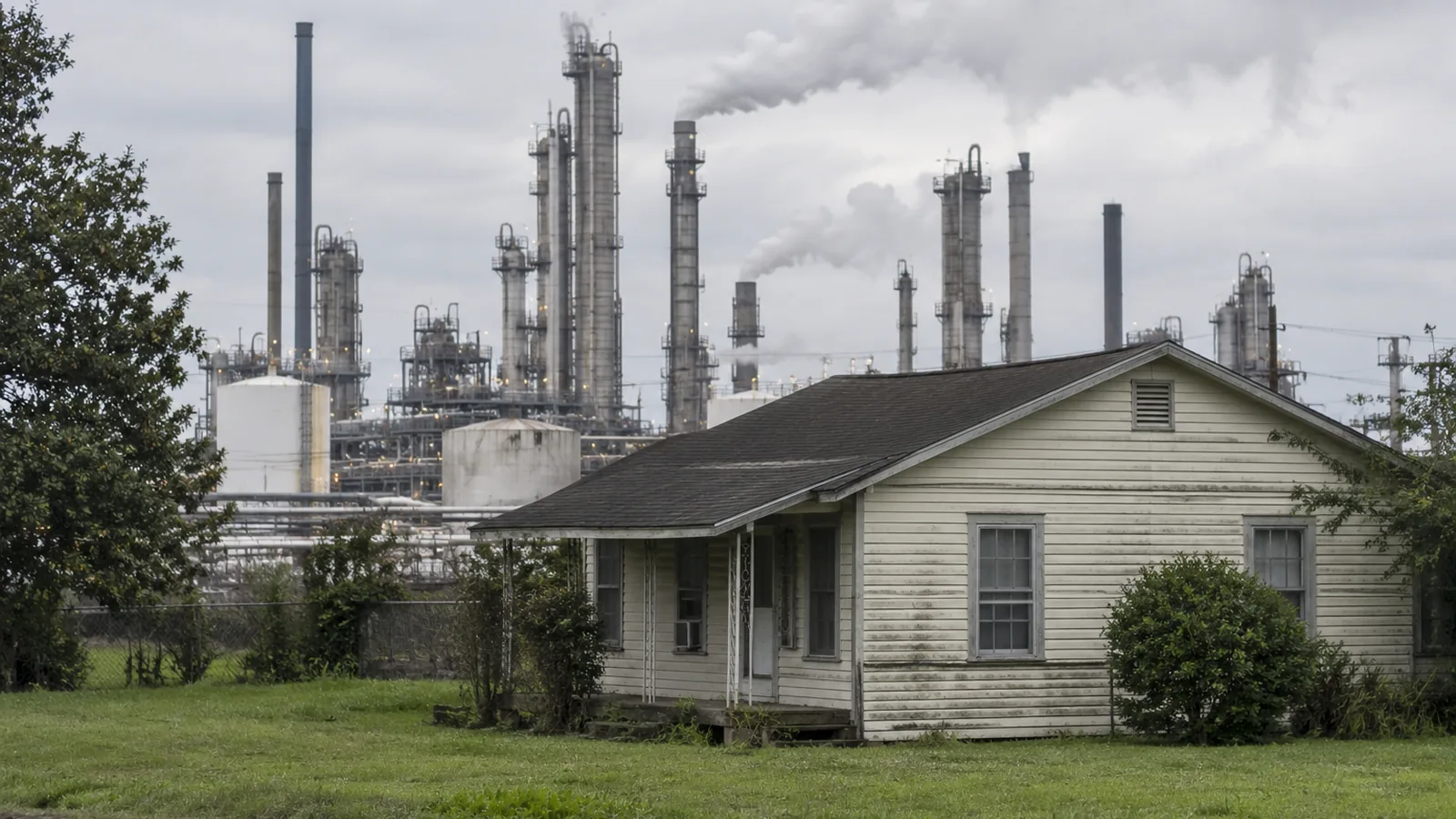
Almost all the pregnancy advice I’ve read over the years is about choices: the folate, the coffee, the soft cheese, the glass of wine. Reading a new paper out of Louisiana, I kept coming back to a question none of that advice touches. What if one of the exposures that counts in a first trimester comes with your address, not your grocery list?
In the river parishes of southeast Louisiana, the petrochemical corridor people there call Cancer Alley, mothers without private insurance who lived in the most heavily polluted air had 4.29 times the odds of having a baby with a congenital heart defect (95% CI 1.85 to 9.91) compared with mothers in the least polluted air, according to a case–control study published in Environmental Health. Mothers in the broad middle band of exposure had 3.09 times the odds (1.35 to 7.12), per the published summary of the results.
| Result | Value (OR) | Lower bound | Upper bound |
|---|---|---|---|
| Highest vs lowest exposure | 4.29 | 1.85 | 9.91 |
| Middle vs lowest exposure | 3.09 | 1.35 | 7.12 |
The researchers took 454 infants born with heart defects between 2018 and 2021 in the three state health regions spanning Baton Rouge, New Orleans and the river parishes between them, and compared them with 1,362 babies born without one, matched on race, insurance status and gestational timing. For each mother’s address they ran the EPA’s Risk-Screening Environmental Indicators model at its finest resolution, which estimates how much of 20 developmental toxicants from nearby industrial facilities lands at a given spot and weights each one by how toxic it is to a developing body. The top quarter of modeled exposure counted as high and the bottom tenth as low. The strongest numbers came from an analysis restricted to mothers without private insurance, which the authors ran so insurance status couldn’t muddy the comparison. These are modeled numbers, built from what facilities report releasing, not anything measured in a mother’s lungs, so the model can’t see where she commuted, what was burning in her kitchen or how hard she was breathing.
Severe defects carried the signal. Mild defects showed a much weaker pattern, and so did septal defects, the only subtype with enough cases to analyze on its own. Among the chemicals, benzene and formaldehyde had the highest toxicity-weighted modeled concentrations, and both were tied to higher odds of a heart defect, as was toluene; the other 17 toxicants, taken together, carried a significant association too. Until this paper, nobody had studied heart defects and pollution in Louisiana at all, in a state that has lined its river with refineries and chemical plants for generations.
I expected noise
I’ll admit where I started. Air pollution and birth defects is a field full of studies that lean the same way without quite landing, and I assumed this would be one more. The best-known American look at solvents and the fetal heart, a National Birth Defects Prevention Study analysis of 2,047 mothers of babies with heart defects, found nothing for aromatic solvents, the class that includes benzene: an odds ratio of 1.1 for any heart defect, with an interval running from 0.8 to 1.6. That study measured something different, though. It reconstructed workplace exposure from mothers’ telephone interviews about their jobs, reviewed by industrial hygienists, rather than modeling emissions at a home address. It doesn’t cancel the Louisiana result, and the Louisiana result doesn’t cancel it.
What shifted me was where the numbers sat. Both estimates land far above 1, the middle group at about threefold and the top at about fourfold, and the chemicals that rose to the top are the ones toxicologists already lose sleep over. The intervals are wide and they overlap, so I wouldn’t read the step from three to four as precise; a few hundred cases only buy so much certainty. The direction held anyway. And benzene has shown up in this early window before. A Texas registry study in Environmental Health Perspectives found that mothers in the census tracts with the most benzene in the air had 2.30 times the odds of a baby with spina bifida (1.22 to 4.33). That’s a different defect in a different state, so it’s context rather than confirmation, but it’s the same chemical linked to a structure that forms in the first weeks of pregnancy.
A heart built before anyone knows
This is where I had to put the paper down. Wait, why would a molecule drifting off a stack in St. James Parish have anything to do with a heart that isn’t fully a heart yet?
Timing, mostly. The heart builds itself from a simple tube of cells that loops, folds and walls itself off into chambers and valves, and a 2018 review of environmental contaminants and heart defects calls gestational weeks 3 through 8 the most vulnerable period, while noting the job still isn’t finished at week 8. Plenty of women spend part of that stretch not knowing they’re pregnant. If something in the air of her bedroom does reach the embryo, it gets there while nobody is watching.
The mechanisms on the table are proposals, not things anyone observed in these babies. The review lists a surge of reactive oxygen species, mitochondria producing less energy, inflammatory signaling and embryonic hypoxia, an embryo running short on oxygen. For benzene and formaldehyde specifically, the study authors point to oxidative stress, impaired cell proliferation and epigenetic disruption. Picture cells that have to divide on a strict schedule to seal off a ventricle, slowed or knocked off course in exactly the wrong week. Get that wrong and you can end up with a hole, a misrouted vessel or an undersized chamber.
Nobody gets to wave this off as a niche question. About 30% of heart defects trace to chromosomal, single-gene or other known causes, and for the remaining 70% the cause is unknown. The CDC counts heart defects in nearly 1% of US births, about 40,000 babies a year, and roughly one in four of those defects is critical. Of the babies born with a critical defect, about 75% are expected to reach their first birthday.
| Measure | Share |
|---|---|
| of congenital heart defects | 70% |
Who breathes it
One detail looks technical and isn’t. Among privately insured families, the odds came out comparatively low. The authors offer two explanations: privately insured families are less likely to live in the most polluted zones to begin with, and records-based surveillance misses more of the milder defects, which dilutes any association. They lean on the second. Either way, the analysis that held up was the one about families without private insurance, who generally have the least room to pick up and move.
That pattern runs through what’s known about this corridor. A 2026 systematic review of 53 studies on industrial pollution and health in Louisiana found that Black and lower-income residents are exposed to more industrial activity than white and higher-income residents, with one analysis of state environmental data putting emissions in communities of color at 7 to 21 times those in predominantly white ones. The review also flagged three of the 53 studies for petrochemical industry ties, and two of those three reported null findings. Keep that in mind the next time someone tells you the evidence here is mixed.
The new paper’s lead author, Kimberly Terrell, has been building this case for years. Her 2024 study in Environmental Research: Health found that babies in Louisiana’s most polluted census tracts had a 36% higher risk of low birthweight and a 25% higher risk of preterm birth than babies in the least polluted ones, and estimated that about 2,166 low-birthweight and 3,583 preterm births a year were attributable to that pollution.
In spring 2025, after her work drew attention at Tulane Day at the state Capitol, her dean told her that outside communications not tied to client work would need pre-approval. Terrell called it a gag order and resigned from Tulane’s Environmental Law Clinic, alleging the university had put state funding for its Charity Hospital project ahead of her academic freedom. Tulane disputed her account. A spokesperson for Governor Jeff Landry said he never threatened to withhold funding, and that the governor’s office appreciated Tulane “standing up for our Louisiana businesses and jobs.”
Set that line next to a study about babies’ hearts. When a governor’s office responds to research on birth outcomes by thanking a university for defending business, I read an administration that hears the plants louder than the parishes. I don’t care which party the governor belongs to. Putting American families first means a pregnant woman in St. James Parish outranks a facility’s permit, and nobody gets a pass on that for being on the right team.
The study that would settle much of this isn’t hard to design: monitors in the homes of pregnant women along that river, running through weeks 3 to 8, recording what they actually breathe instead of what a model infers from facility reports. Louisiana’s health department could pay for it, and so could the EPA. Until one of them does, “we don’t know what causes most heart defects” can’t double as a reason to stop asking.
If I were pregnant and living along that corridor, I’d look up every facility reporting releases near my address in the EPA’s Toxics Release Inventory before my first prenatal visit, and I’d bring the list with me.
Sources
- Environmental Health: Terrell et al., Maternal exposure to industrial air pollution and congenital heart defects, a case–control study (2026)
- Scienmag/Bioengineer: Industrial air pollution in Louisiana’s chemical corridor linked to higher odds of severe infant heart defects (2026)
- Environmental Research: Health: Terrell et al., toxic air pollution, low birthweight and preterm birth in Louisiana (2024)
- Systematic review: industrial pollution and health in Louisiana, 53 studies (2026)
- Environmental Health Perspectives: Lupo et al., maternal exposure to ambient benzene and neural tube defects, Texas 1999–2004 (2011)
- Occupational and Environmental Medicine: Gilboa et al., maternal occupational solvent exposure and congenital heart defects (2012)
- International Journal of Environmental Research and Public Health: Nicoll, environmental contaminants and congenital heart defects (2018)
- CDC: Data and statistics on congenital heart defects
- TaxProf Blog: Tulane law clinician resigns, says university gag order censored her pollution research (2025)