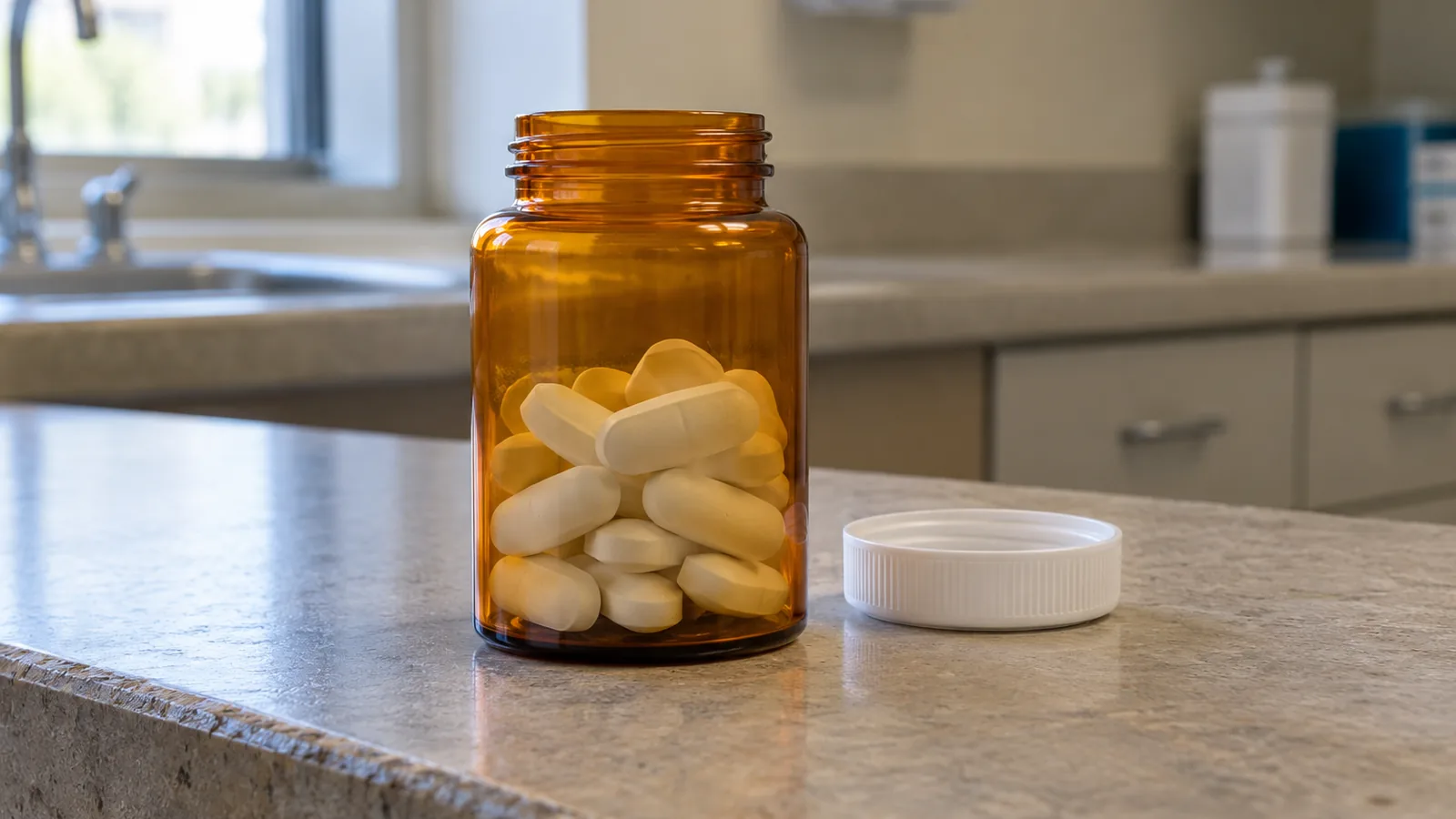
Ed Waldner was 55 when the exhaustion set in, the kind that arrived no matter how light his day had been. The cause turned out to be glioblastoma, the brain cancer oncologists dread most, and these days Waldner says he feels very good and is especially grateful when his routine scans come back with one word attached: stable. For a disease whose median survival runs roughly 12 to 18 months, that word carries a great deal of weight. Waldner is enrolled in a University of Calgary trial whose experimental ingredient didn’t come out of a biotech pipeline. It is niacin, vitamin B3, the compound cardiologists used to hand out for cholesterol and health-food stores still stock by the bottle.
The interim results, published in the Journal of Neuro-Oncology late last year and only now reaching a wider audience, report that newly diagnosed patients given high-dose controlled-release niacin on top of standard radiation and chemotherapy had a six-month progression-free rate of 82 percent. Gloria Roldan Urgoiti, the oncologist leading the study, supplied the context that gives the number its edge: survival for this cancer “hasn’t changed significantly for 20 years.” Her patients still get the same backbone treatment, radiation plus the chemotherapy drug temozolomide, known as the Stupp protocol, and that is the yardstick the trial was built to beat.
According to the Calgary team’s paper, the phase II portion enrolled 29 patients, and 24 of them got far enough to be judged at the six-month mark. On central radiology review, the six-month progression-free rate came in at 82.3 percent. The historical benchmark for the Stupp protocol alone is 53.9 percent, and the investigators decided in advance that the trial would count as a success only if niacin lifted that figure to 73.9 percent. It cleared the bar by more than eight points, landing 28.4 percentage points above the benchmark, and the interim analysis put the conditional power above 93 percent.
| Group | Value (percent) |
|---|---|
| Stupp benchmark | 53.9 |
| Preset success bar | 73.9 |
| Niacin trial | 82.3 |
The idea started in the laboratory of co-investigator V. Wee Yong, where mouse experiments found that niacin extended survival. The proposed mechanism is the immune system, specifically the immune cells a glioblastoma spends its energy suppressing. “Niacin treatment rejuvenates immune cells so they can do what they are supposed to do,” Yong said.
Grant agencies paid for this trial. No drug company did. The money came from the Canadian Institutes of Health Research and the Alberta Cancer Foundation, and the niacin itself, a controlled-release product called NiacinCRT, was bought from the supplement maker Designs For Health at the public price, with no contract and no company input into the design or the analysis. There is no new molecule here for a sponsor to patent and price, only a very old vitamin in a time-release formulation, which goes a long way toward explaining why the people testing it are working on grant money. It also explains why the trial is the size of a classroom. Studies built on goodwill and public grants rarely get the money to grow.
So the caveats come with the territory, and some of them are self-inflicted. Twenty-four evaluable patients, one arm, no concurrent control group: the 53.9 percent comparison comes from historical data, not from patients enrolled alongside Waldner. The version of the paper posted to Research Square reports a 95 percent confidence interval of 82.14 to 82.46 around the headline rate. That is an interval about a third of a percentage point wide, drawn around two dozen patients, in a trial where a single patient’s outcome moves the rate by roughly 4 points. The same document gives phase II enrollment as 29 in one section and 38 in another, and says four patients came off niacin for toxicity while itemizing three. None of that erases the signal. It is bookkeeping the final analysis will have to clean up before anyone outside Calgary takes the decimal places at face value.
The safety record deserves the same plain reading. The dose-finding phase settled on 2,000 milligrams a day after both dose-limiting toxicities turned up at 2,500: a grade 3 drop in platelets, and grade 3 nausea with elevated bilirubin that required hospital admission. In phase II, niacin was stopped over a liver-enzyme elevation, a severe platelet drop and a fall in neutrophils. At these doses the vitamin behaves like a drug, and the researchers say flatly that high-dose niacin should not be considered harmless just because it sits on a store shelf.
What the trial has so far is a signal strong enough to justify finishing it. Median progression-free survival in the niacin arm was 10 months and median overall survival was 17 months, with 77.5 percent of patients alive at one year. Dr. Marc Siegel, who was not involved in the study, told Fox News Digital that B vitamins, niacin especially, “are underrecognized as immune boosters,” and offered a measured forecast: “There probably will end up being a small impact here, so this is useful information, though clearly not a cure.” Enrollment is meant to reach 48 patients, with the final analysis due at the end of 2026 or early 2027.
Roldan Urgoiti has no sponsor to please and a six-month number most glioblastoma investigators would frame and hang on the wall. Her public comment on it reads like a line from the procedure manual: “Anything that may help should be explored, but it requires strict protocols and safety monitoring.” In a field that has spent twenty years waiting for good news, the most careful voice in the room belongs to the person holding the good result.
Sources
- Roldan Urgoiti et al., phase I-II niacin study in glioblastoma (Research Square)
- Journal of Neuro-Oncology record, Roldan Urgoiti et al., 2025
- ScienceDaily, This common vitamin could help fight one of the deadliest brain cancers
- Fox News, Aggressive brain cancer may respond to high-dose vitamin therapy, study suggests