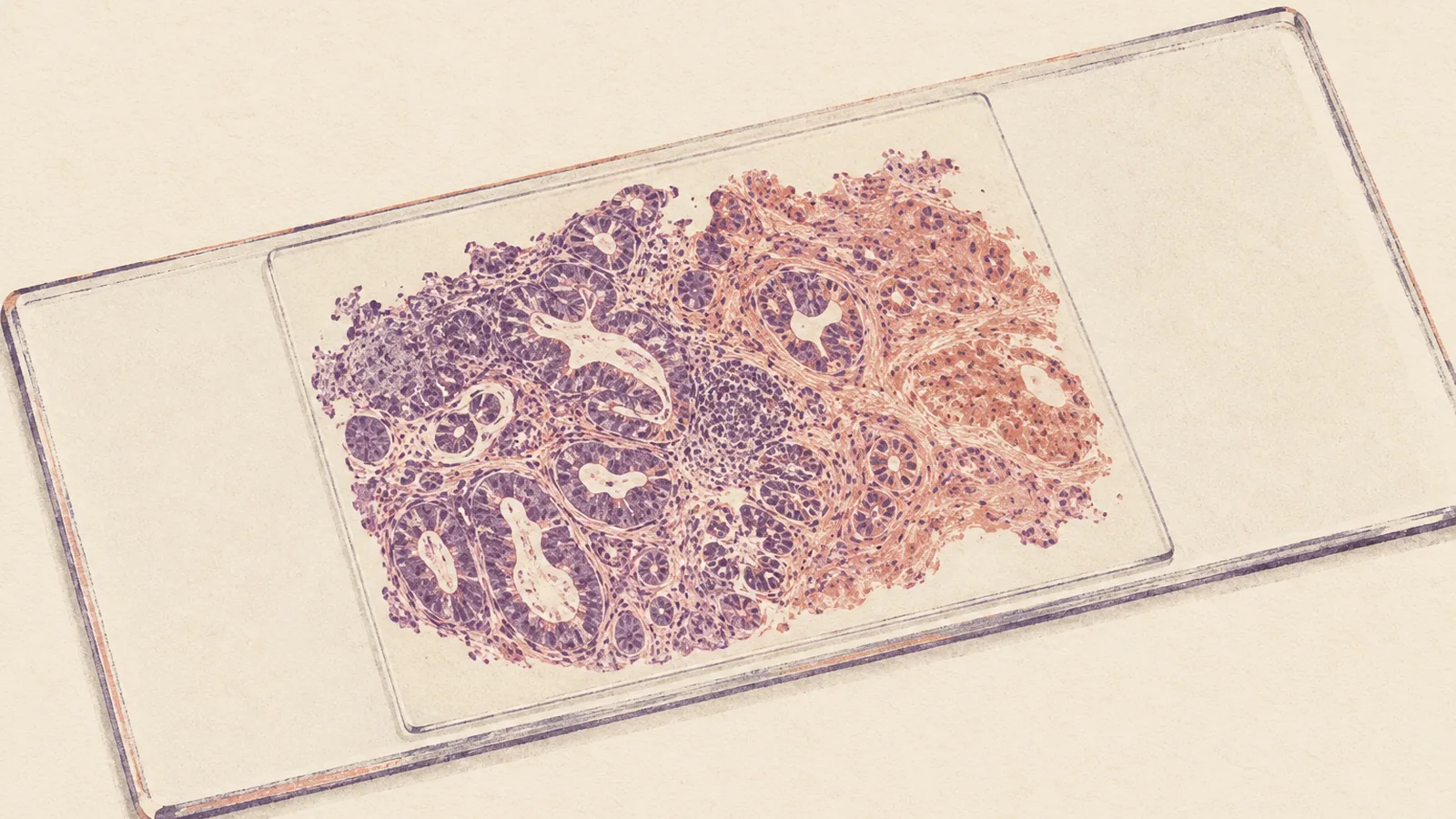
On October 13, Despoina Kalfakakou, the lead investigator on a new paper out of NYU Langone, described her team’s work as “the most granular view to date of pancreatic ductal adenocarcinoma,” in NYU’s announcement. It is the sort of line every lab writes, and in this case it is hard to argue with. Working with co-senior investigators Aristotelis Tsirigos at NYU and Diane Simeone at UC San Diego, the group read the gene activity of 443,451 individual cells from 62 primary tumors, according to the paper in Nature Genetics, and laid 53,236 spots of spatial data across 11 of those tumors, which records not just what a cell is doing but where in the tissue it is doing it. The announcements couldn’t quite settle on how many people that represented (NYU said 56 patients, a UC San Diego account carried by KPBS said 59), which is a small thing, and a reminder that the press version of a study is a separate document from the study.
What the census found is that a pancreatic tumor is rarely one thing. Each held somewhere between two and 11 genetically distinct clones, populations of cancer cells sharing a common makeup, sitting side by side and heading in different directions. “Our work shows that within a single tumor, different clones are evolving in parallel, taking on different identities,” Simeone said, as reported by KPBS. The identities in question are the two subtypes oncologists have leaned on for most of a decade, a “classical” form and a more aggressive “basal” one, and the team’s earlier preprint describes them as a gradient running across clones rather than two clean bins.
Those bins have been doing quiet work in the clinic. In the Canadian COMPASS trial, which sequenced the advanced tumors of 150 patients before their first chemotherapy, patients with classical tumors on modified FOLFIRINOX went a median 7.17 months before their disease progressed, while patients with basal-like tumors on the same four-drug regimen went 2.50 months, results presented at the 2019 Gastrointestinal Cancers Symposium showed. Median survival on that regimen split 10.1 months against 5.3. On gemcitabine plus nab-paclitaxel, the other standard option, the trial detected no significant difference in progression at all. Dr. Knox, who presented the data, said the basal-like group “may be particularly resistant to mFOLFIRINOX,” and was careful to add that the markers still needed validation before anyone used them to pick a drug.
A map of clones complicates that sorting in a specific way. A biopsy labeled classical samples one corner of a tumor that may be carrying basal clones somewhere else, and the clones that worried the researchers most were the ones that had scattered through the tissue. Those dispersed clones showed epithelial-to-mesenchymal transition, the program cells switch on when they prepare to migrate, along with suppressed immune activity; the authors associated them with metastasis and lymph node colonization, and found they tended to drift toward the basal state.
One route into that basal state ran through DNA. The paper links focal amplification of MYC, a growth-driving gene on chromosome 8q24, to classical-to-basal transitions inside tumor lineages and to weakened immune-response programs, and the team confirmed the amplification by FISH in two tumors. When they knocked MYC down in mouse and primary human models, the classical programs came back and so did the immune pathways. The preprint’s own abstract calls this transition rare.
The closest the study came to watching treatment at work was six tumors sampled both before and after chemotherapy. The paper’s extended data sorts their clones into those the drugs eradicated, those that survived, expanded or shrank, and new ones that appeared afterward. It is a glimpse of selection happening inside a person, and it is six tumors.
That is the evidence under the headline ScienceDaily ran twelve days after the paper: “Scientists discover how pancreatic cancer rewrites its DNA to escape treatment,” closing on “a potential new way to fight the deadly disease.” The DNA half holds up better than it sounds, since an amplified MYC gene is a genomic change. The rest stretches. A transition the authors themselves call rare became the cancer’s general strategy, six paired samples became escape from treatment, and a knockdown in laboratory models became a way to fight the disease.
The immune finding is where the stretch starts to matter, because it points at a drug. NYU’s release says some clones showed heightened TIGIT activity alongside suppressed PD1, which may help explain why PD-1 immunotherapies so rarely work in pancreatic cancer. In the paper, the TIGIT evidence on display is an interaction: tumor cells carrying NECTIN2, a molecule TIGIT binds, sitting next to TIGIT-positive T cells in a tumor with copy-number changes. TIGIT is a brake on those T cells, so the picture is of clones that may be pressing it. ScienceDaily’s account adds that clinical trials of drugs inhibiting MYC or TIGIT are already underway.
TIGIT has been tried before, by one of the deepest-pocketed companies in oncology. Roche discontinued its anti-TIGIT antibody tiragolumab in July 2025, and at ESMO 2025 it laid out the results. In first-line liver cancer, adding tiragolumab to atezolizumab and bevacizumab moved median progression-free survival from 8.2 months to 8.3, a hazard ratio of 0.97. In the esophageal SKYSCRAPER-07 trial, the combination posted a median progression-free survival of 20.8 months against 29.1 for atezolizumab alone, while adding toxicity. MedPath noted that Merck’s and GSK’s TIGIT antibodies were absent from ESMO’s presentations that year and that AstraZeneca, with a bispecific, was the most prominent company still invested. None of those trials enrolled pancreatic patients, so they settle nothing about TIGIT in this disease. They do establish what the mechanism has cost so far, and why a tissue map showing TIGIT-positive cells near certain clones is a reason to ask which patients might respond, not a reason to expect the next antibody to succeed where Roche’s failed.
| Group | Value (months median PFS) |
|---|---|
| Atezolizumab + bevacizumab | 8.2 |
| Plus tiragolumab | 8.3 |
MYC has the opposite history. It spent decades on the list of targets nobody could drug, and the first direct inhibitor to reach people, Peptomyc’s OMO-103, has a thin start. In its first-in-human trial, published in Nature Medicine in February 2024, 22 patients with advanced solid tumors enrolled, and eight of the 12 scanned at nine weeks had stable disease. One pancreatic cancer patient, treated in the fourth line and kept on the drug for more than six months, showed 8 percent tumor shrinkage, an 83 percent drop in circulating tumor DNA and a 49 percent reduction in total disease volume, the shrinkage and volume figures coming from different radiographic measurements. That is one patient. The follow-up phase 1b study in pancreatic cancer, NCT06059001, pairs OMO-103 with standard care; ClinicalTrials.gov lists it as active, not recruiting, with no results posted.
The disease leaves little room for any of this to be oversold. The five-year survival rate for pancreatic cancer was reported at 13 percent for the third straight year in the American Cancer Society’s 2026 figures, as relayed by the Pancreatic Cancer Action Network, with 52,740 Americans expected to die of it this year.
Simeone’s comments on the paper, as KPBS carried them, end with the line that “Moores Cancer Center is redefining what’s possible in pancreatic cancer.” Her team’s map has changed what the disease looks like under the microscope. The survival figure, three years running, has stayed exactly where it was.
Sources
- Nature Genetics: Kalfakakou et al., “Clonal heterogeneity in human pancreatic ductal adenocarcinoma and its impact on tumor progression” (October 13, 2026)
- NYU Langone Health: “Continuously evolving cells help pancreatic cancer evade treatment and spread” (October 2026)
- bioRxiv: Clonal heterogeneity in human pancreatic ductal adenocarcinoma, preprint (February 2025)
- The Hospitalist: COMPASS trial, expression signature linked to chemoresistance (2019)
- MedPath: Roche presents complete TIGIT failure data at ESMO 2025
- Peptomyc: first MYC inhibitor OMO-103 phase 1 results (February 2024)
- ClinicalTrials.gov: NCT06059001, OMO-103 phase 1b in pancreatic ductal adenocarcinoma
- Pancreatic Cancer Action Network: five-year survival stalled at 13% (January 13, 2026)
- KPBS: UC San Diego-led study finds how pancreatic cancer cells can change genetic makeup (October 13, 2026)
- ScienceDaily: “Scientists discover how pancreatic cancer rewrites its DNA to escape treatment” (October 25, 2026)