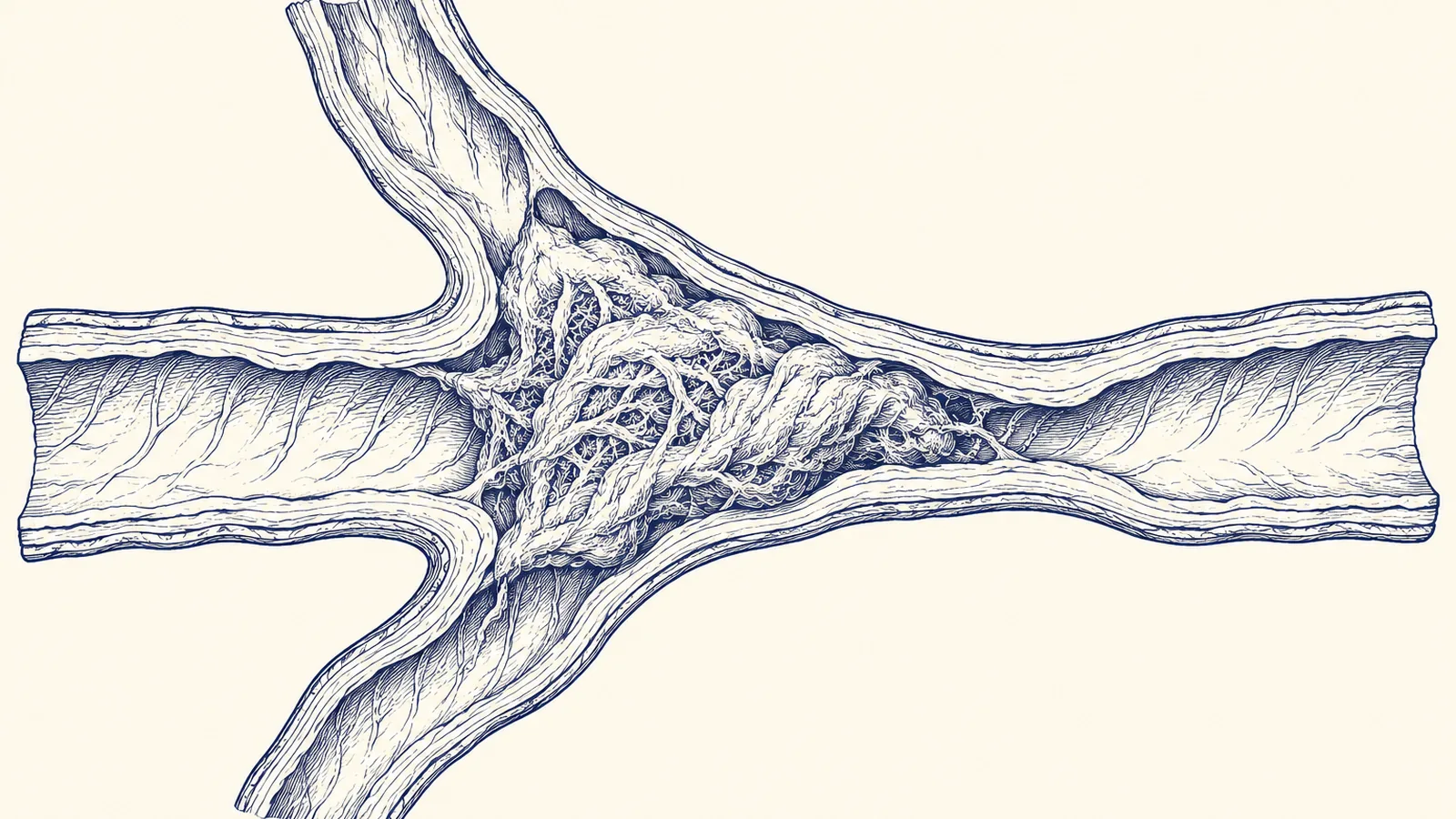
In April 2021, American regulators stopped the Johnson & Johnson vaccine over six cases in women aged 18 to 48, out of roughly 7 million doses. The clots were in the large veins that drain the brain, and they came with an odd laboratory signature: the women were clotting while their platelet counts fell. By the time the pause was lifted on April 23, the CDC had reviewed 15 such cases among more than 6.8 million doses and warned that the syndrome could also strike the large blood vessels of the abdomen.
The syndrome got a name, vaccine-induced immune thrombotic thrombocytopenia, or VITT, and a mechanism. The body makes antibodies against platelet factor 4, a protein the platelets carry, and those antibodies switch the platelets on, so they get used up building clots and the count drops. Across published VITT series, 19 percent of patients had clots in the splanchnic veins, the portal and mesenteric vessels that carry blood from the intestine to the liver, and 91 percent tested positive for the anti-PF4 antibody, according to figures compiled in a 2024 case report in the Journal of Medical Case Reports. That definition fit the adenovirus vaccines from AstraZeneca and J&J, and the story the public was told followed from it: the vector vaccines had a clot problem, and Pfizer and Moderna did not.
A definition built around one mechanism is very good at finding that mechanism. It says nothing about a different one. And the abdominal clots doctors keep describing after mRNA shots look different.
The accumulated findings strongly implicated COVID-19 vaccine as the cause of our patient's SMV thrombosis
An 80-year-old on his fifth dose
The Japanese patient in that 2024 report, written by Keita Suto and four colleagues, was an 80-year-old man who had already had four Pfizer doses and was receiving his first Moderna dose, his fifth mRNA injection overall. Six days later he arrived with a clot in the superior mesenteric vein that extended into the portal vein, a swollen small bowel and fluid in his abdomen. His D-dimer, a marker of clot breakdown, was 19.8 micrograms per milliliter, where the lab’s normal range stops at 1.0 micrograms per milliliter. His platelets were 113,000 per microliter, just under the lab’s floor of 120,000, which is a far cry from the collapse that defines VITT. His anti-PF4 test was negative, and his protein C, protein S and antiphospholipid tests were unremarkable. Heparin and then apixaban dissolved the clot almost completely by 45 days after discharge.
| Measure | Value |
|---|---|
| patient, six days after his Moderna dose | 19.8 micrograms per milliliter |
| top of the lab's normal range | 1.0 micrograms per milliliter |
His doctors did not hedge. “The accumulated findings strongly implicated COVID-19 vaccine as the cause of our patient’s SMV thrombosis,” they wrote, while acknowledging that the relationship between mRNA vaccines and VITT itself is unknown.
Two years earlier, in July 2022, physicians writing in IDCases had described a 51-year-old man whose severe upper abdominal pain began one day after his first Moderna dose. Imaging found a clot in his main portal vein and his superior mesenteric vein. His platelets ran between 121,000 and 153,000 per microliter during the admission, the same range his records showed back in 2019, before any vaccine existed. The usual inherited and acquired clotting disorders came back clean: factor V Leiden, the prothrombin gene mutation, proteins C and S, antiphospholipid antibodies. One antithrombin reading was low and the repeat was normal. The anti-PF4 antibody was never tested at all. The authors wrote that the case “did not meet the diagnostic criteria for VITT,” that a clot within a day of vaccination “is not typical for an autoimmune phenomenon,” and that “whether there is indeed some other mechanism, as depicted in our case, needs further investigation.”
This week TrialSite News ran a report of another such case under a headline that carries its own disclaimer: “causation remains unproven.” That is true of any single patient, and it was true of the J&J women in 2021 too. What turned those six cases into a recognized syndrome was a mechanism people went looking for. The mRNA cases have so far produced a “needs further investigation” and not much investigating.
These are dangerous clots to wave off. In acute mesenteric venous thrombosis, the bowel dies in about 30 percent of patients, and roughly 20 percent of those die within 30 days, according to the literature Suto’s team cites. Their table of six earlier splanchnic clots after vaccination, all after AstraZeneca’s shot, lists three deaths. Six hand-picked case reports can’t give anyone a fatality rate, but they do show how these clots end when nobody catches them in time.
A negative test is not an alibi
The objection deserves a straight answer. The Japanese man was 80, had a body-mass index of 33 and had prostate cancer under surveillance, and cancer raises clot risk. The American man was obese and diabetic, and his liver looked fatty with a nodular contour on CT. Doctors were finding portal vein clots in men like these long before 2021.
That’s exactly why the testing matters. The VITT criteria answer one narrow question, whether this is the antibody-driven platelet collapse that followed the adenovirus vaccines. A patient whose platelets never collapse fails those criteria automatically, and the 2022 patient failed them without anyone running the antibody test. Failing VITT criteria rules out one mechanism. It doesn’t clear the shot, and his own doctors said as much when they asked for other mechanisms to be studied.
Then they closed the same paper by writing that “we certainly do believe that the benefits of vaccine outweigh overall risk.” A case report can’t measure overall risk; the paper had just finished saying the mechanism was unknown. The sentence is there because medical journals had come to expect it at the end of any vaccine safety report, and that habit is part of why these signals rarely get followed up.
When institutions want reassurance, they reach for population studies, and those deserve the same scrutiny. The best known on this question is a self-controlled case series from New Zealand, published in Thrombosis Research in December 2022. It covered hospitalizations from February 2021 to February 2022 and counted admissions in the 21 days after Pfizer doses. It found 272 splanchnic thrombosis admissions, 26 of them inside the risk window, for an incidence rate ratio of 0.71 (95 percent confidence interval 0.43 to 1.16). That is no detectable increase, and the upper bound still leaves room for a 16 percent rise in risk. The work came from the Vaccine Safety Surveillance and Research Group inside the national immunisation programme, housed in the same Ministry of Health that ran the rollout, and the paper states that “funding for this programme was provided by the New Zealand government.” The authors concede that “assessment of clinical records was not conducted to validate the diagnoses or codes used.”
| Result | Value (IRR) | Lower bound | Upper bound |
|---|---|---|---|
| New Zealand hospital admissions | 0.71 | 0.43 | 1.16 |
So the main reassuring study covered Pfizer only, while both case patients above had just received Moderna. It relied on billing codes nobody checked against a chart. It counted every splanchnic clot together, with no way to pick out the rare patient whose platelets stayed normal. And it ended in February 2022, before anyone in New Zealand could have been an 80-year-old on a fifth mRNA dose. Twenty-six events can rule out a large, common effect. They can’t rule out a narrow one hiding inside a common diagnosis.
Who holds the next card
In 1976, the swine flu program was halted after doctors in a few states noticed Guillain-Barré cases clustering after the shot. It took linked records and chart review, not more reassurance, to settle what had happened. The American system built for that job now is the CDC’s Vaccine Safety Datalink, a partnership with 11 health systems that supply electronic health records and run weekly rapid-cycle comparisons of vaccinated and comparison groups. It has already done this kind of work on myocarditis and Guillain-Barré after COVID-19 vaccination.
The question these case reports raise is narrow enough for it to answer. Among chart-confirmed portal and mesenteric vein clots in the three weeks after a Pfizer or Moderna dose, broken out by product and dose number, how does the rate compare with matched unvaccinated windows, and how many of those patients had platelets that never dropped? Until someone with those charts publishes that answer, the “causation remains unproven” line at the top of each new report is standing in for an analysis nobody has shown the public.
Sources
- Journal of Medical Case Reports: Suto et al. (2024)
- IDCases: Shrestha et al. (2022)
- Thrombosis Research: Walton et al. (2022)
- TrialSite News: Rare abdominal blood clots after mRNA COVID-19 vaccination (2026)
- CDC: FDA and CDC lift recommended pause on Johnson & Johnson (Janssen) COVID-19 vaccine (2021)
- RAPS: FDA, CDC recommend J&J vaccine pause while rare clot reports investigated (2021)
- CDC: Vaccine Safety Datalink