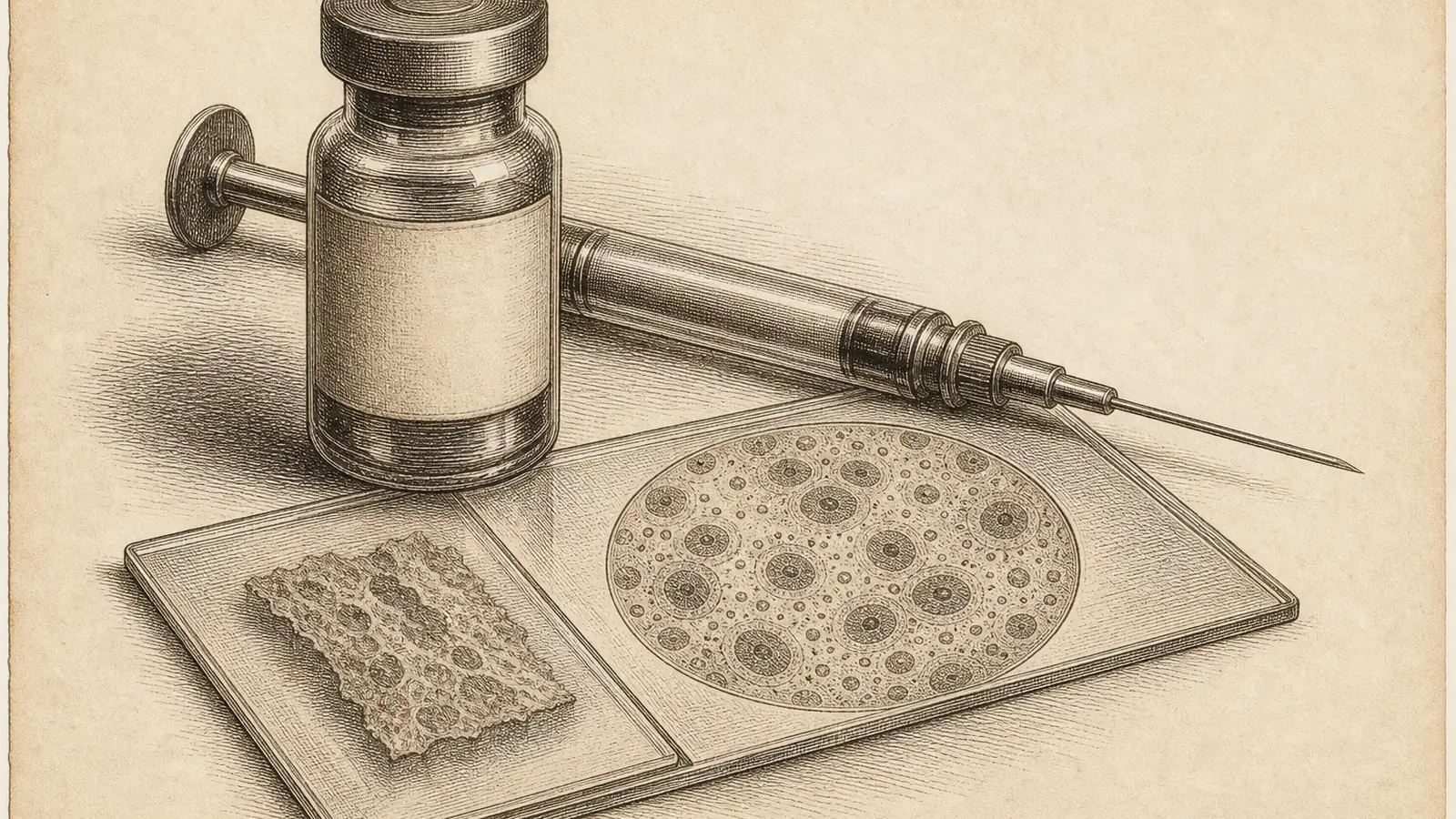
In 1977, in Turin, a hepatologist named Mario Rizzetto stained a slide of liver tissue from a chronic hepatitis B patient and saw something he could not place: a previously unknown antigen sitting inside hepatocyte nuclei alongside HBV. He called it Delta. It would take a few more years before anyone understood that Delta was not a piece of hepatitis B at all, but a separate, parasitic virus that hijacks HBV’s envelope and produces the most lethal form of viral hepatitis known to medicine.
That was forty-nine years ago. Europe has had an approved drug for it since 2020. American patients got theirs on May 22, 2026.
On that date, the Food and Drug Administration granted accelerated approval to Gilead’s Hepcludex, generic name bulevirtide-gmod, an 8.5 mg once-daily subcutaneous injection for adults with chronic HDV without cirrhosis or with compensated cirrhosis. It is the first targeted treatment ever cleared in the United States for the disease. Before that, the standard of care was off-label peginterferon, a year of weekly injections that, in the landmark 2011 NEJM trial of peginterferon plus adefovir, achieved sustained HDV RNA clearance in roughly a quarter of patients. The other three quarters got the side effects and kept the virus.
So the news is a milestone. The more useful question is why it took until May 22 to reach American patients when the European Medicines Agency had granted conditional approval in July 2020 and full marketing authorization in July 2023. The answer, on the public record, is that Gilead submitted a U.S. application and the FDA rejected it in 2022. According to Gilead’s communications and contemporaneous reporting in Medscape, the rejection did not turn on efficacy and did not turn on safety. The public reason given was manufacturing and supply. From that 2022 rejection to last week’s approval was three years, during which American patients with progressive liver disease lived on peginterferon or on nothing. Whatever the legitimate manufacturing question was, the cost of resolving it in private was paid by people who had no seat at the table.
To see why a drug for this virus is worth the argument, it helps to know what bulevirtide actually does.
HDV is a strange virus. It cannot replicate without hepatitis B in the same cell, because it cannot package its own surface protein and so borrows HBV’s. Both viruses enter hepatocytes through the same front door, a bile-acid transporter called NTCP. Bulevirtide is a 47-amino-acid synthetic peptide modeled on the stretch of HBV’s surface protein that latches onto NTCP. Inject it, and it occupies the receptor. Block the door, and the virus has nowhere to go.
The evidence that this works is good, by the standards of a small-population disease. In MYR301, the phase III trial, 150 patients with chronic HDV were randomized 1:1:1 to no treatment, bulevirtide 2 mg/day, or 10 mg/day. At week 48, the trial’s primary endpoint, 48 percent of patients receiving bulevirtide achieved a combined response (undetectable HDV RNA or a two-log reduction, plus normalized ALT). In the delayed-treatment control arm, 2 percent did. By week 96, with continued therapy, the response rates were maintained or improved, and a companion biopsy study in the same journal showed that bulevirtide did not just push down HDV RNA in blood. It reduced the number of HDV-infected liver cells, with signs of decreasing intrahepatic inflammation. Adverse events were mostly mild, with no serious adverse events related to bulevirtide. After four decades of off-label peginterferon and most patients failing it, that is what a breakthrough looks like.
What the public has never been allowed to see is the substance of the 2022 rejection. Gilead’s chief medical officer Dietmar Berger described the approval as the result of “years of close engagement with the FDA and the application of rigorous science to address a serious disease with long-standing unmet need.” That is press-release language for a delay whose specifics no one outside the room is allowed to read. The FDA’s complete response letters are not public documents. The company chooses how much to disclose. The agency does not have to disclose anything. And so the operational record of three years of unbought time is a sentence about close engagement.
Pricing is the next fight, and Gilead has so far declined to put a U.S. number on the record. The trials so far have followed patients to 96 weeks, not to functional cure, and viral suppression depends on continued dosing. An indefinite injection of an expensive peptide, in a disease concentrated in populations with the least leverage over health-system negotiation, is going to put access squarely on the table. The drug exists. Whether the people who need it reach it is a question of money and policy.
This is also an accelerated approval, anchored to surrogate endpoints (HDV RNA and ALT), with continued approval contingent on a confirmatory long-term outcomes study. The hard question that study will eventually answer is whether suppressing HDV with bulevirtide prevents the cirrhosis, liver failure, and hepatocellular carcinoma that delta is famous for. The phase III biopsy data point that direction. Clinical outcomes will take years.
Delta has been a frontier of hepatology since the slide on Rizzetto’s microscope in 1977. The drug that finally crosses it has existed for years. The question now is whether approval becomes access, or whether the next stretch of the wait is the one Americans pay at the pharmacy counter.
Sources
- Gilead Sciences – FDA Grants Accelerated Approval to Hepcludex (bulevirtide-gmod) for Chronic Hepatitis Delta Virus (2026)
- PubMed – MYR301 phase III trial: bulevirtide monotherapy through week 96 (2024)
- PubMed – Companion biopsy study: blocking viral entry with bulevirtide reduces HDV-infected hepatocytes (2024)
- PubMed – 2011 NEJM trial: peginterferon plus adefovir versus either drug alone for hepatitis delta
- Gilead Sciences – Gilead Sciences to Acquire MYR GmbH, developer of bulevirtide (2020)
- PubMed – Patient-reported outcomes in MYR301 bulevirtide trial (2024)