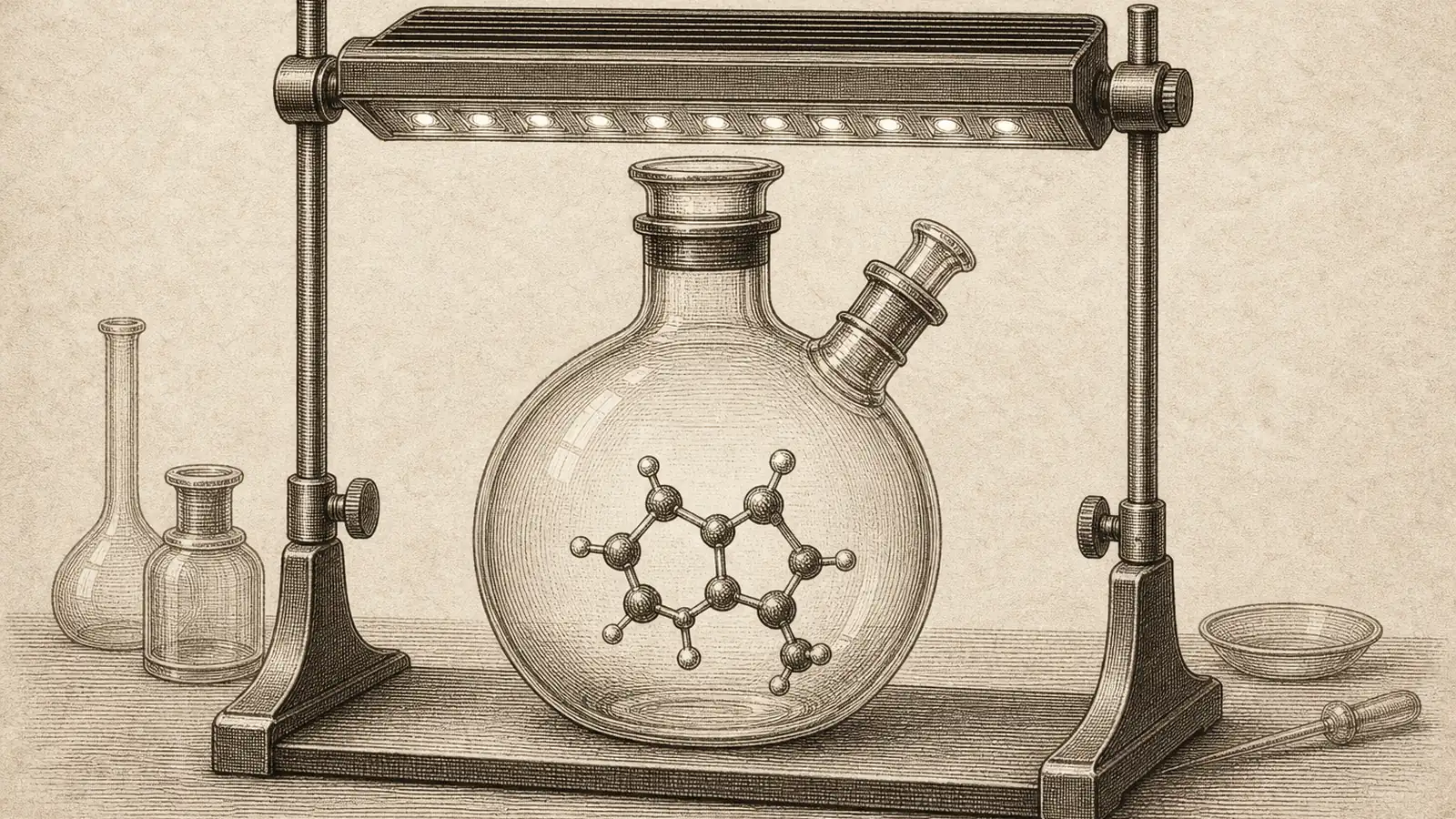
I always assumed that building a drug molecule was a kind of controlled violence. High heat, ultraviolet lamps, reagents you would not want anywhere near your skin, a lot of brute force spent forcing stubborn atoms to sit where a chemist wants them. So when I read that a lab had started assembling complex drug scaffolds under nothing harsher than the same soft blue glow people run over their fish tanks and indoor herb gardens, I did a genuine double take. The light was almost the whole point, and the light was cheap.
That is more or less what happened at the University at Buffalo. In work published July 9 in Science, chemists led by Patricia Z. Musacchio, working with teams at Binghamton University and Worcester Polytechnic Institute, showed they could take a common class of building-block molecules and, using blue LED light to switch on a catalyst, rebuild two neighboring carbon atoms in a single shot. The lamps sit in small shelved compartments the team nicknamed “Buffalo boxes,” each holding a vial lit up like a tiny aquarium. Nothing in that setup is exotic. That is what makes it worth stopping on.
Here is the part I had to sit with for a minute. In the usual route for this kind of modification, a chemist makes 1 change per reaction: attach a group, work it up, purify, then start the whole march over again for the next one. This method makes 2 in a single pass.
The starting material is an “alkyl C–X synthon,” which is chemist-speak for a carbon with a halogen (a chlorine, bromine, or iodine) hanging off it. Blue light switches on the catalyst, and the catalyst does something that sounds almost rude to the molecule: it strips away an electron and generates what is called an alkene radical cation. Knock an electron off a stable molecule and you get something desperate, electron-hungry, unstable in exactly the way you want. In that hungry instant, two new groups snap on across two adjacent carbons, a move chemists call vicinal disubstitution.
Wait, why would pulling off a single electron make a molecule accept two new pieces at once? That is the question I kept circling. The answer is that the radical cation is not one reactive spot but a reactive bond: both carbons of the old double bond wake up together, so the molecule can be decorated on both sides in the same event instead of across two separate, sweated-over steps. “The advantage is getting two modifications from a single reaction, whereas you normally only get one modification,” Jennifer Hirschi of Binghamton, who ran the computational modeling, told reporters. “More changes in fewer steps is crucial when creating small-molecule drugs.”
Why chemists care about cramming more changes into fewer steps comes down to shape. Flat molecules are easy to draw and easy to make, but flat also tends to be promiscuous, binding in more places than you meant it to. Chemists want increasingly three-dimensional structures, the Buffalo group says, because they may be more potent and more selective inside the body, hitting the intended target and skipping the rest. Getting there the old way meant a long line of one-modification-at-a-time steps, each one a fresh chance to lose material, time, and money. Doubling up the carbons is how you shorten that line.
And the light itself is the quiet elegance of the whole thing. “UV light could degrade or decompose the organic molecules that we’re making, so the visible light is a much more mild approach,” Musacchio said. Ultraviolet has the energy to drive reactions, but it also has the energy to shred the delicate molecules you are trying to assemble in the first place. Blue visible light nudges the catalyst awake without cooking the product. “We’ve used the relatively mild conditions of visible light to expand what chemists can do with a longtime organic chemistry staple,” she said.
Let me be straight about the size of this. Nobody swallowed anything. No patient got better, no disease got touched, no trial got run. This is not medicine. It is leverage over the machinery that makes medicine: a faster, gentler way to build the crowded, three-dimensional molecules drug hunters have chased for years. It sits years upstream of any pharmacy shelf, which is exactly why it is easy to shrug at, and exactly why I am not going to.
Because here is who paid for it. The work was funded by the public, through the National Institute of General Medical Sciences at the NIH and the National Science Foundation’s ACCESS program. And the team’s stated next move, in its own words, is to work with pharmaceutical companies to tune the method toward specific drug targets. That is the familiar American arc: taxpayers buy the discovery, industry buys the discovery a second time on the way out the door and sells it back to us with a markup. I do not think the science is a scandal. I think the ownership might be, and the receipt for it is being written right now, quietly, upstream, where nobody is looking.
So no, I am not clearing a shelf in my medicine cabinet this week, and I will not pretend a lab in Buffalo just handed me anything I can swallow. What I am doing is writing down who paid for the light. It was cheap, and it was public, and when the drugs it helps build come back with their inevitable price tag, I want the receipt that says we already paid for the hard part once.
Sources
- News-Medical – Blue LED lights help chemists build complex drug molecules (2026)
- Mirage News – Blue Lights, Chemistry Streamline Drug Creation (researcher quotes, 2026)
- Bioengineer.org – Blue Light and Chemistry Simplify Complex Drug Production Steps (2026)
- Science – Vicinal disubstitution of alkyl C–X synthons via alkene radical cation generation (Musacchio et al., July 9, 2026), DOI 10.1126/science.aef0766