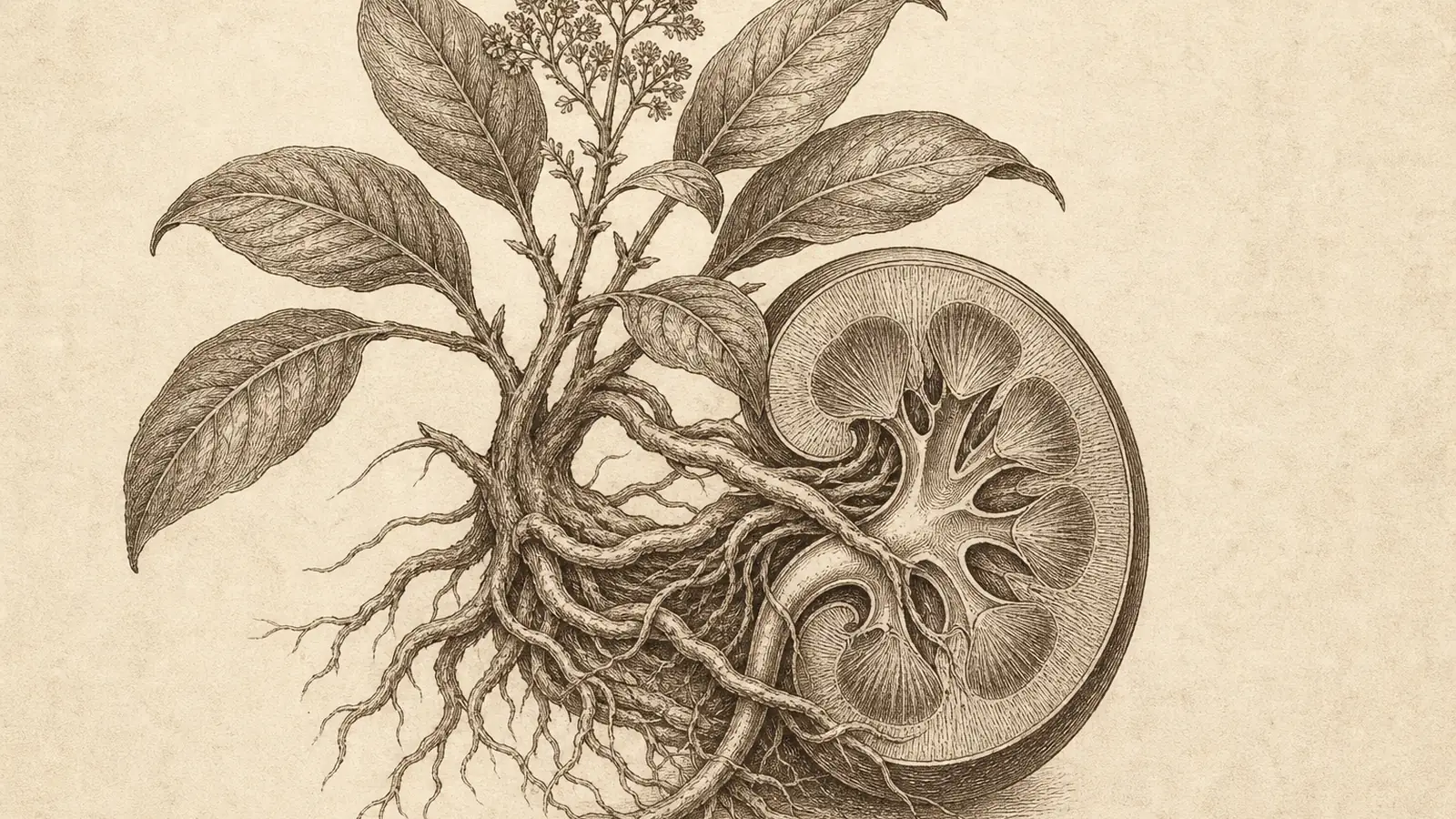
A Shanghai lab just credited a plant steroid with quieting the molecular switch behind kidney scarring. The same molecule sits on a GNC shelf right now, labeled ecdysterone, sold to lifters chasing bigger shoulders.
The reflex is to scroll past another “anti-aging herbal extract” press release. I almost did. Then I noticed which target the paper says it hits, and that the molecule has already been carried through a 233-patient Phase 2b in sarcopenia with no treatment-related serious adverse events, plus a 238-patient Phase 2/3 in COVID. That is when the story stopped being about a Yunnan mountain plant and started being about who runs the kidney pipeline, and who has zero commercial reason to fund the trial that would actually settle this.
Here is the catch I cannot get past. 20-hydroxyecdysone is a natural product. A French biotech, Biophytis, is carrying a synthesized version through clinical trials under the code BIO101, but for muscle wasting and COVID, not chronic kidney disease. There is no Bayer-sized profit pool waiting at the end of a CKD Phase 3 on a molecule that anyone with a Cyanotis-root supply chain can ship by the kilo. So nephrology has not seriously engaged with it. The big trials do not get planned. The story stays in mouse-model papers from Chinese labs.
The paper itself, by Gu and colleagues in Acta Materia Medica, is the methodical kind I like. They start with a 75 percent ethanol extract of Stellaria yunnanensis Franch, a flowering plant native to Yunnan, and code it JM11002. The extract calms two of nephrology’s standard surgical mouse injury models: unilateral ureteral obstruction (UUO) and unilateral ischemia-reperfusion injury (UIRI). Then they purify the active molecule, 20-hydroxyecdysone, label it JM11201, and run a harder gauntlet. The pure compound replicates the extract’s effect in UUO and also rescues function in UIRI with contralateral nephrectomy, the brutal version where the healthy kidney is taken out and there is no compensation. Across the ladder, the compound suppresses TGF-β1/Smad3 signaling and drops the expression of fibrosis-related proteins in the obstructed kidneys.
You have to know what TGF-β1/Smad3 is to feel why that sentence matters. It is the master switch for fibrosis in nearly every solid organ. When your kidney is damaged, this pathway tells fibroblasts to lay down collagen, scar tissue replaces functioning nephrons, filtration drops, and you drift toward dialysis. It is the scarring axis the kidney-drug field has been circling for twenty years. The drugs that actually slow CKD progression in patients, SGLT2 inhibitors and finerenone, are not direct hits on this pathway, but tamping down TGF-β/Smad-driven fibrosis is widely proposed as part of how they work downstream. A clean, oral, well-tolerated suppressant of the pathway itself would change the field. Pharma knows this, which is why a string of direct anti-fibrotic candidates (pirfenidone retreads in CKD, anti-CTGF antibodies like pamrevlumab) have been chased and mostly disappointed.
And the wildest part: 20-hydroxyecdysone’s case for hitting this pathway is not new. A 2012 paper in the Journal of Diabetes and Its Complications already showed the compound attenuates TGF-β1-induced fibrosis in HK-2 human proximal tubule cells, reverses TGF-β1-driven Smad7 downregulation, and blocks Snail expression. That cell-culture mechanism evidence has been sitting in PubMed for over a decade. The animal-model layer is now stacked on top. And meanwhile, the same molecule cleared a 233-patient Phase 2b in elderly sarcopenia patients, with tolerability through six to nine months at 350 mg twice daily, and Phase 1 work supports single doses up to 1,400 mg without major safety signals. The basic dose-finding and safety lift is already done. What is missing is an investigator-initiated CKD Phase 2, and no one has commercial reason to write that protocol.
A few cold notes before I get carried away. UUO and UIRI are surgical, acute injury models. They show whether a compound can blunt fibrosis under brutal, forced damage. They do not show whether it does anything for slowly progressing diabetic or hypertensive CKD, which is the kidney disease that actually fills American dialysis chairs. Acta Materia Medica is a serviceable open-access journal, indexed in Scopus and EMBASE, but it does not carry the weight of Kidney International or JASN. The result needs a Western replication before any nephrologist changes practice. The press release also does not disclose funding or competing interests for the paper, which I would want to see before treating it as anything more than a strong signal.
So where does this leave me? Cautiously, openly interested. One mouse study lands on top of a decade of consistent cell-culture mechanism work, on top of human safety data already on file from a different indication, hitting a target the kidney-drug field has chased indirectly for years. If I had stage-3 CKD in my family and a nephrologist with a curious mind, I would print the Acta Materia Medica paper and the 2012 Journal of Diabetes and Its Complications paper and ask what an investigator-initiated Phase 2 in early CKD would look like, because nobody with a marketing budget is going to design that trial. A plant steroid that hits the right switch, sitting in plain sight, waiting for someone with no Bayer-sized incentive to take it seriously.
Sources
- Gu et al. – 20-Hydroxyecdysone and Stellaria yunnanensis extract suppress kidney fibrosis in mouse models, Acta Materia Medica (2026)
- News-Medical – Anti-aging herbal extract shows promise against chronic renal failure (2026)
- PubMed – 20-Hydroxyecdysone attenuates TGF-β1-induced renal cellular fibrosis in proximal tubule cells, Journal of Diabetes and Its Complications (2012)
- Biomedicines – 20-Hydroxyecdysone: From Plant Extracts to Clinical Use, including Biophytis Phase 2b sarcopenia trial (2021)