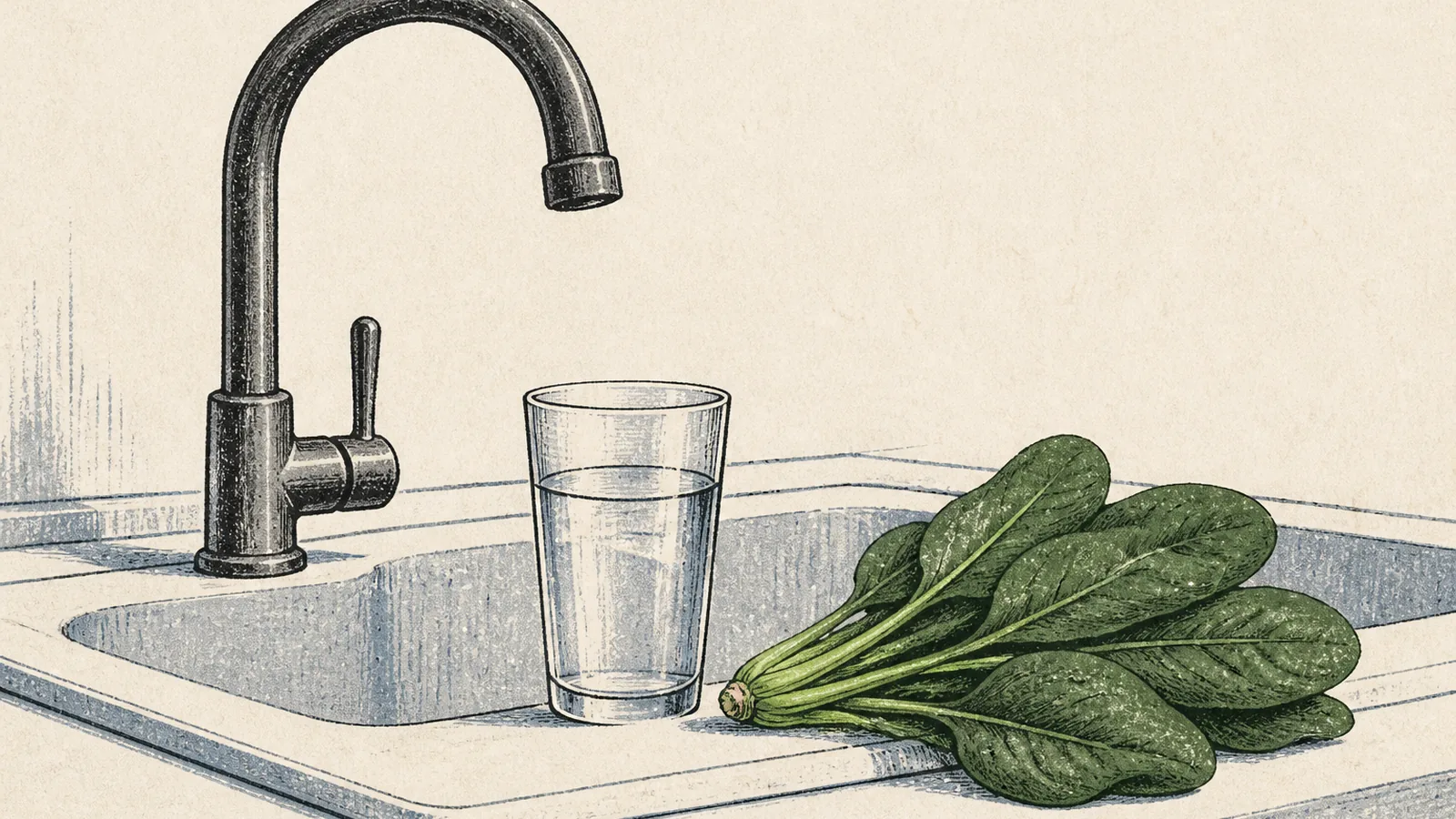
I keep coming back to this. The same nitrate ion, the same chemistry you’d diagram on a high school whiteboard, and over 27 years two completely different fates. Eating it in roughly a cup of baby spinach a day was associated with less dementia. Drinking it in tap water was associated with more. And the concentration where the water signal starts climbing is roughly one-ninth of what the US EPA still permits in your municipal supply.
The paper is from Catherine Bondonno’s group at Edith Cowan University and the Danish Cancer Research Institute (DOI 10.1002/alz.70995, published in Alzheimer’s & Dementia in December 2025, with coverage resurfacing this week). They took 54,804 dementia-free Danish adults from the Diet, Cancer and Health cohort, asked them what they ate and drank, and watched them for roughly a quarter-century, adjusting for the usual suspects (age, sex, BMI, smoking, alcohol, education, physical activity, the rest of the diet). The trick nobody had pulled at this scale before was to split nitrate by where it came from.
Vegetable nitrate, at the highest intake versus the lowest, returned a hazard ratio of 0.90 (95% CI 0.83 to 0.98). Modest, cleanly significant, pointing the right way. The other column is the interesting one. Nitrate from animal foods, from additive-permitted processed meats like cured deli, and from drinking water all came in with elevated dementia risk, and the associations were stronger for early-onset cases, the dementias that show up before 65. Same molecule. Opposite ledger entries.
OK so why would a nitrate ion care where it came from? The suspected chemistry, which is what Bondonno’s group is now chasing in the lab on a $1.7 million Australian NHMRC grant, goes like this. When nitrate rides in on a plant, it arrives bundled with vitamin C, polyphenols, and a small pharmacy of antioxidants that nudge the body’s nitrate-to-nitrite conversion toward nitric oxide, the friendly vasodilator your endothelium relies on. When the same nitrate arrives in a glass of water, those compounds aren’t there to ride shotgun. The chemistry tilts the other way, toward N-nitrosamines, a family the press materials describe as carcinogenic and potentially damaging to the brain. Bondonno’s line in the EurekAlert release is that water doesn’t bring its own bodyguards. Lab work is still needed to lock the human pathway down, but the framework lines up with what’s already known about how the gut handles dietary nitrate.
Now the number that should make any American on a small water system or a private well sit up. The Danish researchers saw dementia risk start climbing at drinking-water nitrate concentrations as low as 5 mg per liter, measured as the nitrate ion. The US EPA’s Maximum Contaminant Level is 10 mg/L nitrate-as-nitrogen, which converts to roughly 45 mg/L expressed as nitrate ion, the same way the Danish study reports it. So the cohort’s risk threshold isn’t half of the EPA limit, the way headlines about this kind of result usually frame it. It’s closer to one-ninth. And that EPA standard, by the way, was set in 1962 to prevent acute “blue baby syndrome,” the pediatric emergency where nitrate-to-nitrite conversion in an infant’s gut steals oxygen-carrying capacity from hemoglobin. It was never built around a 27-year cognitive trajectory. The agency hasn’t seriously revisited it.
This isn’t a rare-event problem. Environmental Working Group’s analysis of utility records from 2021 to 2023 found 62.1 million Americans on community water systems that tested at or above 3 mg/L of nitrate ion in at least one sample, and 38 million on systems that touched 5 mg/L or higher. That’s about one in five people on the public supply. Small and very-small systems carry the worst treatment economics, but the exposed population also includes plenty of mid-sized and large cities sitting downstream of fertilizer runoff and CAFO lagoons. The molecule is industrial agriculture’s signature in the groundwater, and it does not respect city limits.
I came in skeptical of yet another observational nutrition paper, because the field’s signal-to-noise ratio has earned that reflex. Three things changed my mind on this one. The cohort is huge and the follow-up is the longest available for the question. The dose-response showed up cleanly across multiple nitrate sources within the same people, which is hard to chalk up to ordinary confounding, because the confounders would have to flip direction depending on whether the nitrate arrived in arugula or in well water. And the suspected mechanism is biochemistry that has been worked out independently of this paper, not a just-so story stitched on after the result came in. The authors report no conflicts of interest. Disclosed funders include the Danish Cancer Society, the World Cancer Research Fund, the Independent Research Fund Denmark, the Novo Nordisk Foundation, the Australian National Health and Medical Research Council, the National Heart Foundation, and Western Australia Future Health.
The honest limit is that this is observational. You can’t randomize 50,000 people to drink contaminated water for 27 years, and nobody should pretend you could. What you can do is hold this result up against the EPA’s number, ask what that number was originally built to do, and notice the answer is “save a 1962 infant from acute hemoglobin failure,” not “protect a 65-year-old brain from 30 years of low-grade exposure.”
What I’ll actually do with this is not panic about a salad. I’ll keep eating leafy greens, which this paper basically endorses. I’ll look up my own utility’s most recent nitrate test, because every Consumer Confidence Report is public, and if I had a private well in farm country I would test it. And I’ll treat the EPA’s MCL the way it deserves: a number built for one acute pediatric problem in the Eisenhower administration, not a number that has earned trust on what decades of low-grade exposure do to a brain. The agency owes the public a reassessment that takes this evidence seriously. The receipts are on the table.
Sources
- Bondonno et al., Alzheimer’s & Dementia – Source-specific nitrate intake and incident dementia in the Danish Diet, Cancer and Health Study (2025)
- ScienceDaily – Dementia risk linked to nitrate in drinking water, study finds (2026)
- EurekAlert – Nitrate in drinking water linked to increased dementia risk while nitrate from vegetables is linked to a lower risk (2026)
- Environmental Working Group – Drinking water of almost 1 in 5 Americans contains nitrates linked to cancer and birth defects (2024)
- ATSDR / CDC – U.S. Standards and Regulations for Nitrates and Nitrites Exposure