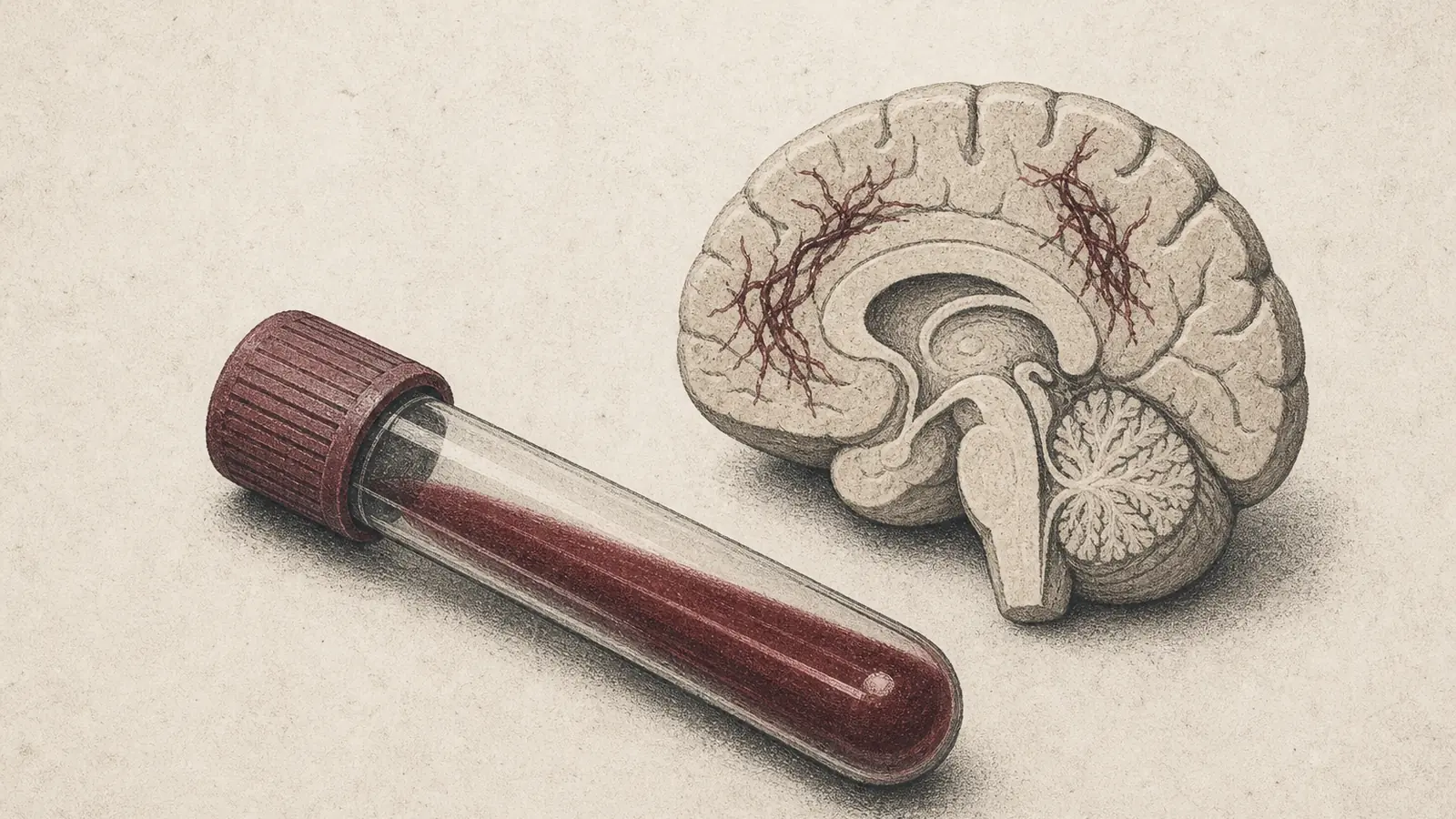
I went into this year’s Alzheimer’s coverage expecting a comeback story, and what I got was a magic trick I’ve watched before. The new drugs can prove they grabbed their target, but not that grabbing it helps anyone. And the one clean thing this whole expensive pivot has produced so far is a blood test.
The Alzheimer’s Association International Conference in London has a new headliner. For twenty years the marquee protein was amyloid, the sticky plaque that piles up between brain cells. This year the crowd is around tau, the protein that twists into tangles inside the cells, and the pitch off the stage is that tau is where the disease actually lives. “Tau is the next important target,” Voyager’s CEO Al Sandrock told BioSpace, the logic being that amyloid marks the quiet early phase while “tau has taken over the process” by the time your memory starts slipping. Biogen brought a tau-lowering drug, Voyager a gene therapy built to slip across the blood-brain barrier, Denali antibodies riding a molecular transport truck into the brain. Nobody is abandoning amyloid; those therapies are still on the market and still selling. Tau is just the protein everyone wants to talk about now.
Before I get skeptical about the salesmanship, I want to be fair to the science, because the amyloid story wasn’t nothing. Two decades of work did prove amyloid is there and that you can clear it out. What it did not do is help people much. The anti-amyloid antibodies that reached the market, Leqembi and its cousins, slowed decline by a sliver while causing brain swelling and bleeding in between 12 and 35 percent of treated patients, versus 3 to 13 percent on placebo. The FDA hung a black box warning on them, its most severe. You can scrub the plaque out of a brain, it turns out, and the average patient barely notices. That is the establishment’s actual track record, and it is the one the industry is now asking you to forget as it turns to tau.
And the tau drugs are failing in the exact same shape. Semorinemab drove tau up in the blood, the pharmacodynamic sign that the antibody was latching onto its target, and did nothing to slow the tangles piling up in the brain. Gosuranemab, in a 654-person trial called TANGO, engaged its target in the spinal fluid and then showed no benefit on the brain scans and, if anything, a nudge toward faster decline. Tilavonemab and zagotenemab were shelved, and Johnson & Johnson’s posdinemab is the newest to stumble out of phase 2 after failing to slow the disease. The pattern is so consistent that the neurologists writing it up called it openly reminiscent of the amyloid story: the drug hits the target, the target moves, the patient does not.
So I kept circling the obvious question, the one nobody selling a tau pipeline wants on stage. If the antibody is clearly binding tau, why doesn’t the brain get better?
The best explanation researchers have is a geography problem, and once it clicked for me the whole run of failures made sense. Tau does its damage inside the neuron. It spreads from cell to cell in a creepy trans-synaptic hand-off, passing tiny toxic seeds across the junctions where neurons talk, and the chemical tags it picks up along the way change how easily it jumps and gets taken up by the next cell. An antibody floats in the fluid between cells. It can only grab the tau that has already spilled into the open. So it mops up the extracellular tau beautifully, which is exactly why the blood levels climb, the antibody is holding all that loose tau, while the seeds threading themselves neuron to neuron, tucked inside the cells where an antibody can’t follow, keep right on spreading. The drug is fishing in the river while the disease burns down the houses on the bank. Target engagement was never the same thing as treatment, and a decade of trials paid to learn that lesson twice.
So what did two decades of tau and amyloid work actually produce? A blood test, and I mean that as a compliment, because it is the one thing in this field that reliably does what it claims. The star is a fragment called p-tau217. In May 2025 the FDA cleared a plasma p-tau217 test that, in its clearance study, hit a positive predictive value of 92 percent and a negative predictive value of 97 percent against the expensive PET scans and spinal taps it is meant to replace. Editorialists in JAMA Neurology started calling the moment “time for tau,” and here the enthusiasm is earned: a cheap tube of blood standing in for a several-thousand-dollar brain scan means far more people can actually get diagnosed.
But read the fine print, from the same journal. When Salvadó’s team ran p-tau217 in people who had no symptoms yet, the standalone blood test landed around 81 percent accuracy. To push that to 91 percent in a healthy population, you have to confirm the result with a PET scan anyway. So it is a superb rule-out and a serious cost-saver, and it is not the crystal ball that a phrase like “detects preclinical Alzheimer’s” makes it sound like.
Two decades and untold billions landed us somewhere strange. The most useful thing tau and amyloid research produced isn’t a cure. It’s a way to find the disease earlier, in people we still cannot effectively treat. And a positive result on that lovely new blood test funnels a frightened person straight toward the black-box antibodies that clear the plaque and barely move the needle. The test does what it says, and its best customer is a drug that mostly doesn’t. The conference floor won’t print that on a poster: the win was a diagnostic, and the diagnostic’s main market is a treatment that underdelivers.
Would I take the blood test? If I had symptoms and wanted to know whether Alzheimer’s was the reason, yes, because ruling it out is worth a lot and this test is honestly good at that. But I wouldn’t go hunting for p-tau217 in my blood while I still feel fine, not until somebody shows me a tau drug that changes what happens next instead of one that just proves it grabbed the protein. Until then I’ll treat my brain the way the evidence actually supports, from the outside in: sleep, movement, blood pressure, blood sugar, the boring stuff that protects a brain. I am not going to pay to learn a diagnosis nobody can do anything about yet.
Sources
- STAT – AAIC in 30: Alzheimer’s treatments focus on tau, blood-brain barrier (2026)
- BioSpace – Tau-targeted Alzheimer’s treatments heat up while amyloid therapies persist, AAIC 2026
- JAMA Neurology – Evolving Role of Plasma Phosphorylated Tau 217: Time for Tau (2025)
- JAMA Neurology – Salvadó et al., Plasma Phosphorylated Tau 217 to Identify Preclinical Alzheimer Disease (2025)
- PMC – Initial failures of anti-tau antibodies are reminiscent of the amyloid-β story (2022)
- Nature Reviews Drug Discovery – Anti-tau antibody stumbles in phase II Alzheimer trial (2024)
- Nature Reviews Neuroscience – Oligomeric tau might spread trans-synaptically in Alzheimer disease (2023)
- Journal of Neuropathology & Experimental Neurology – Tau post-translational modifications impact propagation and uptake (2025)
- STAT – Manufacturers need to be more open about a dangerous Alzheimer’s drug side effect (ARIA) (2023)
- Fujirebio – FDA marketing clearance for the Lumipulse G pTau 217/β-Amyloid 1-42 plasma ratio test (2025)