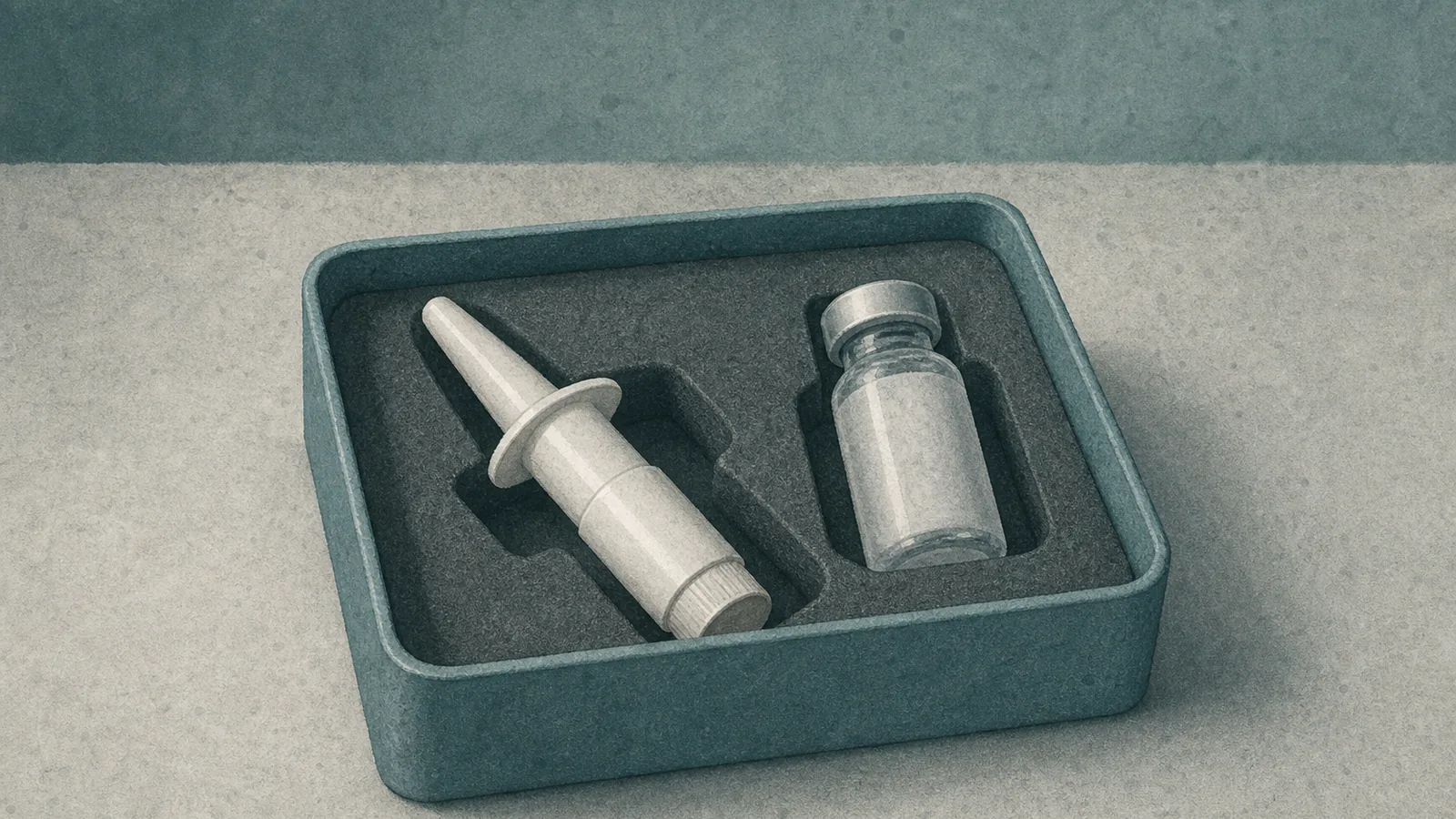
The trial finished its follow-up in September 2023. The press tour arrived in June 2026. On June 5, ScienceDaily ran the headline that the AI-designed universal coronavirus vaccine had passed its first human trial, and IFLScience and the rest of the science-news circuit ran behind it within hours. The paper the tour was built on landed in the Journal of Infection that same week, and it used a quieter word. Across the four dose-escalation cohorts, the authors wrote, immunogenicity was “modest in the context of substantial pre-existing immunity.” That sentence did not travel.
What was tested: 39 healthy adults between 18 and 50, vaccinated at the NIHR Southampton Clinical Research Facility under a two-dose protocol of a DNA vaccine called pEVAC-PS, sprayed through the skin by a needle-free jet, in four sequentially assigned dose levels of 0.2, 0.4, 0.8, and 1.2 mg. No placebo arm. Open label, which is to say everyone knew who was getting what. The design is correct for an early safety look and incapable, by construction, of demonstrating that a vaccine works. Immunogenicity analyses excluded some participants, and the population by then was a confounded one: nearly everybody enrolled had been vaccinated against COVID already, many had been infected during the Omicron wave the recruitment period straddled, and the trial could not, against that background, cleanly show an added antibody response from the new shot. The paper says so.
Where statistical signals did surface, the language was careful. In the higher dose groups, neutralizing antibody titers against Omicron BA.1 rose significantly between baseline and weeks 6 and 8 (p<0.05); against Delta, the rise reached significance in pairwise comparisons. The p-values say the changes are unlikely to be noise. They say nothing about how large the changes are. The authors do not call the signals a breakthrough. The wire copy did.
The AI piece, on its own, is the interesting science. Heeney’s lab fed Sarbecovirus genomes (the family containing the original SARS, SARS-CoV-2, and a long list of bat coronaviruses the field flags as having pandemic potential) into a computational pipeline that produced a single synthetic antigen meant to cover the lineage. The authors call it a “computationally optimised PanSarbeco” immunogen and frame the trial’s contribution narrowly: the data, they write, supports “the feasibility of this antigen design strategy.” Feasibility is a smaller claim than the wire copy made of it, and feasibility is not, by itself, the runway for Phase 2.
Phase 2 funding is what the announcement was built to attract. DIOSynVax, the Cambridge spin-out that owns the technology, was founded in 2017. Jonathan Heeney is its co-founder, chief scientific officer, senior author on the paper, and a shareholder; Rebecca Kinsley runs the company as chief executive. Several of the paper’s co-authors are DIOSynVax employees or shareholders, which the conflict-of-interest disclosure says outright. The trial sponsor of record was University Hospital Southampton NHS Foundation Trust, not the company, but the company’s people designed the antigen and signed the paper. Innovate UK, the British government’s innovation funder, put £1.9 million into the trial; DIOSynVax added £400,000 of its own. Separately, in March 2022, the Coalition for Epidemic Preparedness Innovations (the body launched at Davos in 2017 with $460 million from Norway, Japan, Germany, the Wellcome Trust, and the Gates Foundation to compress vaccine development timelines) signed a $42 million partnership with DIOSynVax to take the platform into mRNA. The press release mentioned Innovate UK and described DIOSynVax as a Cambridge spinout. It did not foreground the employee and shareholder conflicts, the company’s own contribution to the trial budget, or the $42 million CEPI deal waiting downstream.
A 39-person open-label Phase 1 with modest immunogenicity, finished in 2023, published and announced in 2026, with the senior author a co-founder and shareholder of the corporate beneficiary, funded by a government innovation agency looking for pandemic-preparedness wins for its scoreboard, sitting on top of a $42 million downstream deal from the body whose entire mandate is pandemic-preparedness wins. The press release said the trial passed. The paper said what was actually earned: feasibility, a clean safety signal, a modest immune response on top of a heavily pre-immune population, and a Phase 2 in want of a runway.
A computer designed the antigen. That part is not nothing, and might one day matter. “Passes its first human trial” is a different sentence.
Sources
- Munro et al., Journal of Infection – A phase I, needle free, dose escalation clinical trial of pEVAC-PS, a candidate pan-Sarbecovirus Vaccine (2026)
- ScienceDaily – AI-designed universal coronavirus vaccine passes first human trial (2026)
- University of Cambridge – Cambridge-developed SARS-CoV-2 vaccine receives £1.9 million from UK government for clinical trial
- Cambridge Enterprise – Cambridge spin-out enters $42m partnership to develop future-proofed coronavirus vaccines
- IFLScience – In a world first, fully AI-designed, needle-free, universal coronavirus vaccine completes human trials (2026)
- Medical Xpress – AI-designed universal vaccine clears first human trial (2026)