What if you could quiet the inflammation chewing through your jawbone with what you eat for five days? It’s a genuinely interesting question, and a King’s College team has just published the first feasibility pilot to actually try it in patients with severe gum disease. Twenty-eight people with periodontitis cycled through three rounds of a boxed near-starvation diet alongside the standard periodontal deep-cleaning, with the kit supplied by a company the field’s founding researcher built. The reported biomarkers showed no statistically significant differences from the control group on any of them. And the clinical measurements every periodontist actually uses to track the disease, whether the pocket around the tooth gets shallower, whether the bone holds, the institutional press writeups walked around almost entirely.
Both of those things can be true at once, and the genuine interest of the biology question is why this trial is worth reading carefully instead of dismissing.
Here is what Giuseppe Mainas and his collaborators did. They recruited patients with severe periodontitis at sites in Spain and randomized them to one of two arms, both receiving the standard subgingival instrumentation your dentist actually does to slow the disease. The test arm added three five-day cycles of a fasting-mimicking diet on top of treatment, the first cycle the same day as the deep cleaning and the others at roughly day 45 and day 85. The trial registration lists twelve patients per arm in the internal pilot phase, twenty-eight total enrolled. That tells you exactly what kind of trial this was: a feasibility check, not an efficacy verdict.
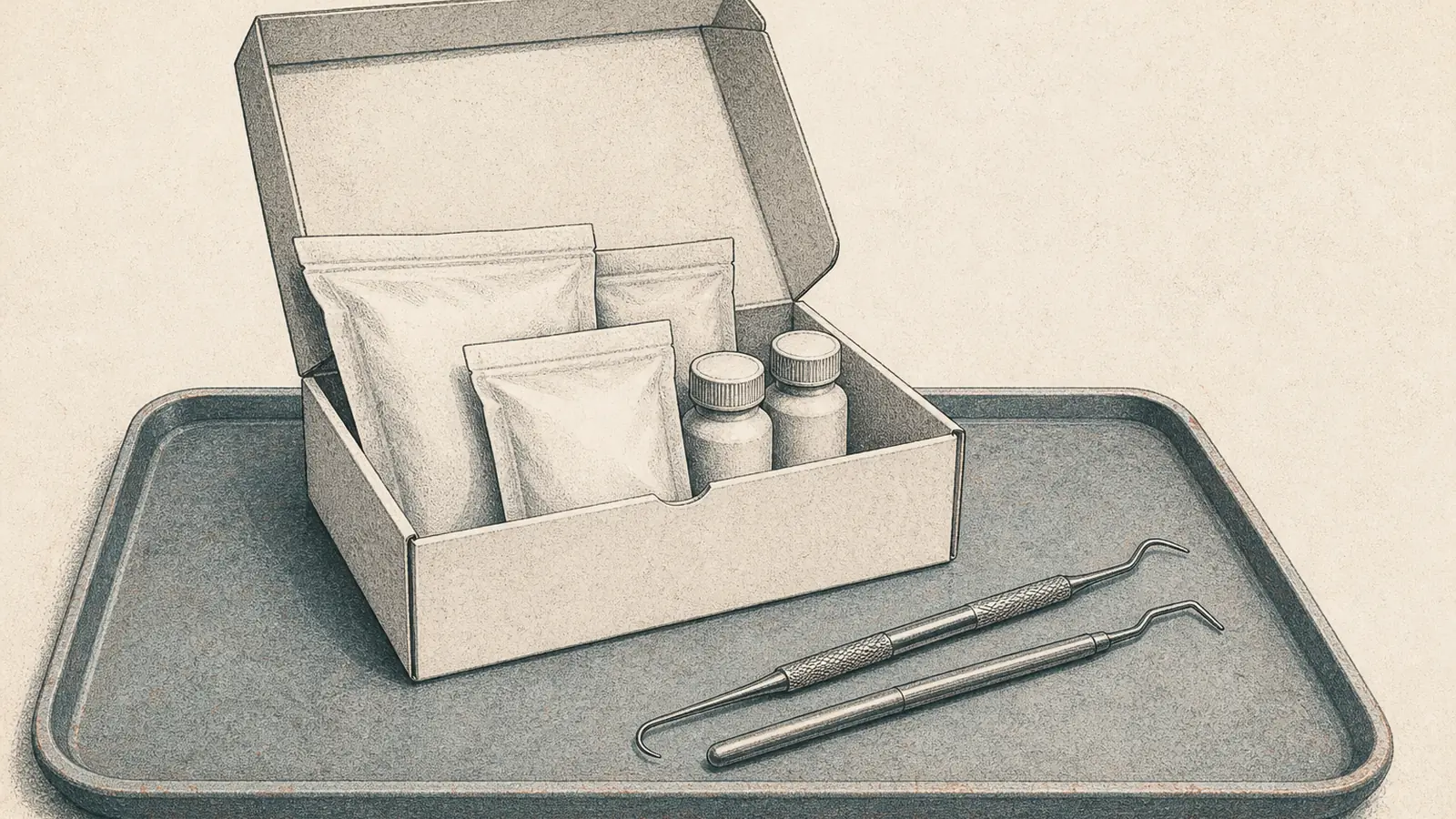
The diet was not water fasting. It was the ProLon kit, the boxed five-day program of soups, bars, and supplements made by L-Nutra: about 1,100 calories on day one and 750 a day for the four after that, then a soft-foods reintroduction. Structured low-calorie eating, shipped in a box, with a brand on the side. Hold that detail while you read the results.
So what moved. Per the King’s release and the EurekAlert summary, the fasting group showed a trend toward lower high-sensitivity C-reactive protein at three months, plus trends toward lower MMP-8, IL-6, and IL-1β in the gingival crevicular fluid (the inflammation-rich fluid pooling in the pocket around the tooth) the day after treatment. None of those trends reached statistical significance, and the King’s release says so in plain language. On the feasibility question, the trial succeeded: severely sick gum-disease patients tolerated three rounds of a boxed near-starvation diet. The harder question, whether any of this actually treats gum disease, the data cannot yet answer.
The part a patient cares most about is the part the press writeups walked around. Probing depth. Bleeding on probing. Clinical attachment level. These are the periodontal measurements that predict whether you keep your teeth. The registered protocol shows they were collected at day 90 and day 180; they just were not the primary outcome (hs-CRP was) and the press releases do not say what they showed. A trend toward lower inflammation in the fluid around a tooth is biologically suggestive, but it’s not the same as the pocket getting shallower or the bone holding. The headline almost writes itself (“fasting fights gum disease!”) and the trial it sits on top of cannot yet support it.
The biology is the part that justifies running the study in the first place. Periodontitis is, in the modern picture, an inflammatory disease as much as a bacterial one. The plaque is necessary but not sufficient; the destructive piece is your own immune system going to war in soft tissue it cannot fully clear, breaking down connective tissue and resorbing bone in the process. Anything that quiets systemic inflammation should, in principle, give the gums some breathing room. Five-day low-calorie cycles are one of the few non-pharmaceutical interventions with documented effects on systemic inflammatory markers, working through cellular housekeeping (autophagy), shifts in immune-cell populations, and metabolic resetting away from chronic activation. The link to the mouth is not crazy. It’s the kind of mechanism-plausible hypothesis that earns a properly powered trial.
And then there’s the product, which nobody else covering this will dwell on. ProLon comes from L-Nutra, the company founded by Valter Longo at USC, the researcher who built the modern fasting-mimicking concept in the first place. Per USC’s own disclosure, Longo holds an ownership interest in L-Nutra. USC also holds an ownership interest and stands to receive royalties on the company’s products. That does not make this trial corrupt. The MRC’s Impact Accelerator Account funded the work, the King’s investigators have no disclosed L-Nutra equity, and using the standardized commercial kit is the methodologically right move (it removes a formulation confounder). What it does mean is that almost every fasting-mimicking diet trial in the literature runs on one company’s product, and the follow-on periodontitis work that will inevitably build on this pilot will run on it too. The wellness ecosystem about to swallow the ScienceDaily headline and post “fast your way out of gum disease” videos is also, one or two clicks away, selling you the kit. Knowing where the money points is part of reading the literature honestly.
A trial that would settle the patient question looks different from this one. It would be larger, powered to detect a real effect on probing depth and clinical attachment, not just biomarker noise. It would put the branded ProLon kit head-to-head with a home-prepared five-day low-calorie reset at the same caloric envelope, so we could tell whether any benefit is the diet or the proprietary formulation. It would follow patients out at least a year, because what matters is whether the tissue around the tooth holds, not whether one inflammatory marker dips at three months. And it would report, in the press release, what the periodontal probe actually found. The current pilot is a permission slip to run that trial. It is not the trial itself. The authors are also right about the obvious safety constraint: fasting protocols are not for everyone, and diabetics on glucose-lowering drugs especially should not go near 750 calories a day without a physician in the loop.
What do I make of it? The question is the right one to ask, the biology is plausible enough to keep chasing, and I’ll be reading the next, properly powered trial with genuine interest. None of which means you should change anything about how you care for your teeth on the strength of a twenty-eight-patient pilot whose primary biomarker did not reach significance and whose clinical measurements the press releases quietly did not announce. Floss. Get the deep cleaning. Be specifically skeptical of anyone monetizing the gap between an interesting feasibility study and a gum-saving claim.
Sources
- Mainas et al., “A Fasting-Mimicking Diet Affects the Inflammatory Response Following Periodontal Treatment: A Multi-centre Feasibility Randomised Controlled Pilot Trial,” Journal of Clinical Periodontology (2026)
- King’s College London press release on the FMD periodontitis pilot
- EurekAlert release: “Fasting-mimicking diet reduces gum disease inflammation”
- Trial registration NCT06074861, Fasting-mimicking Diet and Periodontitis (CenterWatch summary of the ClinicalTrials.gov record)
- ScienceDaily summary: “Can fasting fight gum disease? Scientists find surprising link”
- Wei et al., review of fasting-mimicking diet effects on aging and inflammatory markers (PMC)
- ProLon product page (L-Nutra), manufacturer description of the five-day kit
- USC Gerontology, Longo / L-Nutra ownership and conflict-of-interest disclosure