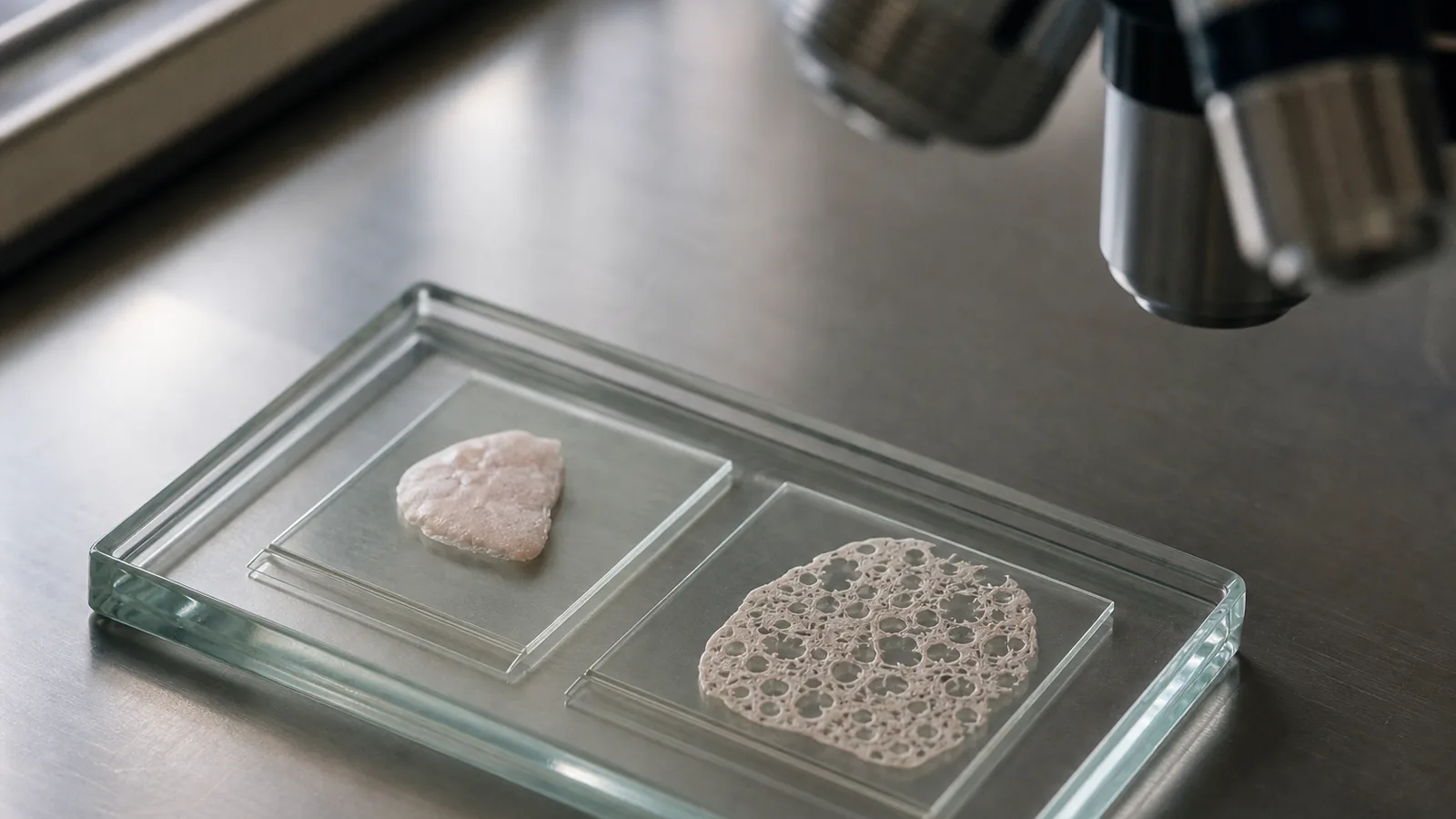
Your thymus runs a small repertory theater. Some of its cells dress up as gut, some as neuron, some as skin, some as pancreas, all of them squatting inside one tiny organ behind your sternum, wearing costumes for tissues they will never really be. A paper out this month in Nature Immunology adds one more performer to the troupe: a subset of medullary thymic epithelial cells that look and behave a lot like the alveolar cells lining your lungs. The team behind it argues the whole casting department is run by a transcription factor called RUNX1, and that when RUNX1 goes missing from those cells, the lung impersonator goes with it.
I came in expecting another mimetic-cell catalog entry. What got me was the regulator.
RUNX1 is a name most immunologists park in T-cell lineage decisions, not in the stromal compartment that trains those T cells in the first place. According to the Nature Immunology piece describing the study, losing RUNX1 in mTECs reorganizes the whole troupe: the alveolar-like subset is reduced, the balance of medullary thymic epithelial cell populations shifts, and the costume diversity the rest of the school relies on narrows. The thymus, in other words, partly stops staging the play.
Here is the part you need to hold in your head to see why this matters. The thymus is the central school where developing T cells learn the most important rule of the immune system, which is do not attack me. To do that, the school has to show its students every possible self-antigen, including ones that normally live in tissues far from the thymus. So evolution did something deeply strange: it put cells inside the thymic medulla that impersonate peripheral tissues, displaying their hyper-specific antigens to baby T cells so the self-reactive ones get killed before they ever leave. That whole population of thymic mimetic cells is the costume department. The autoimmune regulator AIRE is the most famous director, licensing much of the promiscuous tissue-restricted antigen display, though by now we know it is not the only one calling shots.
We already had a clinical reason to think a lung impersonator must exist somewhere in this department. People born with mutations in AIRE develop a syndrome called APECED, and one of its features is autoimmune pneumonitis. A 2021 review titled An AIREless Breath showed this is not the rarity the textbooks suggested. Historical literature put the rate near 2 percent. A prospective NIH cohort found it in over 40 percent of consecutively enrolled APECED patients, often before the syndrome’s classic features even showed up, with the disease tracking from a dry cough and ground-glass opacities through bronchiectasis to respiratory failure, daily oxygen by age 14 in one child, death decades on in another adult. That is a lot of lungs to lose for a phenomenon the field had been writing off as a footnote. The open question was always which thymic cell, exactly, was supposed to be rehearsing the lung. This study proposes a candidate, and ties the rehearsal to a specific transcription factor.
The work is in mice, and a few things follow at once. The jump from mouse mTEC biology to a human pulmonologist’s exam room is genuine and not small, and RUNX1 has enough day jobs in immune development that prying apart which slice of the autoimmune-lung phenotype belongs to thymic mimicry versus a downstream T-cell defect will take more careful work. What I want next is the same alveolar-like mTEC subset found in human thymic tissue, with its absence tracked against adult-onset autoimmune lung disease.
It slots into a broader run of recent thymus research rewriting central tolerance, including a 2025 Nature paper arguing that mTECs deliberately amplify epigenetic noise to keep the self-antigen catalog maximally weird and maximally complete. Put together with the new alveolar finding, the picture is that your thymus is far more curatorial than the old immunology textbooks credited. It runs a deliberate, transcription-factor-managed casting department so that every organ in your body has an understudy in the medulla during the immune system’s formative years. The lung now has a candidate understudy, at least in mice, with a candidate director.
What I will be watching. Whether anyone can pull the same alveolar-like mTEC out of human thymic tissue. Whether its loss tracks with adult-onset interstitial lung disease, a category that immunology has never had a satisfying mechanistic story for. And whether the RUNX1 axis turns into a question therapy can eventually answer, rather than just a curiosity in a mouse line. If even half of that holds, the next decade of autoimmune-lung research is going to look a lot less mysterious than the last one did. A whole class of unexplained lung disease may turn out to be a casting problem the body never solved.
Sources
- Nature Immunology – alveolar epithelial-like mTECs and RUNX1-driven thymic mimetic-cell heterogeneity (June 2026)
- Michelson & Anderson – “Thymic mimetic cells: ontogeny as immunology” (Annual Review, PMC)
- Ferré et al. – “An AIREless Breath: Pneumonitis Caused by Impaired Central Immune Tolerance” (PMC)
- Vanderleyden & Hsieh – “Thymic central tolerance takes centre stage in autoimmune disease” (Med, 2025)
- “Thymic epithelial cells amplify epigenetic noise to promote immune tolerance” (Nature, 2025)