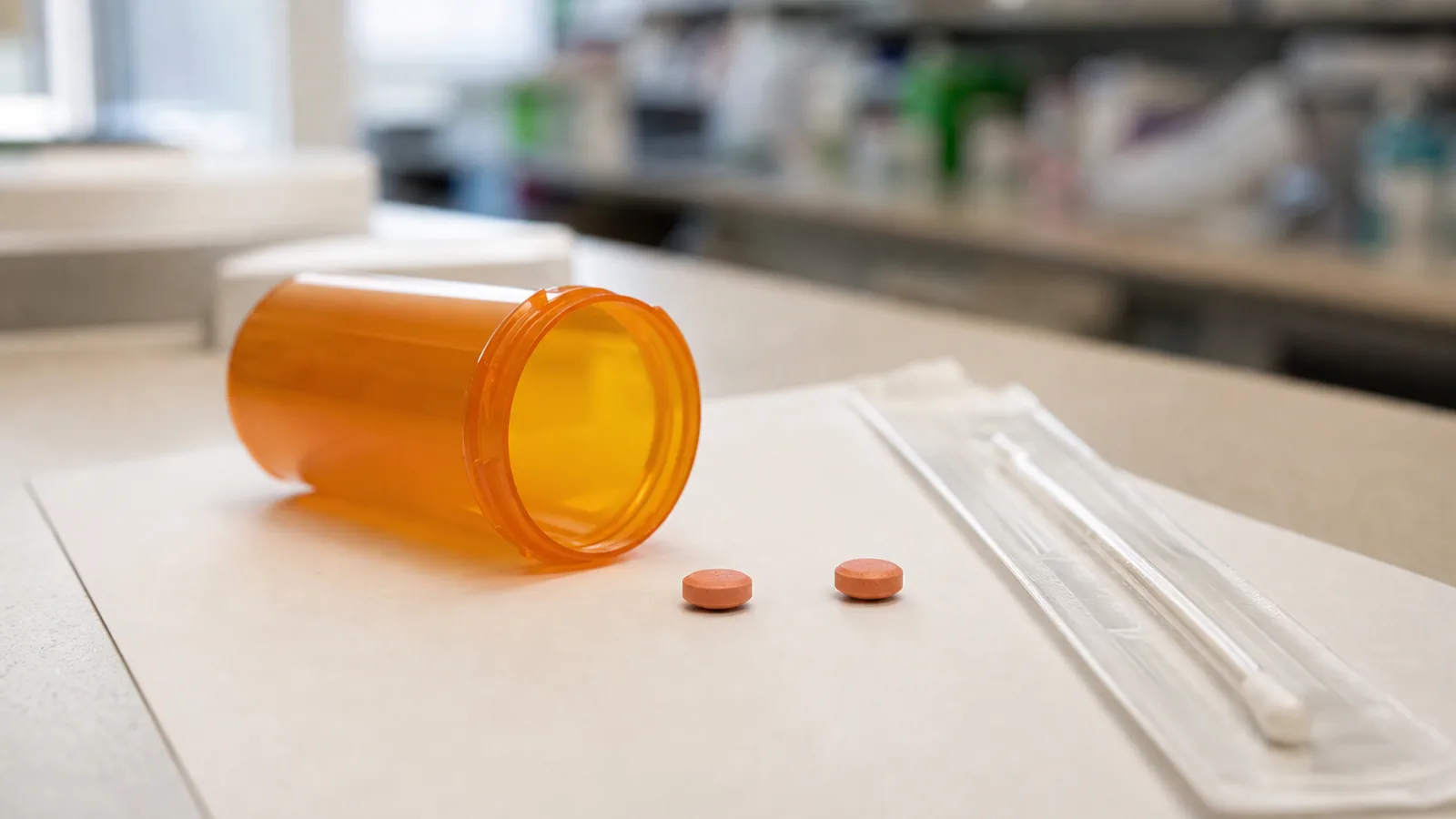
The FDA cleared the first generic of baloxavir on June 17, the one-pill flu drug Roche has sold as Xofluza since 2018, in time for the 2026–2027 flu season. The agency’s press release played the access angle: first single-dose treatment for acute uncomplicated influenza, first new mechanism since the neuraminidase class, available cheaper for patients aged 5 and up. The fact it left out comes from baloxavir’s own pivotal trial. In roughly one in ten treated patients, the influenza polymerase acquired a single amino-acid mutation by day three that sharply blunts the drug’s activity. Generic baloxavir is a clear win on price. It is also a wager on whether U.S. flu surveillance catches that mutation before wider use breeds it into the wild.
To see why both halves matter, start with what the drug actually does and why we waited so long for it. Twenty years passed between Tamiflu’s approval in 1999 and baloxavir’s in 2018, and across that stretch CDC estimates the flu killed somewhere between 6,300 and 52,000 Americans every winter while the antiviral cabinet stayed essentially unchanged. The incentive structure didn’t help anyone in a hurry: Roche and the rest of the industry had a profitable neuraminidase inhibitor still inside its patent window. Baloxavir, when it finally arrived, was a genuinely new mechanism. One oral dose blocks the influenza polymerase’s cap-snatching enzyme, the molecular trick the virus uses to hijack the host cell’s own mRNA-making machinery and turn it into a virus factory. The drug’s long terminal half-life, 49 to 91 hours, is what made the one-pill regimen possible. That part of the pitch has always held up.
The resistance picture hasn’t held up as cleanly. In the CAPSTONE-1 registration trial, the polymerase acquired a substitution at position 38, the I38T mutation, in 9.7 percent of baloxavir-treated adults and adolescents. The mutation appears as early as day three of treatment and is associated with delayed symptom relief, prolonged viral shedding, and rebound viral titers in the patients carrying it. In children the rate ran higher: a published pediatric series during the 2016–2017 Japanese season found I38 resistance in 19.5 percent of treated children, most infected with H3N2. We’ve been at this junction before with a different drug. Seasonal H1N1 picked up the H274Y oseltamivir-resistance mutation during the 2007–2008 season, went nearly universally resistant the following season, and was only reset by the 2009 pandemic strain sweeping the older lineage away.
With baloxavir, the resistant virus is not trapped inside the treated patient. CDC researchers documented a Japanese family cluster in February 2019 in which a 10-year-old took baloxavir, developed the I38T variant, and appears to have passed the resistant virus to an 8-month-old sibling who had never seen the drug. The infant’s virus had a 186-fold reduction in baloxavir susceptibility, and the same season picked up four other baloxavir-naive Japanese children carrying the resistance signature. Japan is also the country with the highest baloxavir uptake on earth, which is exactly the population in which an early signal would surface first.
The other thing the FDA’s “first single-dose treatment” framing softens is that, head to head against the drug it’s competing with, baloxavir’s clinical advantage is narrow. In the registration trials and in subsequent real-world cohort work, baloxavir shortened time to symptom improvement by roughly the same margin as oseltamivir against placebo. The convenience case, one pill versus ten, is genuine. The clinical-superiority case is not. A 2024 Lancet network meta-analysis tried to elevate baloxavir as the only antiviral that may reduce hospitalization in influenza outpatients, but flu-treatment specialists pushed back on the analysis’s dismissal of oseltamivir, noting the included trials were dominated by patients sick enough to qualify for a randomized study but not sick enough to capture the outcomes that matter in the elderly and immunocompromised. None of the antivirals in that review showed a mortality benefit. The honest read is that baloxavir is a convenient drug carrying a resistance liability oseltamivir doesn’t share.
Watch what Genentech did eight months before the FDA cleared the generic. In October 2025 the company launched a $50 direct-to-patient cash program through Alto, Amazon Pharmacy, and Cost Plus Drugs, slicing roughly 70 percent off retail. Roche had booked about $173 million on Xofluza in 2024, a 75 percent jump over the prior year, with the brand retailing somewhere north of $200 a tablet. Call the $50 program access if you want; the timing also looks like a company lowering its own drawbridge before the generic forced it down. Either way, that is the corporate behavior generic threats are supposed to produce, and it is the reason Hatch-Waxman generics matter even before they reach the shelf.
The next data point worth watching isn’t another marketing milestone. It’s the next season’s PA-substitution prevalence in U.S. surveillance reports. If wider, cheaper baloxavir puts the drug into far more pediatric prescriptions, and pediatric patients are the population in which the mutation emerges fastest and from whom onward transmission has already been observed, the public-health calculation is more delicate than the FDA release suggests. Generic naloxone made the country safer in a straight line. Generic baloxavir is more conditional than that, and the condition is surveillance. CDC’s flu-resistance monitoring is the system that has to catch I38T spreading early if this drug is going to stay useful by 2030. Whether that surveillance keeps the funding and staffing it needs through the next quiet flu season is the question that decides whether the cheaper drug stays a good drug.
Sources
- FDA – FDA Approves First Single-Dose Generic Treatment for Influenza (June 17, 2026)
- CDC – About Estimated Flu Burden (annual deaths: 6,300–52,000 between 2010 and 2025)
- Koshimichi et al., Clinical Drug Investigation (2018) – Baloxavir marboxil phase I pharmacokinetics and half-life
- Hayden et al., NEJM (2018) – CAPSTONE-1: baloxavir vs. oseltamivir vs. placebo
- Takashita et al., Frontiers in Microbiology – PA I38 substitution review, including pediatric resistance rates
- Hirotsu et al., CDC Emerging Infectious Diseases (2019) – Human-to-human transmission of baloxavir-resistant H3N2 in Japan
- Gubareva et al., CDC Emerging Infectious Diseases (2008) – Widespread oseltamivir resistance in seasonal H1N1, 2007–08 season
- Yang et al., The Lancet (2024) – Network meta-analysis of antivirals for influenza
- CIDRAP – Flu specialists dispute network meta-analysis dismissing oseltamivir
- CNBC – Genentech launches $50 direct-to-consumer program for Xofluza (October 2025)
- Roche 2024 Financial Report summary – Xofluza sales CHF 152M (~$173M), +75% year-over-year