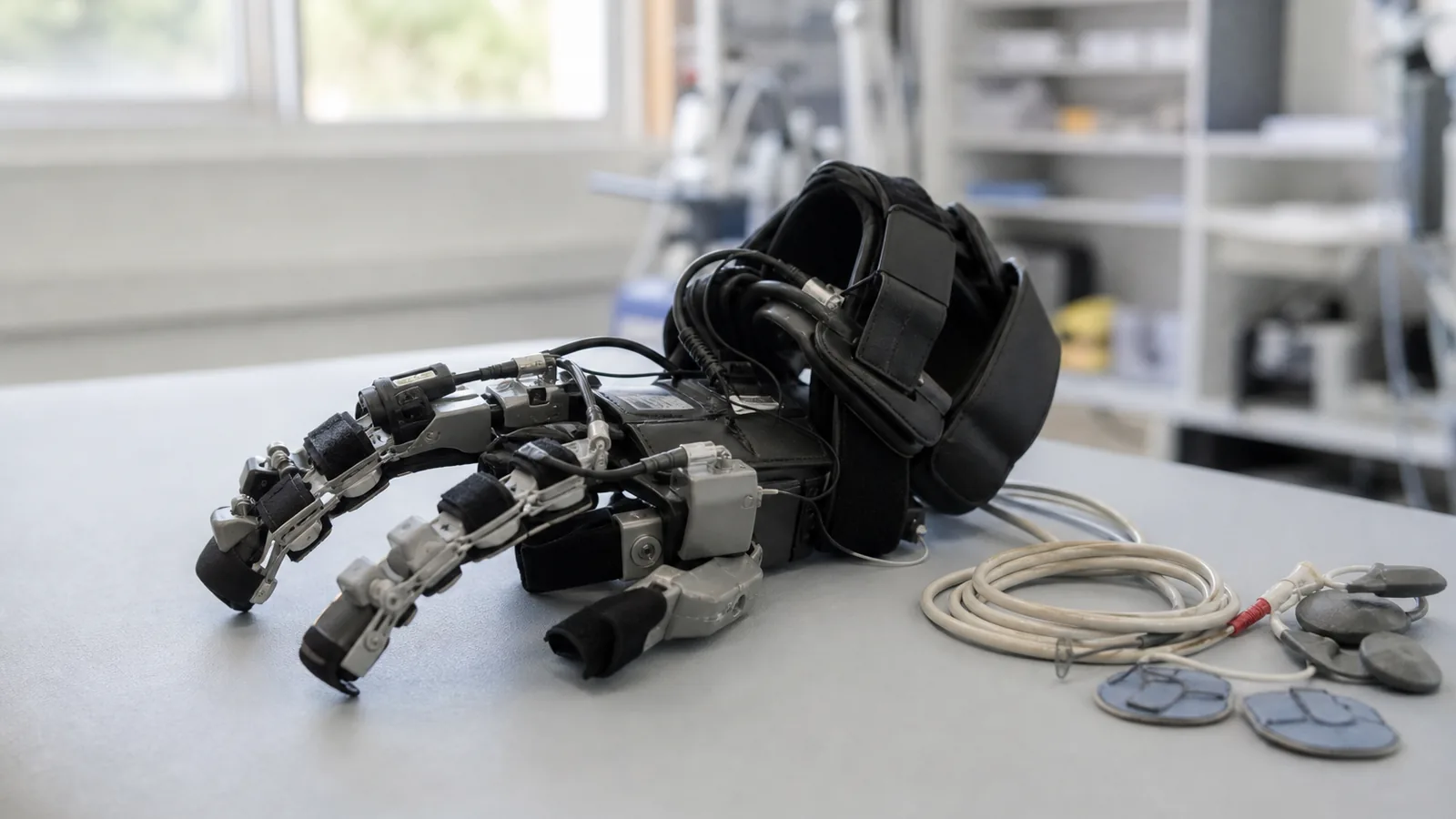
A press release out of the Medical University of Vienna on June 19 says scientists have developed a wearable robotic system to “restore hand function.” The Science Advances paper underneath it tested the device on 14 patients in a single laboratory session. The word “restore” is doing more work than the data can carry.
That gap matters because the robotic glove has been one of rehabilitation engineering’s longest-running promises. Soft pneumatic versions for elderly users in their own kitchens go back at least a decade. Stroke trials of motorized hand orthoses have moved through dozens of small studies, enough that a 2022 systematic review in the Current Journal of Neurology had to sift them just to ask whether any of it was working. Last year, a Cambridge University Press paper in Wearable Technologies coupled the same kind of glove to a wireless task board so stroke patients could rehearse the small motions of daily life. None of these devices has become routine rehab infrastructure. The field has been almost-there for more than a decade.
What the Vienna team, working with collaborators at ETH Zurich, the Technical University of Munich, and the Medical Faculty in Belgrade, actually built is worth understanding on its own terms, because the mechanism is where the story turns. SensoExo is not just a motorized glove. It pairs a hand exoskeleton with a custom-fit neurostimulation sleeve that delivers electrical pulses to the forearm nerves and muscles, plus fingertip sensors that detect touch and grip force and convert those signals back into stimulation the patient can feel. In the seven patients with severe motor impairment, functional electrical stimulation assisted both finger opening and grip strength. The system is trying to close the sensorimotor loop on both ends at once: artificial assistance for the outgoing motor command, and artificial restoration of the incoming tactile signal that lets a healthy hand know how hard it is squeezing a paper cup.
That is a meaningful shift from the pneumatic-glove generation, which mostly powered the fingers and left the patient flying blind on touch. The Vienna team’s three-condition comparison, no support versus exoskeleton alone versus combined exoskeleton plus stimulation, is a sensible design for a feasibility paper, and the combined therapy outperformed the exoskeleton alone in the severely impaired subgroup. Of the eight patients who attempted grasping tasks, muscle stimulation helped with bulky objects, while the artificial sensory feedback helped patients handle fragile ones without crushing them. The team also reports that the artificially mediated touch expanded the area of the hand where patients perceived sensation. If those findings hold up at scale, the closed-loop architecture, not the exoskeleton, is what carries the result.
The trouble starts when you ask what a 14-patient single-session study can actually tell you. It confirms the device works on a bench and on a few bodies. It cannot show whether daily use over months produces durable function gains, the only thing that matters to a stroke survivor trying to button a shirt, and 14 patients is too few to stratify by lesion site, severity, time since injury, or any of the other variables that actually predict who recovers what. The lead investigator, Stanisa Raspopovic, says as much directly: “The technology is currently a prototype and not a fully developed medical device for everyday use.” That sentence is the one the headline should have led with.
There is also a quieter pattern in this corner of the literature. Wearable rehab devices accumulate elegant mechanism papers and impressive single-session results, and they have for years. The translation step, from a lab proof-of-concept to a reimbursed device a clinic can prescribe, is where the field keeps stalling. The 2022 systematic review on robotic gloves in stroke patients catalogued a body of small studies with heterogeneous protocols. What that literature has not yet produced, and what regulators and payers eventually want to see, is multi-month, adequately powered, controlled trials in defined patient groups. SensoExo’s closed-loop design gives it a stronger scientific story than most of its predecessors. It does not give it a shortcut around that requirement.
What to watch next is concrete: a multi-month, home-use trial in a defined subgroup of stroke or spinal-cord-injury patients, with pre-specified motor and activities-of-daily-living endpoints, where the restored sensations have to work in a kitchen and not just a Vienna lab. That is the test that separates devices that reach clinics from devices that pile up citations. Whether the announcement language also tightens up between now and then, from “restore hand function” to something the n=14 dataset can actually defend, will tell you whether the field has learned anything from the long tail of overpromised rehab robotics that came before.
Sources
- News-Medical – Scientists develop wearable robotic system to restore hand function (June 19, 2026)
- Science Advances – Cimolato et al., SensoExo wearable neurorobotic system (DOI: 10.1126/sciadv.ady3144)
- Current Journal of Neurology – Therapeutic effects of wearable robotic gloves on hand function in stroke patients: a systematic review (2022)
- Wearable Technologies (Cambridge) – Interactive soft robotic hand-task training system for post-stroke rehabilitation (2025)
- ICT4AgeingWell Proceedings – Feasibility of a wearable soft-robotic glove supporting hand function in daily life (2016)