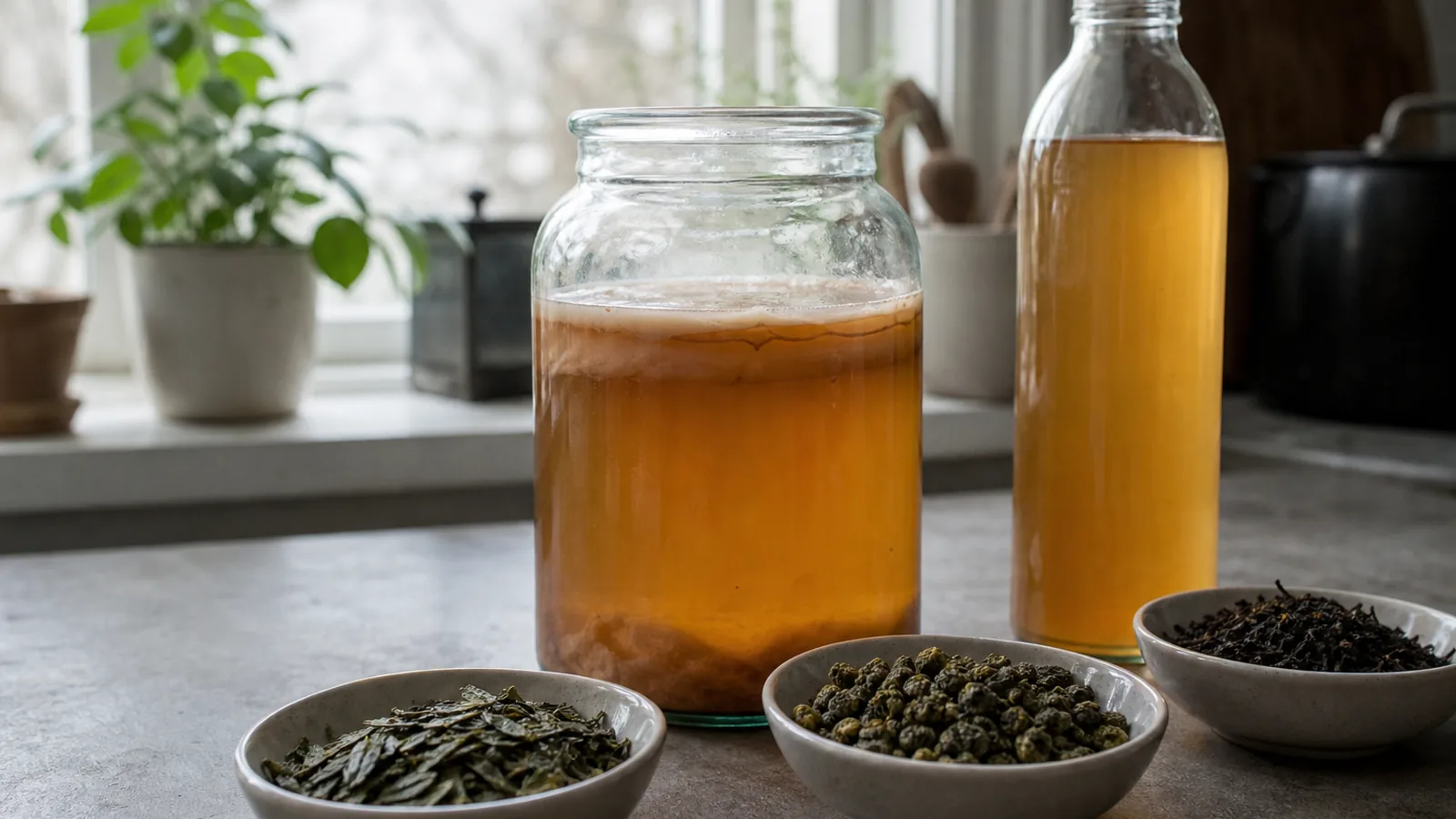
Here is a thing I never thought to ask while paying six dollars for a bottle of fizzy fermented tea: which tea? To me kombucha was always just kombucha, a category, a vibe, a SCOBY in a jar on someone’s counter. But a team in Poland just brewed five kombuchas under the same conditions, changed nothing but the leaves they started with, and watched the antioxidant punch swing wildly depending on what went in. Green and oolong came out strongest. Black and pu-erh trailed. And the single variable that decides which bottle is actually doing the work is the one the label almost never names.
The study, published in Food Chemistry by Helena Moreira, Anna Szyjka, Ewa Barg and colleagues at Wrocław Medical University and the Wrocław University of Environmental and Life Sciences, took black, green, white, oolong and pu-erh tea and fermented each with the same culture. Then they pulled the results apart with chromatography and mass spectrometry, the kind of analytical chemistry that reads a beverage compound by compound. The spread was not subtle. As Moreira put it, “the most surprising aspect was the scale of changes occurring during fermentation and how strongly they depended on the type of tea used.”
That antioxidant ranking matters because the antioxidant halo is basically the entire health pitch on a kombucha label, and here is hard chemical evidence that the pitch is only as true as the tea behind it. The premium price rides on a word the bottle never has to back up.
So why do the teas diverge so far? Not magic. Matrix. “The type of tea acts as a specific matrix that shapes the course of fermentation,” Moreira explained, and individual teas “differ in their content of polyphenols, catechins, caffeine, and other bioactive compounds, which are subsequently metabolized by SCOBY microorganisms.” Sit with what that means. You are not just steeping leaves. You are handing a living community of bacteria and yeast a different raw pantry each time, and they cook a different meal from each one. Green tea arrives loaded with delicate catechins, and the SCOBY works that starting material toward one chemical destination. Pu-erh, already aged and oxidized before it ever meets the culture, sends fermentation somewhere else entirely.
The aroma data makes the divergence almost cinematic. The researchers found elevated linalool and 2-phenylethanol, the floral, rose-and-citrus compounds you would recognize from perfume, blooming up out of the oolong and green ferments. Green kombucha read fresh and vegetal, oolong went floral and fruity, and black tea and pu-erh turned earthy and heavy, fermentation-forward in that funky way. Same culture, same conditions, and five completely different sensory worlds, because the leaf wrote the recipe.
This isn’t a one-off, either. An earlier kombucha comparison running white, green, black and red tea bases landed in the same neighborhood: green tea kombucha held the highest polyphenol content, around 320 mg/L late in fermentation, with the strongest antioxidant readings, while black tea sat at the bottom near 183 mg/L. Two independent teams, same punchline. The tea you choose is the biggest lever on what your kombucha actually delivers, and it is the one variable the marketing skips.
Let me be straight about what this study is and isn’t, because “antioxidant” is the most abused word on any wellness shelf, stamped on everything from chocolate to bottled water as if the molecule were a blessing. This is careful in-vitro chemistry. It measured what is in the bottle and how well those compounds mop up free radicals in a test tube. It did not put kombucha in front of a single human being, and Moreira says so plainly: “further clinical studies are necessary to clearly confirm the impact of particular types of kombucha on human health.” No funding disclosure accompanied the announcement, and no cell, animal, or human testing was part of this round. Higher antioxidant capacity in a beaker is measurable and meaningful. It is not a health outcome in you, and I won’t pretend that gap doesn’t exist.
But here is what I make of it. The wellness industry sells kombucha as one undifferentiated promise per shelf while quietly charging premium prices, and this research says the promise holds only on a condition that is printed nowhere. If you want the bioactive payoff people are reaching for, the chemistry points at green and oolong bases, not the black tea most kombucha starts from. That is the kind of specific, checkable, do-it-yourself fact the supplement aisle hates and I love. Next time I brew a batch, I’m starting with green. And next time I buy one, I’m turning the bottle around to see whether they’ll even tell me what tea is in it. My bet is most won’t.
Sources
- ScienceDaily – “The tea in your kombucha changes more than just the taste” (2026)
- Food Chemistry – Chandran, Moreira, Szyjka, Barg et al., tea-matrix modulation of kombucha (2026; 514:149160)
- Wrocław Medical University – “From tea to kombucha” study announcement with researcher quotes
- Phys.org – five-tea comparison of kombucha aroma and antioxidant activity (2026)
- Antioxidants (PMC7278673) – chemical profile and antioxidant activity of kombucha from white, green, black and red tea
- EurekAlert! – “From tea to kombucha” research release