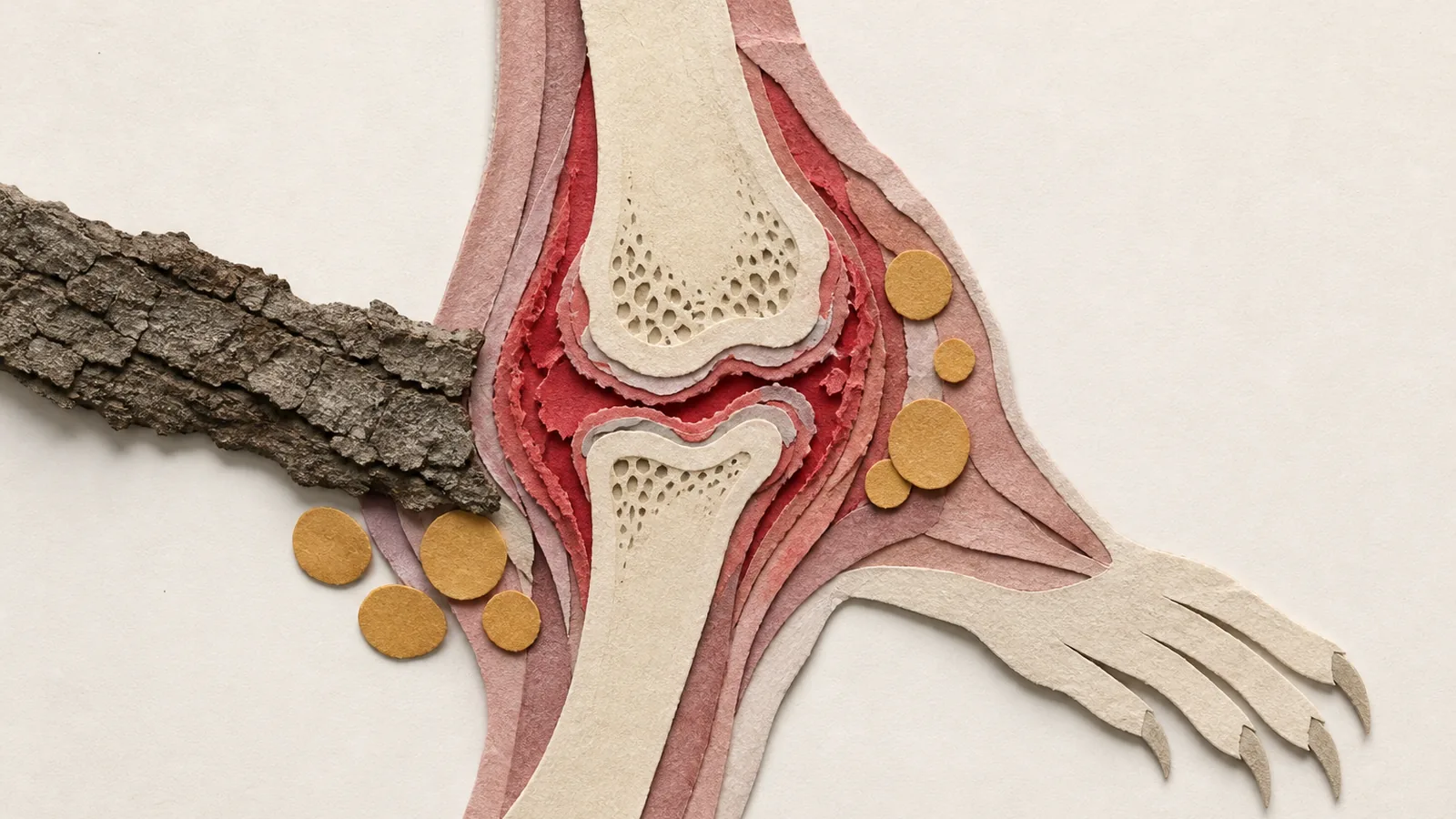
I have a reflex when a headline promises that some ancient tree bark cures a modern autoimmune disease: I close the tab. Most of the time that instinct serves me well. This one cost me. The study underneath the headline is chasing something far stranger than a folk remedy, because the bark compound quieted arthritis in rats by reaching, from upstream through the cell’s fat metabolism, the exact signaling pathway that the black-box arthritis drugs are built to shut off head-on. Fat metabolism and swollen knuckles. I had never once put those two things in the same sentence.
The compound is obakulactone, a tetracyclic triterpenoid pulled from Phellodendri cortex, the bark of the Amur cork tree that has sat in the Chinese herbal cabinet for centuries. In a paper published in the journal Engineering, a team led by first author Hongda Liu gave it to rats whose joints had been deliberately inflamed with complete Freund’s adjuvant, the standard way to provoke an RA-like inflammatory arthritis in the lab. Three doses, 50, 100, and 200 milligrams per kilogram per day, for 21 days.
The swelling came down. Histology showed the cartilage damage and the synovial inflammation, the joint lining that turns to aggressive scar tissue in rheumatoid arthritis, easing back toward normal. And the inflammatory signals that drive the disease fell in step with the dose: IL-1β, IL-6, IL-17, and TNF-α. Two of those, TNF-α and IL-6, are the exact cytokines that today’s blockbuster biologic drugs are built to neutralize.
Here is where I stopped skimming. The target obakulactone locks onto is not an immune receptor at all. It is ACOT1, acyl-CoA thioesterase 1, an enzyme whose job is managing how cells handle fatty acids. Wait, why would a fat-processing enzyme have anything to do with an autoimmune attack on your knuckles? That is the question the study actually chases, and the answer rearranges how you picture the disease.
Follow it downstream. Obakulactone binds ACOT1 and tags it for destruction through the ubiquitin-proteasome pathway, the cell’s shredder. With ACOT1 gone, a downstream enzyme called SCD1 quiets, and the two signaling highways that keep inflamed joint cells multiplying and scarring, JAK-STAT and PI3K-AKT, go quiet with it. The balance of unsaturated fatty acids resets, arachidonic acid, linoleic acid, and α-linolenic acid pulled back toward normal, and the greasy inflammatory byproducts those fats throw off, leukotriene B4 and prostaglandin E2, fall away. The joint’s resident immune cells even switch character, the macrophages sliding from their inflammatory M1 state toward the repair-minded M2. The metabolism had been feeding the inflammation the whole time.
And this is the part that should unsettle the people selling the current drugs. JAK-STAT is not some obscure target. It is the target. Tofacitinib (Xeljanz), baricitinib (Olumiant), and upadacitinib (Rinvoq), the JAK inhibitors that pull in billions treating rheumatoid arthritis, work by blocking that exact pathway directly, at the end of the signaling line. They also carry an FDA black-box warning for heart attack, stroke, blood clots, cancer, and death, added after Pfizer’s own ORAL Surveillance trial found tofacitinib could not clear the safety bar set by older TNF blockers. Obakulactone reached the same pathway from the other end, by resetting the fat metabolism feeding into it. Whether coming at JAK-STAT from upstream would actually spare patients the clots and the cancers is precisely the question a rat cannot answer, and precisely the question worth paying to ask. The authors pitch the work as an answer to a familiar problem: current RA drugs, on their telling, deliver limited efficacy at the cost of serious side effects. Hard to argue.
So here is the unglamorous part, the one a wellness headline will never print. This is rats. Twenty-one days, an adjuvant-induced arthritis model that has flattered a long line of compounds that went on to do nothing in people. And obakulactone’s grip on ACOT1 is loose: a dissociation constant of 6.18 and 6.34 micromolar across two independent binding assays, the lead-level range where medicinal chemists start optimizing, not where a finished drug sits. The paper discloses no funding source, and it comes from a pharmacology group working to validate a compound from the traditional Chinese pharmacopeia. None of that makes the biology wrong. It makes it unfinished.
The question I keep sitting with is who pays for the human trial. A compound scraped from tree bark is far harder to fence behind a clean patent than a molecule built from scratch, and thin exclusivity is exactly how promising natural-product leads stall in the preclinical drawer for want of a sponsor. So I am not about to go chew cork-tree bark, and neither should you; the isolated compound at a controlled dose is the whole point, and no one has tested that in a human yet. What I will do is watch obakulactone closely, read every line of the first human trial if one ever gets funded, and refuse to let an upstream metabolic signal that reaches the black-box drugs’ own pathway die quietly just because a tree is too hard to own.
Sources
- Engineering – Liu et al., “Obakulactone Alleviates Rheumatoid Arthritis by Promotion of ACOT1 Degradation via the Ubiquitin–Proteasome Pathway and Restoration of Unsaturated Fatty Acid Homeostasis” (2026)
- Engineering (journal of record) – same study, official landing page
- EurekAlert – press release detailing the ACOT1 binding, SCD1/JAK-STAT/PI3K-AKT cascade, and M1-to-M2 macrophage shift
- ScienceDaily – “Natural compound may fight rheumatoid arthritis at its source”
- Healio – FDA adds black-box warning to JAK inhibitors over heart events, cancer, and death
- Journal review (PMC) – efficacy and safety of tofacitinib, baricitinib, and upadacitinib, including ORAL Surveillance
- Molecules (MDPI) – review of Phellodendri amurensis cortex: phytochemistry and pharmacology