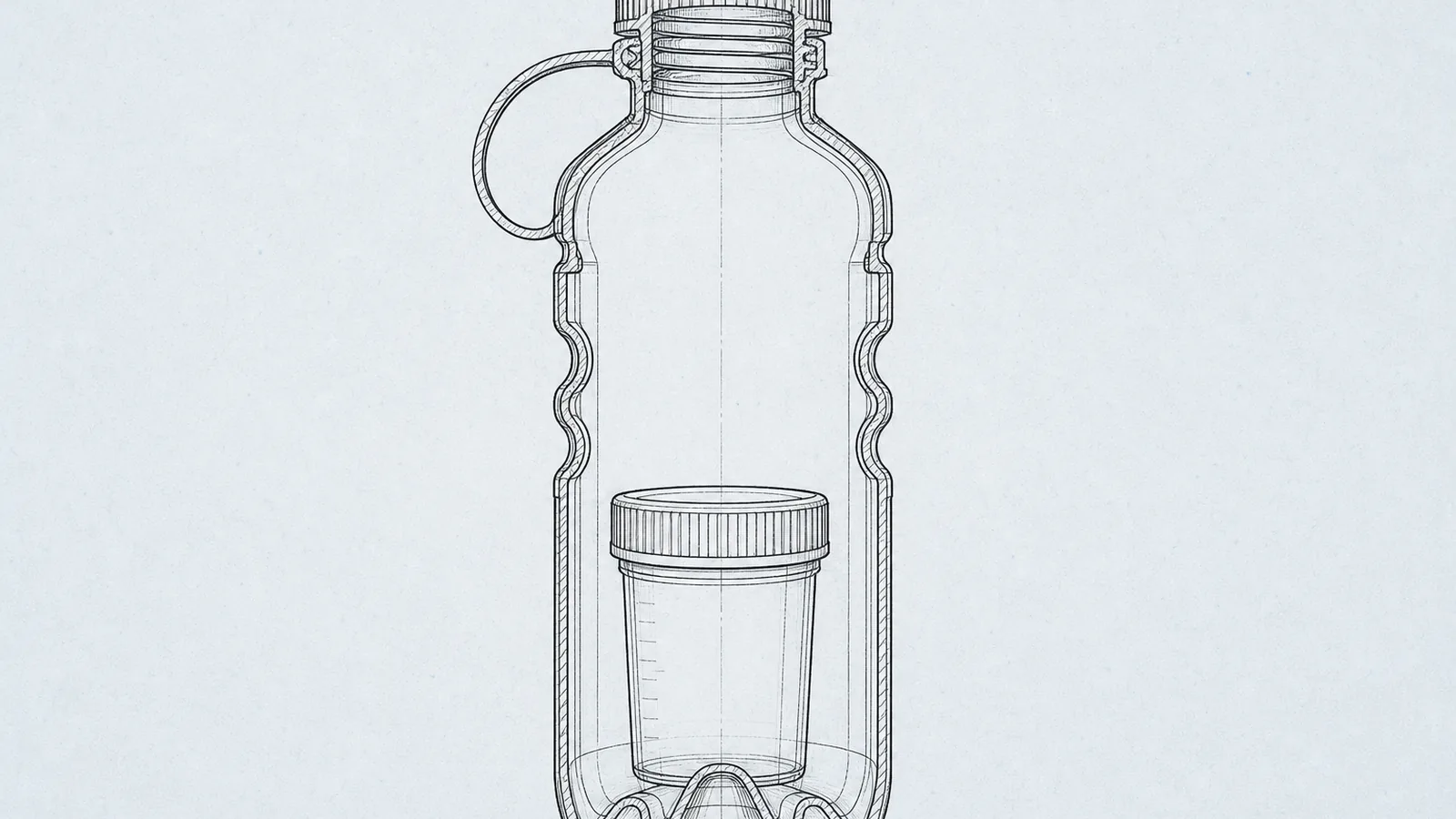
I bought the “BPA-free” water bottle years ago and quietly filed the whole question as settled. Someone had run the studies, someone had decided, and the label was my receipt. So the thing that stopped me this month was not a scary new finding. It was the opposite: a careful review of decades of human research on bisphenol A and cancer that landed on one deflating word. Inadequate.
The word wasn’t “safe,” and it wasn’t “dangerous.” It was “inadequate,” which is to say that after all this time we still cannot tell whether BPA causes cancer. And once I read how the reviewers got there, that verdict stopped sounding like a shrug and started sounding like an indictment of the ruler, not the chemical. We built the measurement wrong, then called the result clean.
The review, published in July 2026 in Environmental Health with an explicit emphasis on exposure assessment, combed the epidemiologic literature and reached the same place California’s own carcinogen reviewers have long sat: the human evidence is inadequate to say whether BPA causes cancer. It concentrated on the two cancers where the worry runs loudest, breast and prostate, the tissues an estrogen-mimicking chemical would be expected to touch. And here is the part I had to sit with. BPA is not some rare, exotic exposure. It is detectable in more than 90 percent of the people tested, because it leaches out of can linings, thermal receipts, and polycarbonate and into us on a more or less continuous drip.
You would think a chemical that universal would be the easy one to study. It is almost impossible, and the reason is both elegant and infuriating: your body is very, very good at getting rid of it. Swallow BPA and your gut and liver grab it fast, tag it, and flush it. Its half-life is short, a matter of hours, not days. So when a study measures your BPA from one spot urine sample on one afternoon, wait, what is that number actually capturing? Not your year. Not your decade. Roughly what passed through you since breakfast. The epidemiologists say this out loud: we should not assume that a single urine sample represents exposure over time. Take that one snapshot, sort thousands of people into “high” and “low” on the strength of it, and you have not measured anyone’s lifetime BPA. You have measured their morning. The people who study how BPA exposure gets assessed keep circling the same wall.
And it gets worse for the studies, which is to say more interesting for us. The exposure that may matter most is not the coffee you drank this morning. It is the exposure that reached you before you were born. BPA behaves like estrogen, and the developing breast and prostate are exquisitely tuned to hormone signals arriving at the wrong moment. A whole line of work on fetal BPA exposure and cancer argues the truly vulnerable window is early development, decades before any tumor announces itself. No adult spot-urine study will ever catch that. You cannot sample a sixty-year-old man’s urine today and learn what his mother’s placenta was soaking in in 1974.
When researchers do force an answer out of the spot-urine data anyway, the result should embarrass everyone. One NHANES analysis of 8,035 adults, followed for about 7.5 years, produced a U-shaped curve: people in the second-lowest BPA quartile had a hazard ratio of 0.51 (95% CI 0.30 to 0.86) for cancer death compared with the lowest-exposure group. Read literally, that says a little BPA nearly halves your cancer risk, which no one believes and no plausible biology explains. It is exactly the shape measurement error throws off when your exposure ruler is this noisy.
So here is where my curiosity turns cold. “Inadequate evidence” is not a neutral scientific resting place. In the machinery of chemical regulation it is the single most valuable verdict a manufacturer can get, and the mechanism is concrete. Under California’s Proposition 65, a chemical gets a warning label only after reviewers affirmatively find it causes cancer. An “inadequate” finding is not that finding, so there is no listing, no label, and no required change. The cans keep their lining, the receipts keep their coating, and the burden of proof stays exactly where industry likes it: on you, to demonstrate harm, using studies built so they can never quite demonstrate it. BPA has been parked in this permanent “we can’t tell” for years, and the limbo is worth a fortune to the people selling it.
The cruelest part is the escape hatch that turns out not to be one. When “BPA-free” became a selling point, manufacturers swapped in the cousins, BPS and BPF, structurally close analogs that carry the same endocrine worries and that the research has barely begun to catch up on. Systematic reviews that biomonitor workers exposed to all three already treat them as one family. My reassuring “BPA-free” bottle may just mean I traded a chemical we failed to study for one we have barely begun to.
I am not going to pretend a spot-urine dataset can tell me my personal risk. It cannot, and that is the whole point. But I have stopped reading “inadequate evidence” as “fine.” To me it now reads as an unfinished job the regulators, the funders, and the industry-friendly toxicology programs could have finished thirty years ago and chose not to. So I do the unglamorous things the biology actually supports: I skip canned food when the fresh version is right there, I never microwave anything in plastic, and I decline the paper receipt. None of that is a cure and I am not selling one. It is just what I do while the people who could have measured this properly keep telling me they can’t.
Sources
- Environmental Health – BPA and cancer: a critical review of the epidemiologic literature with an emphasis on exposure assessment (2026)
- Bisphenol A and cancer: a prelude to challenging epidemiology (PMC)
- OEHHA – Evidence on the Carcinogenicity of Bisphenol A
- Frontiers in Public Health – Urinary BPA and cancer mortality, NHANES prospective cohort (2024)
- Food Research International – Methodological approaches for the assessment of bisphenol A exposure (2023)
- Annales d’Endocrinologie – Development gone awry: fetal exposure to bisphenol A and cancer (2025)
- Science of the Total Environment – Biomonitoring of occupational exposure to BPA, BPS and BPF: a systematic review (2021)