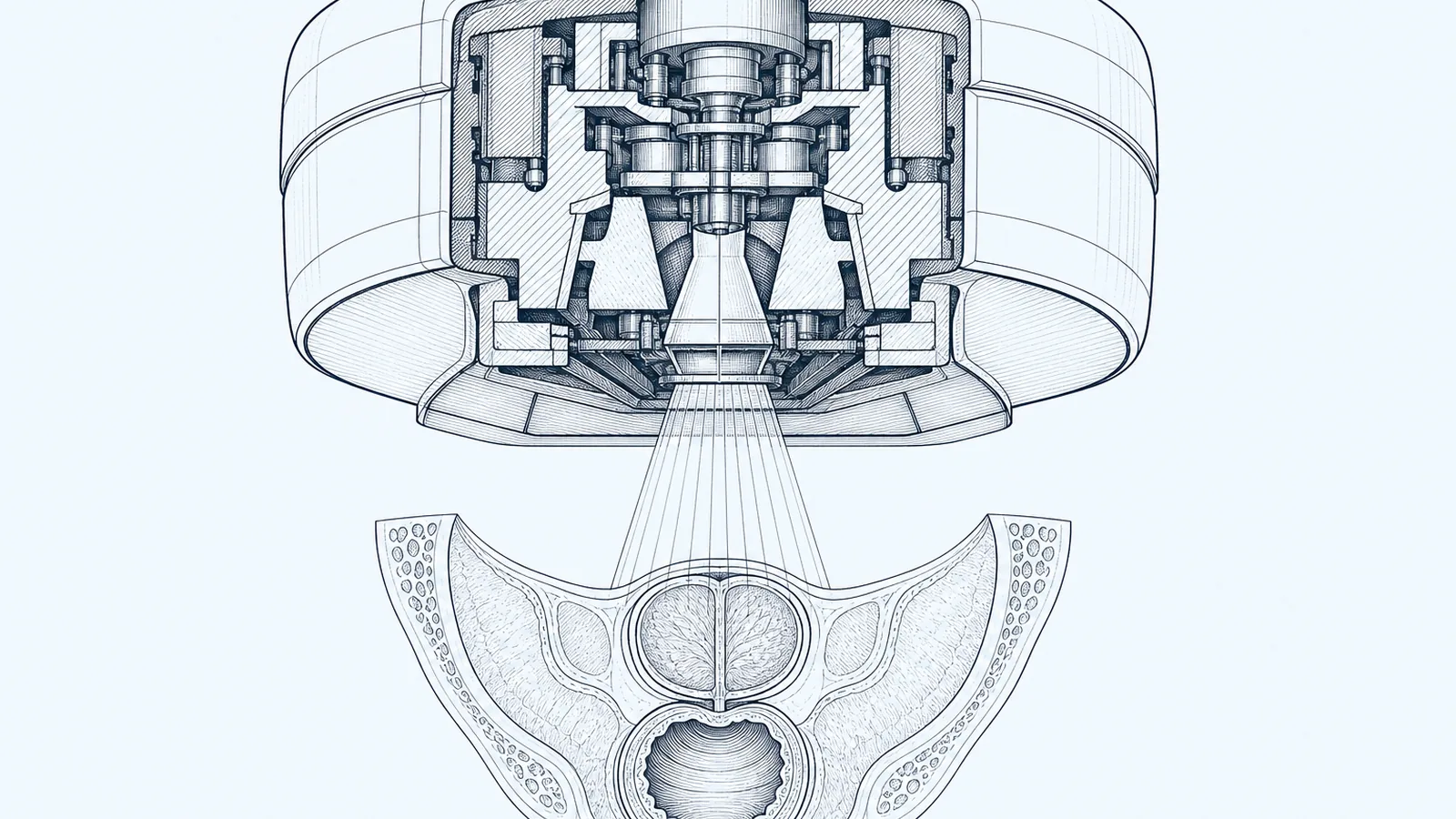
A man told he can be done in a week rather than a month tends to take the week. That is the quiet gravity underneath five-fraction prostate radiation, and it is why, when the Royal Marsden’s PACE-C investigators reported in the summer of 2025 that the shorter course was as safe as the four-week one, the finding traveled fast. The trialists had measured harm two ways. They led with the ruler that showed no difference. On the finer one, the men who got the accelerated beam came out worse.
Start with what they ran. PACE-C randomized 1,208 men with intermediate-risk or high-risk prostate cancer, all of them started on six months of hormone-suppressing androgen deprivation, to one of two beams. Half got moderately hypofractionated radiotherapy, 60 Gy across 20 daily sessions over four weeks, the workhorse schedule. Half got stereotactic body radiotherapy, SBRT, 36.25 Gy in just five sessions over one to two weeks, a bigger dose per visit aimed with tighter margins. The question the trial set for itself first was early toxicity, the gut and bladder trouble that shows up during treatment or within twelve weeks of it.
On the scale the headline rested on, the two schedules looked interchangeable. Using the older RTOG grading system, grade 2 or worse genitourinary toxicity landed at 27 percent for the four-week course and 28 percent for the five-day course. Bowel toxicity came in at 11 percent versus 13 percent. Neither gap cleared statistical significance. That is the sentence that got quoted.
The same men were also scored on a second, finer ruler, the CTCAE system, and there the columns stopped matching. Grade 2 or worse gastrointestinal toxicity was 10 percent after the four-week course and 17 percent after the five-day one, a difference the trial’s own statistics flagged as real (p=0.0011). Bladder toxicity leaned the same way, 28 percent against 34 percent, sitting right on the line of significance (p=0.050). The coarse scale saw no difference. The fine one did.
None of this is catastrophe. Grade 3 events, the kind that put a man in a procedure room, stayed at or below 1 percent in both arms, and no one died of the treatment. But “as safe” is a claim about safety, and the more sensitive instrument these same investigators chose to use recorded the accelerated schedule doing measurably more damage to the bowel of the men who received it. Which measurement you lead with is an editorial decision, and the field led with the one that flattered the shorter course.
There is a larger absence sitting behind the toxicity argument. The reason a man lies still for the beam at all is whether it controls his cancer, and on that question PACE-C has not reported. Its efficacy endpoint, freedom from biochemical or clinical failure, is not yet mature. So the current enthusiasm is for convenience and roughly comparable early side effects, banked well ahead of any answer to whether the five-day course controls cancer as well as the four-week one in these higher-risk men.
The lower-risk predecessor offers a reference point, and it comes with a footnote worth reading. PACE-B tested SBRT in low-to-intermediate-risk men who took no hormones, and its five-year outcomes had 95.8 percent of the SBRT group free from failure against 94.6 percent on the standard schedule, statistically non-inferior. Encouraging, as far as it goes, and it goes as far as low-risk disease. That trial was funded by Accuray, the company that sells the machines that deliver SBRT. It does not make the numbers wrong. It does mean the technique’s foundational safety-and-efficacy story was underwritten by the vendor with the most to gain when clinics adopt it, and that is the kind of detail that belongs in the room when the next chapter arrives wrapped in the word “safe.”
It is worth being honest, too, about the word that pulled this into wide circulation to begin with. The topic rode a heavily shared video titled, flatly, “prostate cancer cure.” Cure is a heavy word, and in the brachytherapy literature it rests on a surrogate: a PSA reading at or below 0.2 ng/mL four years out. Not a body cleared of disease. A blood number under a threshold.
The specialty’s own journals have started circling the same discomfort. A 2023 NIH-funded lab study reported that ablative radiation “improves survival but does not cure” mouse models of prostate cancer, a preclinical result rather than a verdict on what the beam does in men, but a pointed choice of words all the same. A 2026 European Urology Oncology editorial ran under the title “The Price of Cure”; a 2024 paper asked whether androgen deprivation is the cure for prostate cancer or a driver of mortality. The men in PACE-C were all on that hormone therapy, in both arms, which is its own question about what “the treatment” even refers to.
The Royal Marsden team wrote that the two courses were similarly safe, and on the ruler they chose to headline, they were. The finer column in their own table, the one recording 17 percent of SBRT men with grade 2 bowel toxicity against 10 percent on the older schedule, is still sitting there for anyone who reads past the conclusion.
Sources
- The Lancet Oncology – Tree et al., PACE-C early toxicity results (2025)
- The ASCO Post – PACE-C early toxicity, MHRT vs SBRT in intermediate/high-risk prostate cancer (June 2025)
- The ASCO Post – 5-year outcomes from PACE-B (October 2023)
- The Lancet Oncology – Tree et al., PACE-B 2-year toxicity; trial funded by Accuray (2022)
- Brachytherapy – King et al., ABS consensus (biochemical cure after LDR brachytherapy defined as PSA ≤0.2 ng/mL at 4 years) (2021)
- Communications Medicine – ablative radiotherapy improves survival but does not cure mouse prostate/colorectal cancer (2023)
- European Urology Oncology – “The Price of Cure: Rethinking Success in High-risk Prostate Cancer” (2026)
- Journal of Cancer Research and Therapeutics – androgen deprivation therapy: cure or driver of mortality? (2024)
- YouTube – “Prostate cancer cure” (originating trending video)