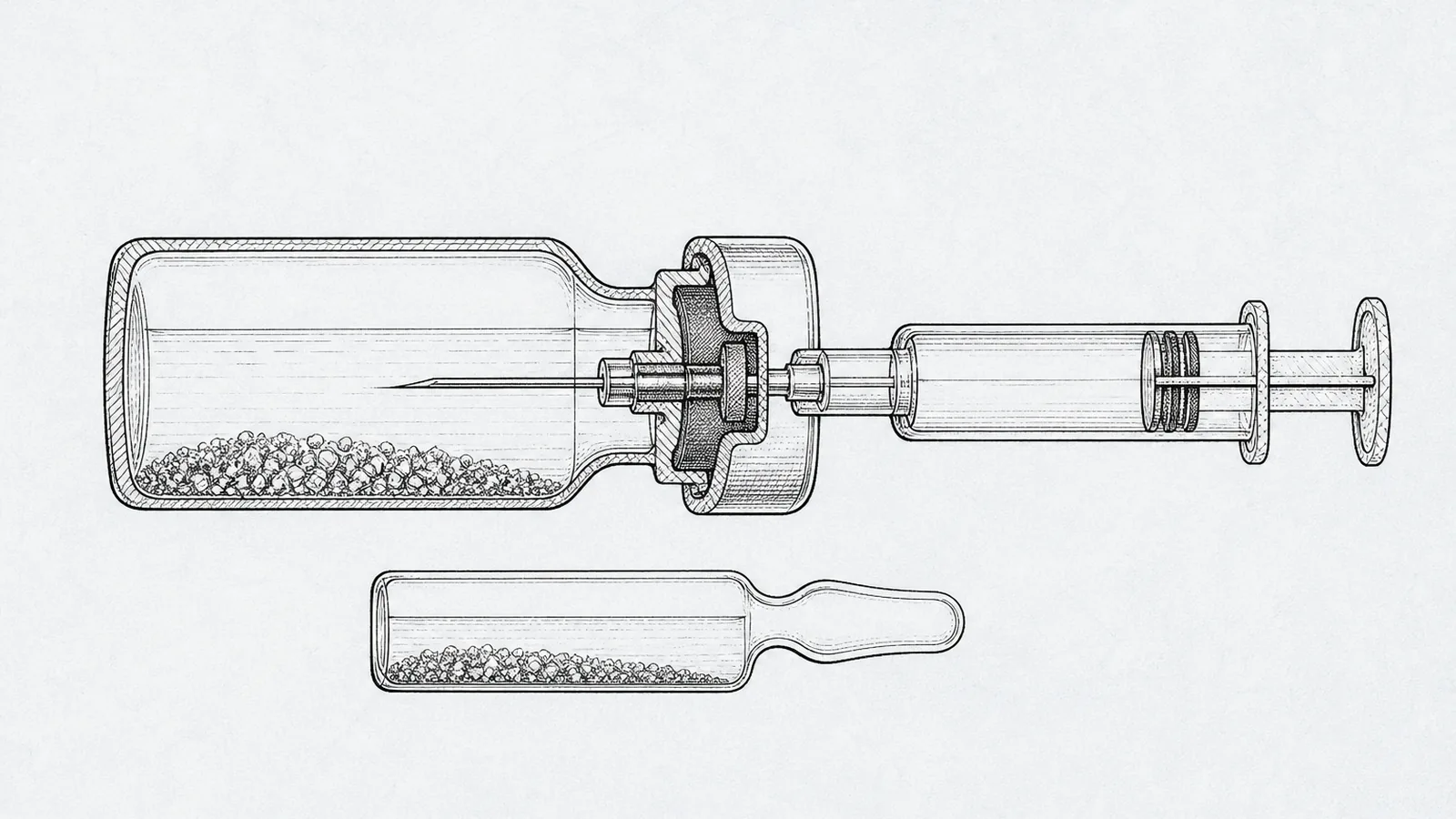
The recruitment materials handed to young Danish women in Merck’s FUTURE II trial called the injection “saltvand,” saline, and told them the study was “NOT a side effect study.” The trial protocol, carrying the same sponsor’s name, listed the comparator as 225 micrograms of aluminum and named safety as a primary objective. Both documents describe the same needle going into the same arms. Only one of them is true.
Nearly two decades later, a biostatistician Merck’s own lawyers sat down and deposed put the problem in one sentence. “By responding to safety concerns about the Gardasil vaccine with reports and studies that are fatally flawed,” Martin Kulldorff wrote in his expert report, “Merck has done a great disservice to public health, irrespectively of whether there is a problem with the vaccine or not.” Read the qualifier twice. Kulldorff is not claiming the documents prove Gardasil maimed anyone. He is claiming something narrower and harder to wave off: that Merck built its trials so the question could never be answered.
The comparator was the adjuvant
A placebo is supposed to be inert. It exists so that everything the vaccine does, and nothing else, shows up in the difference between the two arms. An inert comparator is the only way to isolate what the vaccine does from what the aluminum does. That is the entire logic of the design.
In the Gardasil program, the comparator was not inert. According to the peer-reviewed reconstruction by Lucija Tomljenovic and Leemon McHenry in the International Journal of Risk & Safety in Medicine, 10 of the 11 pivotal V501 trials used Merck’s proprietary amorphous aluminum hydroxyphosphate sulfate, AAHS, as the “placebo.” AAHS is not a bystander. It is the adjuvant, the component engineered to provoke the immune system hard enough to drive the high, durable antibody response the vaccine is sold on. Merck injected the biologically active ingredient into the control group and called it a control.
The consequence is not subtle, and it comes out of Merck’s own data. The authors document that headache, fever, nausea, and dizziness turned up at similar rates in the Gardasil arm and the AAHS “placebo” arm. That similarity is presented, to this day, as reassurance: the vaccine looks no worse than placebo. It is the opposite of reassurance. When your comparator can produce the same injuries as your product, matching rates do not clear the product. They mean the instrument cannot see. The Nordic Cochrane Centre put it in one line, which Tomljenovic and McHenry quote: an active comparator “may make it impossible to detect serious harms of the HPV vaccines in the randomized trials if comparators cause the same or similar harms.”
There was exactly one trial, V501-018, that used a genuinely inert carrier solution instead of the adjuvant. It enrolled 1,781 children aged 9 to 15. FUTURE II, the trial whose recruits were told the shot was saltwater, enrolled 12,167 on the aluminum comparator. The clean comparison ran on the smallest population. The aluminum comparison carried the safety database.
And the clock ran for fourteen days
The second design choice is about time. In the expert reports filed in the litigation, Peter Gøtzsche, founder of the Nordic Cochrane Centre, describes how Merck logged serious harms: every serious adverse event was collected for 14 days after each injection, and after that window a serious event entered the count only if a study investigator judged it related to the shot. Autoimmune conditions, the category at the center of the injury claims, do not keep to a two-week schedule. They surface over weeks, months, years. A fortnight-long window does not measure them. It closes the door before they arrive, and Gøtzsche’s reading is that the design excluded the large majority of the events that mattered.
Put the two choices together and the picture is not of a study that failed to find a signal. It is of a study assembled so that a signal, if one existed, had nowhere to register. That is what Kulldorff means by fatally flawed, and it is why his qualifier is the honest part rather than a hedge. The documents establish how the safety question was handled. They do not, and cannot, establish what the answer would have been under an inert protocol.
Follow the money, on both sides of the table
The scale is worth stating. Gardasil sales grew 29 percent to $8.9 billion in 2023, one of the largest franchises Merck has ever owned. A product that size does not get a skeptical in-house safety review. It gets a defense.
The rule is to follow the money wherever it runs, including toward the people making the accusation. Kulldorff was paid as an expert witness for the plaintiffs. That is a fact, it is disclosed, and it belongs in the story. It is also not an answer. A paid statistician’s arithmetic on a placebo’s composition is either right or wrong on its own terms, and the check he cashed does not change what the protocol says the comparator contained. Reuters and the trade press have made his contract the headline. The 225-micrograms line in the protocol has drawn no comparable coverage.
The two facts have moved on different clocks since. On June 9, 2025, Health Secretary Robert F. Kennedy Jr. fired all seventeen sitting members of the CDC’s Advisory Committee on Immunization Practices and named replacements two days later. Kulldorff chaired the reconstituted committee before moving in December 2025 to a senior HHS science post. The new ACIP stood up an HPV working group whose charter, finalized that same December, directs it to review “the potential toxicity of HPV vaccine, adjuvants, and potential contaminants.” In February 2026, Stanford infectious-disease professor Jake Scott answered in a CIDRAP op-ed arguing the field had already settled the adjuvant and safety questions the working group wants to reopen. The messenger’s contract gets litigated in public. The two-week window and the aluminum comparator do not.
One document that could have forced a public reckoning stayed sealed. Jennifer Robi, in a wheelchair since sixteen after three Gardasil doses in 2010 and 2011, settled with Merck on confidential terms before a Los Angeles jury could weigh the expert reports. A settlement is not an admission. It is also not disclosure.
So the record sits where it started. The trial-design files that Kulldorff and Gøtzsche read are held by the sponsor that wrote them and by an HHS working group that has announced a multi-year review it has not completed. No pivotal trial ran an inert comparator at the scale needed to catch a rare autoimmune signal, because that comparison was reserved for the 1,781-patient cohort and the aluminum arm carried the rest. Until someone commissions the study Merck never ran, the safety of Gardasil is not established or refuted by the pivotal trials. It is untested, dressed as tested, and the people who could order the honest version have not.
Sources
- Tomljenovic & McHenry – A reactogenic “placebo” and informed consent in Gardasil trials, Int. J. Risk & Safety in Medicine 35(2):159–180 (2024)
- Children’s Health Defense – Merck Designed Gardasil Trials to Mask HPV Vaccine Harms (Gøtzsche expert report)
- Maryanne Demasi – Kulldorff Exposes HPV Vaccine’s Illusion of Safety (2026)
- BioSpace – Two of Kennedy’s New ACIP Picks Were Paid Expert Witnesses in Merck Vaccine Cases
- CIDRAP – Op-Ed: The HPV vaccine prevents cancer. The new ACIP wants to re-examine that.
- Children’s Health Defense – California Woman Confined to Wheelchair Settles With Merck Over HPV Vaccine Lawsuit (Robi v. Merck)
- BioSpace – Merck Posts $60B in Sales for 2023 Driven by Keytruda, HPV Vaccine