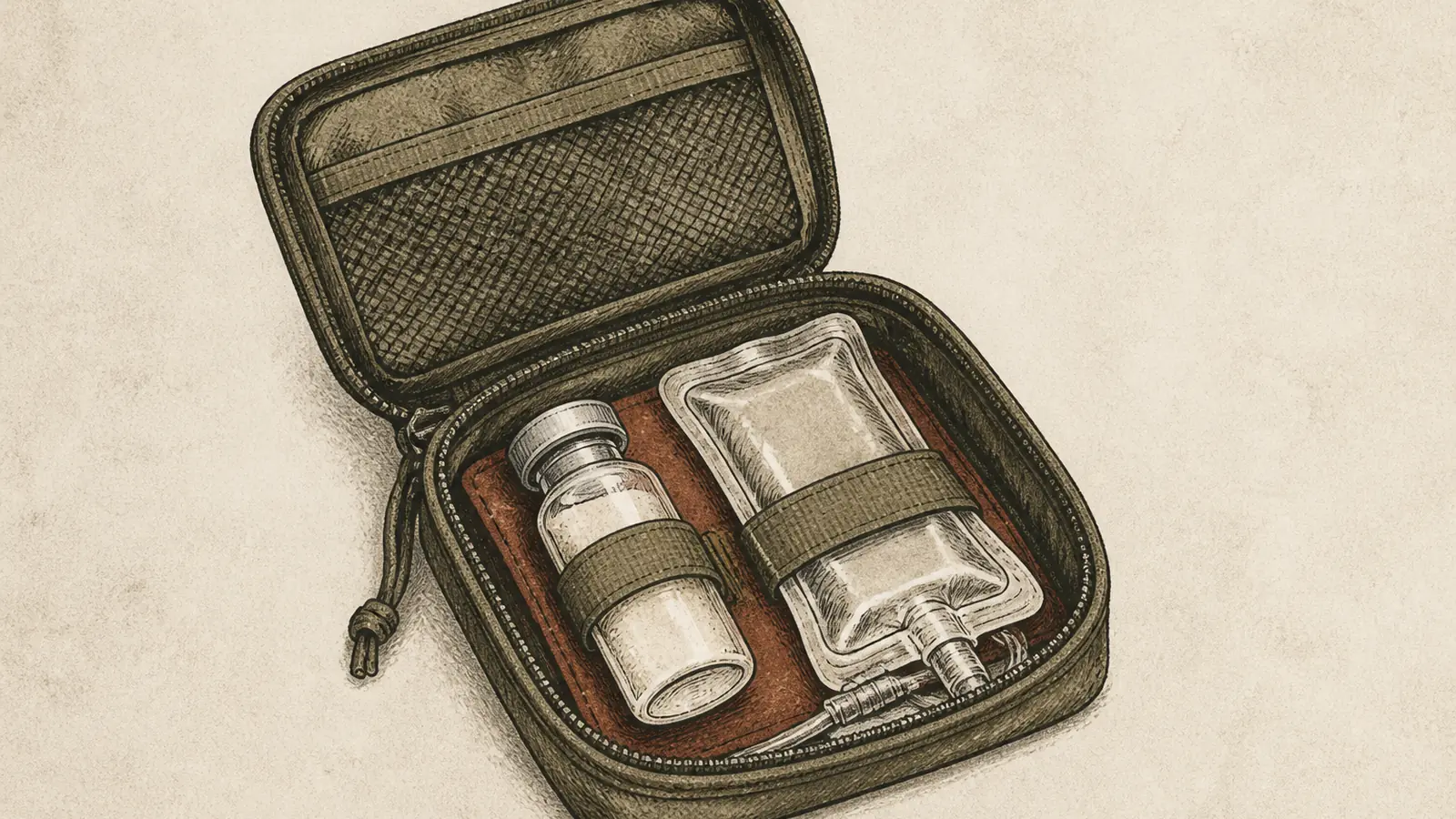
I always assumed the reason you cannot keep plasma in a backpack was chemistry. Plasma is where the clotting factors live, the fibrinogen and the fragile proteins that keep you from bleeding out, and I figured those were simply too delicate to survive outside a deep freezer. Powdered plasma sounded like a modern trick, some stabilization science we cracked recently.
Then I checked the date. An American physician named Max Strumia worked out how to dry human plasma into a shelf-stable powder in 1938, at a hospital outside Philadelphia. The chemistry was solved before my grandmother was born.
- 1938Strumia dries human plasma
- 2011U.S. special operators carry French FDP
- 2014Teleflex-DHA collaboration begins
- 2026FDA licenses a U.S. version
So read the FDA’s announcement carefully. On July 29, 2026 the agency licensed Ezplaz Freeze Dried Plasma, the first freeze-dried plasma product ever licensed in the United States, granting the biologics license to Vascular Solutions LLC, a subsidiary of the device maker Teleflex. Useful news. It is also, once you know the history, an almost comic admission of how far behind we let ourselves fall. Our own special operators have carried the French version of this powder into combat since 2011, obtained through FDA exception pathways because no licensed American product existed to hand them. Fifteen years passed before we made our own.
Here is how the powder is made, because the process is the fun part. You take a single unit of ordinary fresh frozen plasma, collected at a licensed blood bank, and freeze it solid. Then you pull it into a vacuum and let the ice go straight from solid to vapor, skipping the liquid stage entirely. The water leaves; the proteins stay behind as a dry cake, folded and intact. Why does that spare them? Because it is liquid water moving through proteins, freezing and thawing, that pulls them apart, and here the water is locked in place by the cold the whole time it exits. I had this backwards. I assumed heat or age was the enemy, when the enemy was the water itself. The result is plain: the process preserves much of the plasma’s coagulation activity through storage. Add sterile water when a patient needs it and the plasma reconstitutes in about one to two and a half minutes.
And here is why the format matters when someone is bleeding on a highway or a battlefield: it sits on a shelf at room temperature. Teleflex lists storage anywhere from 2 to 25 degrees Celsius, a twelve-month shelf life, shipped in a flexible plastic bag instead of the breakable glass bottles older versions used. No freezer, no thawing rig, no thirty-minute wait while a frozen unit warms up as someone loses blood. Ezplaz is licensed for adult patients who need plasma when other plasma products are not available, which is exactly the gap that opens in the back of an ambulance, in a helicopter, in an aid bag, or in a small hospital that never had a plasma freezer. Hemorrhage is the leading cause of preventable death in trauma, and it kills on a clock this format is built to beat.
The design leans the same way. Ezplaz comes in blood group AB, and in group A with low-titer anti-B antibodies below 1:200, so it can be given before anyone knows the patient’s blood type, which is the whole problem when a stranger is bleeding at the scene. Canadian trauma physicians have spent years making the case for exactly this kind of prehospital plasma.
None of this is where the story should end, though, because the United States did not merely dabble in dried plasma. During World War II we produced more than 10 million units of it and shipped them overseas. Then we walked away. Demand fell after the war, and the plasma of that era was pooled from many donors into single batches, which turned out to be an efficient way to spread viral hepatitis, so the programs were suspended here and abroad. At the time, that was an honest reason.
But notice what the reason actually was. The hazard was the pooling, not the drying. Modern freeze-dried plasma like Ezplaz is made from a single donor unit, screened the way every blood product is screened, which sidesteps the pooled-donor mechanism that let hepatitis spread through those wartime batches. That fix has been on the table for decades. The French Military Medical Service, the German Red Cross, and South Africa’s National Bioproducts Institute all manufacture regulator-approved dried plasma, and Canada, the Czech Republic, France, Germany, Israel, Norway and the United Kingdom all field it. Our allies answered this question a long time ago.
So walk the timeline. An American invented the powder in 1938. Our allies have fielded it under regulatory approval for years. Our own special operators have carried the French version into firefights since 2011, pushing it into a bleeding soldier’s vein through an FDA exception because Washington had licensed nothing they could use. Teleflex’s collaboration with the Defense Health Agency’s Warfighter Protection and Acute Care program dates to April 2014. Twelve years from that agreement to a license, for a product older than the widespread use of penicillin. The chemistry was never the holdup. What was missing was a regulator willing to move at the speed of the evidence, and a domestic manufacturer, now a for-profit Teleflex subsidiary with a commercial stake, to spend twelve years finally carrying it across the line.
If I were the one bleeding on the shoulder of a road, I would want that powder in the truck, no argument. But knowing how long it sat within reach while our allies and our own medics used it, I will not read “first-ever” as a boast. I read it as a receipt for the wait.
Sources
- FDA – FDA Licenses First-Ever Freeze-Dried Plasma Product in the U.S. (July 29, 2026)
- Teleflex – Announces FDA BLA Approval of EZPLAZ Freeze Dried Plasma (storage, reconstitution, blood groups, indication, DHA collaboration)
- PMC – Dried Plasma: An Urgent Priority for Trauma Readiness (Strumia 1938, WWII production, postwar hepatitis suspension, allied programs, U.S. special-ops use since 2011)
- Canadian Journal of Surgery – Whole blood and freeze-dried plasma in Canadian trauma care
- Military Medicine – Retention of Coagulation Factors and Storage of Freeze-Dried Plasma