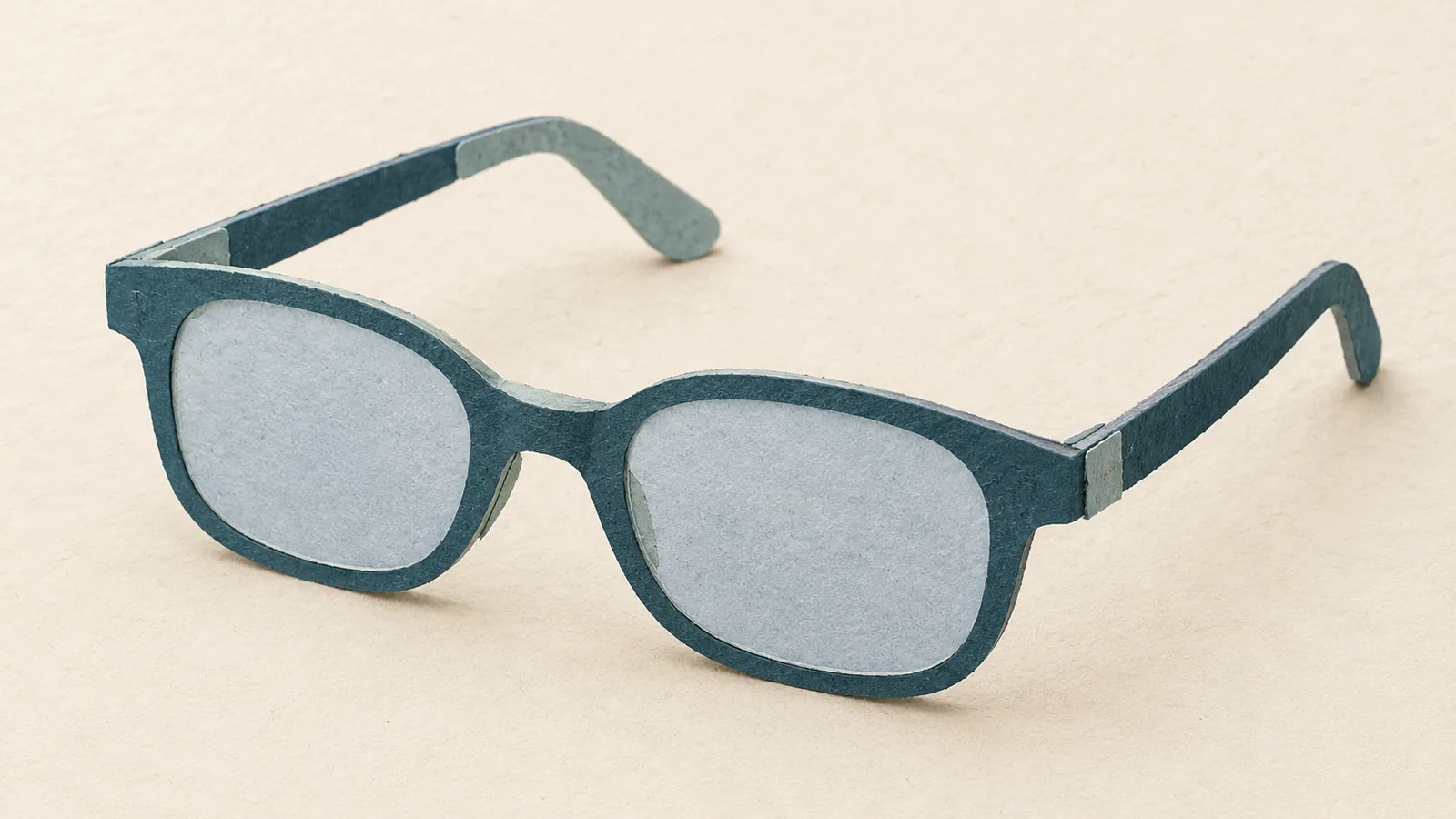
Yang Xiao had six months of data and a company symposium to present it at. The venue was this autumn’s European Society of Cataract and Refractive Surgeons congress in London, the host was EssilorLuxottica, and the product was Essilor Stellest 2.0, a children’s spectacle lens meant to slow nearsightedness. “The treatment response appears to be effectively twice as fast,” Xiao, a principal investigator at Sun Yat-sen University’s Zhongshan Ophthalmic Center, told the room, according to Healio. The arithmetic behind that sentence set the new lens’s six-month result beside the original lens’s one-year result, and the two results came from two different trials.
In a randomized, double-masked trial in China, children wearing Stellest 2.0 showed 0.51 diopters less myopia progression and 0.21 millimeters less eye growth after six months than children in ordinary single-vision glasses. A separate Chinese study of the first-generation Stellest had reported 0.53 diopters and 0.23 millimeters after a year, Healio reported, so six months against twelve with nearly identical numbers became “twice as fast.” Each of those figures, though, is a gap between a lens and its own control group, and nothing in the public account shows that the two sets of children matched in age, starting prescription, hours of wear or how quickly their untreated counterparts’ eyes were lengthening. A faster-progressing control arm, on its own, would make a lens look quicker. Healio’s account of the new trial gives no enrollment figure at all.
The company had a better instrument, and had already used it. In November 2025, EssilorLuxottica announced a one-year randomized contralateral crossover trial published in Translational Vision Science & Technology, in which 50 Singaporean children aged 6 to 10 wore the new design over one eye and the original over the other for six months, then swapped. That is the head-to-head comparison the company points to, and its release reports “significantly higher efficacy” for the new lens without saying how much higher. The doubling in that release belonged to the optics, a lens “delivering twice the power.” The clinical doubling turned up later, in London, assembled from two trials that never shared a child.
The lens the FDA has seen
The first lens earned its place. On September 25, 2025, the FDA authorized Essilor Stellest through its De Novo pathway for children aged 6 to 12, the first eyeglass lenses cleared in the United States to slow childhood myopia. The condition is common enough to matter: Michael Repka, a pediatric ophthalmologist at Johns Hopkins, told Scripps News that 30 to 40 percent of American children will be nearsighted by the time they finish high school.
The authorization rested on a double-masked randomized trial at nine U.S. sites that JAMA Ophthalmology published in August 2026, eleven months after the agency acted. It enrolled 159 children, and 135 completed the 24-month visit. Over two years, children in single-vision glasses progressed by an adjusted 0.90 diopters and children in Stellest by 0.25, an adjusted difference of 0.64 diopters (the arm figures are rounded) that produces the widely quoted 71 percent reduction. Eye growth was 0.21 millimeters against 0.45, a 53 percent reduction, and children aged 6 to 8, whose eyes change fastest, saw an 87 percent relative reduction in progression. Ocular adverse events occurred in 9 of 77 children wearing Stellest and 12 of 82 in ordinary glasses, none serious or lens-related. For a pair of glasses, that is a strong showing.
The fine print sits right beside it. The trial’s primary endpoint is at 36 months; the 24-month data were analyzed early, under a penalized statistical threshold, to support the regulatory submission, and children more nearsighted than −4.50 diopters were excluded. The first author, Jason Shen, is EssilorLuxottica’s director of vision science research, and the studies were funded by EssilorLuxottica, Healio reports. Shen’s summary, that “myopia in children can be actively managed rather than simply corrected,” reads well as science and better as a sales line.
What happens when the glasses come off is the question every parent eventually faces, and the two-year paper, which followed children while they were still wearing the lenses, does not answer it. A 2023 systematic review of children who stopped optical myopia treatments included a 50-child crossover trial of spectacle lenses with highly aspherical lenslets, the design family behind Stellest. Eye growth ran at 0.12 mm a year during six months of wear and 0.34 mm a year in the six months after the lenses came off, which the reviewers classed as a strong rebound. Six months is a short window and those children averaged about 11, older than Stellest’s youngest wearers, but it is the kind of number a family deserves to hear before the prescription, not after.
One family, from trial to till
EssilorLuxottica’s interest does not end at the lens. Through Luxottica, a subsidiary since 2018, the group owns LensCrafters and the vision insurer EyeMed, and the original Stellest carries a suggested retail price of $450. The same corporate family funds the trials, employs the lead author of the pivotal paper, makes the lens, runs a national optical chain and owns an insurer, and its chief operating officer, Davide Schinetti, called the six-month “magnitude and speed” of the response “very encouraging.” No single fact there is a scandal. Together they are why a cross-study “twice as fast” deserved a slower read than it got.
The other London account was looser still. Mark Bullimore of the University of Houston, speaking at the pediatric ophthalmology subspecialty day held alongside the congress, presented the new lens as having shown “the ability to stop myopia progression in its tracks” over six months, and cited no specific statistics, according to Ophthalmology Times, which added that the one- and two-year data “are expected to be even more informative.” Stellest 2.0, meanwhile, is already sold in China, Malaysia, France, the United Kingdom and Canada. The FDA cleared the first lens. It has not cleared the second.
Forty minutes of recess
Sun Yat-sen University has tested a myopia intervention on children before, one with nothing to sell. In 2015, Mingguang He’s team published a cluster randomized trial in JAMA of 1,903 first-graders at twelve Guangzhou primary schools, six of which added one 40-minute outdoor class to every school day and urged parents to send children outside after school and on weekends. After three years, 30.4 percent of children in those schools had become nearsighted, against 39.5 percent in the control schools, 9.1 percentage points fewer cases of a lifelong condition from a timetable change. “Our study, as a randomized trial, is able to prove causality,” He said at the time.
The outdoor class does a different job from a lens, and its limits count as much as Stellest’s do. It cut how many children became myopic but barely moved the refraction of the group as a whole, a difference of 0.17 diopters over three years, with no statistically significant difference in eye growth. Repka, in an editorial on the study, called the effect “very modest” and said it “should not be overstated.” For a child who is already nearsighted and getting worse, the lens has the stronger trial record. For a child who isn’t yet, a randomized trial of 1,903 schoolchildren found that 40 extra minutes outside reduced new cases, and that intervention has no suggested retail price.
The original Stellest is industry-funded and its long-term picture is incomplete, but it is randomized, masked, published and meaningfully effective. Stellest 2.0 has six encouraging months, a 50-child crossover study whose effect size its own announcement left out, and a speed claim built from two separate trials. Xiao’s longer-term data will arrive eventually, and the claim will then have to stand on one trial instead of two. Until then, the most accurate words spoken in London were the three the headlines dropped: the response, Xiao said, “appears to be” twice as fast.
Sources
- Healio: Myopia control twice as fast with Essilor Stellest 2.0 lenses (2026)
- Optometry Times: JAMA Ophthalmology trial of highly aspherical lenslet spectacle lenses (2026)
- Ophthalmology Times: Stellest 2.0 early trial results at ESCRS 2026
- He et al., JAMA (2015): time outdoors at school and myopia, randomized clinical trial
- Chiu et al., Journal of Clinical Medicine (2023): myopia progression after cessation of optical interventions
- MarketScreener: EssilorLuxottica release on the Stellest 2.0 crossover study (2025)
- Contemporary Pediatrics: FDA authorizes Essilor Stellest eyeglass lenses (2025)
- Scripps News: New FDA-approved glasses can slow nearsightedness in kids
- Sun Yat-sen University: report on the 2015 outdoor-time trial
- Luxottica overview, including LensCrafters and EyeMed