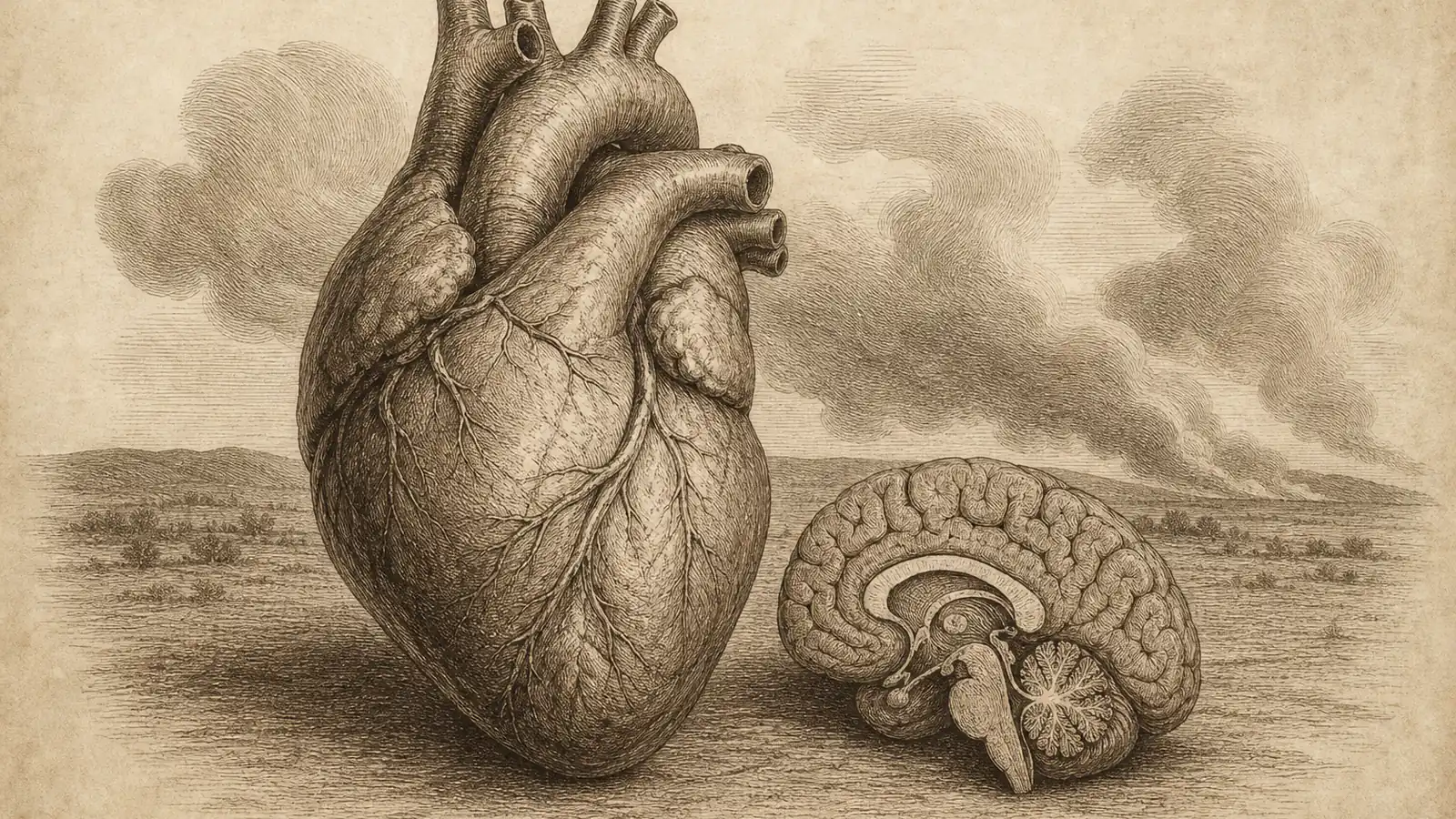
For most of my life I filed wildfire smoke under “lung problem,” the kind you cough your way through, mostly a worry for the people who live close enough to the trees to watch the ridge line glow. I was wrong on both counts, and it’s the second one I keep turning over. The people getting hurt are not only the ones being evacuated. A lot of them are far from any flame, breathing an orange sky and feeling fine, while the damage lands in a driveway or an emergency room days later.
Right now that sky is over Europe. The Lancet opened this month’s issue by calling the fires a health emergency, and for once the word is not inflation. Fires across France and Spain have burned hundreds of square miles, forced 330,000 people out of homes and holiday towns, and grown so hot they are spinning up their own weather, pyrocumulonimbus clouds that throw lightning and start the next fire. By late July the evacuation count across the two countries had passed 360,000, with the threat sliding east toward Greece, Italy, and central Europe.
That is the emergency you can see. The one I want to talk about is the plume, because the plume does not respect an evacuation map, and what it carries has a strange habit of showing up in organs that have nothing to do with breathing.
I went and read the toxicology because one assumption of mine turned out to be wrong. We tend to treat fine particulate matter, the PM2.5 that regulators track, as one thing measured by weight: so many micrograms per cubic meter, worse when the number is higher. But a 2021 study in Nature Communications, covering Southern California from 1999 to 2012, found that the particles in wildfire smoke are not interchangeable with the particles in ordinary city haze. Per unit of mass, wildfire PM2.5 drove up respiratory hospitalizations by roughly 1.3 to 10 percent for every 10 micrograms, versus 0.67 to 1.3 percent for the same weight of everyday urban pollution. Wait, why would the same amount of “dust” do several times the damage depending on where it came from? Because it is not the same dust. Wildfire particles are mostly carbon, heavy on the reactive organic compounds a burning forest and a burning house release, and that chemistry gives them more oxidative punch. Your body reads a microgram of smoke as a bigger insult than a microgram of smog.
And it does not stay in the lungs. Particles that small slip out of the air sacs and into the bloodstream, and once they are circulating they start doing the thing your cardiologist worries about: lighting up inflammation, roughing up the lining of your vessels, and nudging your autonomic nervous system toward the wrong rhythm. That same review lays out how fast this moves. Volunteers breathing wood smoke stiffened up within 24 hours, their arteries measurably less springy than after clean, filtered air. During Australia’s 2006 to 2007 fire season, a jump of about 9 micrograms of smoke PM2.5 over a two-day window was tied to a nearly 7 percent rise in out-of-hospital cardiac arrests, with the sharpest hit landing on men and older adults. These are not people who were burned. They were downwind, and their hearts stopped in a driveway or a kitchen.
Then there is the finding I did not see coming, and it lands right on my beat. When California burned in 2020, a team led out of Harvard’s Chan School combed through 86,609 mental-health emergency-room visits from that July through December and matched them against the wildfire-specific smoke in the air. For every 10-microgram bump in that smoke, visits for mood-affective disorders rose 29 percent, visits for depression rose 15 percent, and anxiety visits rose about 6 percent. The effect was not same-day and gone. It stretched out as long as a week after the haze lifted, which means the sky can look clean again while the nervous system is still catching up. The burden fell where it usually does: women’s depression visits rose 17 percent, youth visits for mood disorders jumped 46 percent, and among non-Hispanic Black Californians mood-disorder visits more than doubled, with steeper increases among Hispanic and Medicaid patients too. Smoke, it turns out, is not only something you inhale. It can pour into your mood a full week later, and I cannot stop thinking about how many of those visits got written off as a bad week rather than an exposure.
| Measure | Value |
|---|---|
| Mood disorders | 29 |
| Depression | 15 |
| Anxiety | 6 |
So the science is solid, and the establishment is not wrong that this is an emergency. My quarrel is with what the word buys the actual human being standing under the orange sky. The Lancet editorial does what most of the institutional response does: it pivots fast from the smoke to the summit, to the climate framing and the international declarations. Physicians are at least starting to treat wildfire smoke as a real clinical exposure rather than a nuisance, which a 2024 JAMA clinical review reflects. But notice what almost never rides in on the emergency language: a plain, fund-it-now push to get particle-filtering respirators, box-fan filters, and clean-air rooms into the homes of the pregnant women, asthmatic kids, and heart patients living downwind. It is a lot easier for an institution to declare a planetary crisis than to hand your grandmother a HEPA filter, and the gap between those two is exactly where ordinary people get left holding the risk.
That gap is why I stopped waiting for the guidance to catch up. I keep a box-fan filter and a couple of real N95s in a closet now, and the day the map turns orange I run the filter and close the house up rather than waiting for an official alert, because the arteries stiffen within a day and the mood effects run a week past the haze, so an all-clear on the air-quality map is not an all-clear for the body. If there is a cardiac patient or a small kid in your house, I would not treat clean-looking air as the all-clear either. The flames have a perimeter. The smoke does not, and neither, it turns out, does the harm.
Sources
- The Lancet – “Wildfires: a health emergency” (editorial, 2026)
- JAMA Network Open – Jung et al., 2020 California wildfire PM2.5 and mental-health ED visits (2025)
- Circulation Research – “Impact of Wildfires on Cardiovascular Health” (2024)
- Nature Communications – Aguilera et al., wildfire PM2.5 vs. other-source PM2.5 and respiratory health (2021)
- JAMA – “Wildfires and Human Health” clinical review (2024)
- PBS NewsHour – 330,000 displaced by wildfires in southwestern Europe (2026)
- Al Jazeera – More than 360,000 evacuated as wildfires rage in France and Spain (2026)