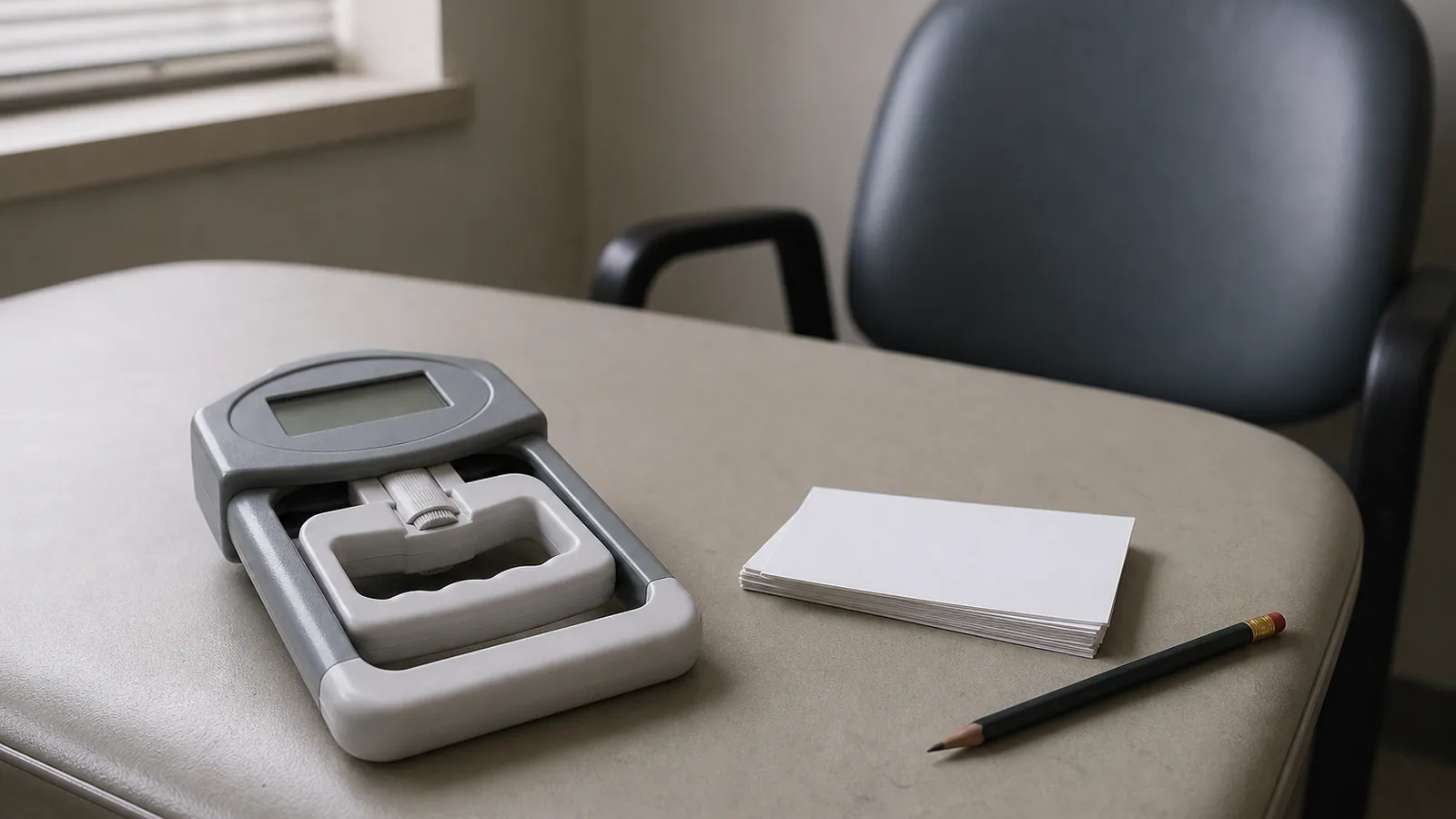
Grip strength is the line I keep getting stuck on in this paper. Word recall too. Those are not feelings or self-report. A dynamometer reads what your hand can squeeze. A memory test counts how many words you can hold for a minute and say back. Both numbers, for the average American walking around at fifty, are worse than they were a generation ago. In the new cross-national paper that documents this, sixteen peer countries ran the same measurements, and the United States is the only one moving meaningfully backward on all of them.
The study landed this month in Current Directions in Psychological Science, with Frank Infurna at Arizona State as lead author and collaborators at Humboldt-Berlin, Brandeis, and the University of Ghana. They pulled harmonized data from the Gateway to Global Aging Initiative, which stitches the U.S. Health and Retirement Study together with Europe’s SHARE, England’s ELSA, and parallel cohorts in China, South Korea, and Mexico. Seventeen countries, tens of thousands of adults between forty and sixty-five, birth cohorts running from the 1930s through the early 1970s. The question was simple: is a fifty-year-old today different from a fifty-year-old thirty years ago, and does the answer depend on the country?
In most of the world, things are roughly stable or actually better. The paper’s Nordic Europe cluster (which the authors define unusually, lumping Denmark, the Netherlands, and Sweden) improved across loneliness and mental health. Mexico shows fewer depressive symptoms and better memory in newer cohorts. England, continental Europe, South Korea, and China land in the middle, varying by measure. The United States is the consistent outlier on the wrong side of every one. Episodic memory in the American sample fell across generations. Memory at the same age in Europe has been rising, which is what you would expect from a century of better schooling and fewer head injuries. We went the other way.
I want to be careful here, because the researchers are careful. They are not saying the average American is cognitively impaired at fifty. They are saying that on standardized tests of word recall and grip strength (and grip strength is a load-bearing biomarker of aging, predicting mortality, fall risk, and cognitive decline better than almost anything that simple has any right to), each new U.S. cohort has performed worse than the one before, while Europeans the same age have improved or held steady. A population-level finding, not a clinical diagnosis. But a population-level finding about an entire generation of fifty-year-olds is exactly the signal you do not want flashing yellow.
So why us? The framing the press release foregrounds, and the one most coverage will adopt, is the policy story: paid leave, subsidized childcare, weaker family supports in the U.S. Infurna’s “sandwich generation on steroids” line, middle-aged Americans pinned between parents living longer with worse chronic disease and adult children priced out of independent adulthood, names a structural pressure the chronic-stress literature has been measuring for years.
But that explanation alone does not carry you from “Europe has better childcare” to “American fifty-year-olds are physically weaker and remember fewer words.” There is something heavier underneath, and the paper’s own framework figure gestures at it even if the press release does not.
Think about what this cohort, born roughly 1960 to 1975, actually lived through. They came of age inside the rollout of ultra-processed food, the first generation of Americans whose pantries were engineered from infancy by the seed-oil and shelf-stability industry rather than by their mothers. They were the cohort handed opioids for back pain in their forties on the assurance, repeated by FDA-blessed product labels and AMA-blessed prescribing guides, that the new long-acting formulations weren’t addictive. Take those two pressures alone, ultra-processed food and the opioid wave, and you already have a heavier explanatory load than the policy story carries. The food rewired their metabolisms. The pills filled hundreds of thousands of American graves before regulators got serious about pulling them back. The other pressures (financialization, manufacturing collapse in their hometowns, healthcare costs no fixed-rate paycheck can absorb, parents’ nursing-home bills detonating whatever savings made it through) are pressing on the same population at the same time.
The biology these point to is not subtle. Chronic low-grade inflammation from a steady diet of industrial food, and the chronic stress of a precarious working life, wears down the hippocampus, which is the brain structure that runs episodic memory and the one the test is measuring. Sleep loss compounds it, and a companion analysis in the Journals of Gerontology of the same harmonized data finds that each new American midlife cohort is sleeping worse than the last. Americans born in the 1960s carry a 72 percent higher risk of short sleep than those born in the 1920s. Sarcopenia, the loss of muscle mass in midlife, is tightly linked to insulin resistance, sedentary work, and the metabolic syndrome that is itself downstream of what Americans eat and how they live. None of this is news to chronic-disease researchers. It is what happens when you take a population, feed it food engineered for shelf life rather than human metabolism, prescribe it psychiatric medication and opioids at world-leading rates, isolate it in car-dependent sprawl, and let its captured regulators wave the whole arrangement through.
The researchers will not say it that bluntly. They frame the drivers as income inequality and weaker family-policy investment because that is the explanatory vocabulary the journal will print and the next NIA cycle will fund. They write inside an academy whose reflex is to point at the Nordic policy model, not at the FDA, not at the food industry, not at the trade regime, not at the Purdue sales reps who built a state of American midlife on prescription pads. The data they assembled, though, is a different and more honest object than the framing the field permits. A reader is free to look at it and conclude that the institutions American adults relied on (food regulators, drug regulators, trade negotiators, the entire managerial class that swore the offshoring and the financialization would deliver prosperity) quietly stopped being on the side of the people whose grip strength they are now studying.
The bodies do not lie. A dynamometer reads what your hand can squeeze. A word list shows what your hippocampus can still hold. By every measure in the paper, the American walking into the clinic at fifty is doing worse than her parents did at the same age. Europe ran the same experiment in different food, drug, and work environments, not even radically different ones in most cases, and got a different answer. That is not a “midlife crisis” in the cartoon Porsche-and-affair sense. It is a generation arriving at the doctor with measurably less of what makes a middle-aged adult functional, and a country that has spent forty years pretending the inputs to that decline were not its own choices.
This study is going to get cited in two predictable ways over the next year, and both will be wrong. The left-coded version will treat it as a brochure for paid leave, which is a fine policy and not a defibrillator for what is actually broken. The pharma-coded version will treat it as a market opportunity: more SSRIs, more cognitive enhancers, more grip-strength supplements, which would only push the population deeper into the trap that produced the data in the first place. My read, plainly: an American adulthood lived inside the food, drug, work, and trade regimes of the last thirty years produces measurably worse fifty-year-olds than the same adulthood lived inside the Danish or Swedish version of those regimes. You do not fix that with one policy. You fix it by being honest about which institutions failed the people now showing up in the data, and acting accordingly.
I came into this paper expecting a familiar “America is lonely” story, and walked out with something colder and more useful: a hard, comparative measurement of a generation’s physical and cognitive decline, made possible only because seventeen countries had the discipline to run parallel surveys for thirty years. The receipts are there. The next question is whether anyone in a position to do something about them wants to read them honestly.
Sources
- Infurna et al., “Historical Change in Midlife Development From a Cross-National Perspective,” Current Directions in Psychological Science (2026, PMC full text)
- ScienceDaily summary of the Infurna study (June 2026)
- Association for Psychological Science release on the new midlife crisis
- Infurna et al., “Loneliness in Midlife: Historical Increases and Elevated Levels in the U.S. Compared with Europe,” PMC
- “An Emerging 21st-Century Midlife Sleep Crisis? Cohort Differences in Sleeping Patterns Among Americans in Midlife,” Journals of Gerontology: Series B