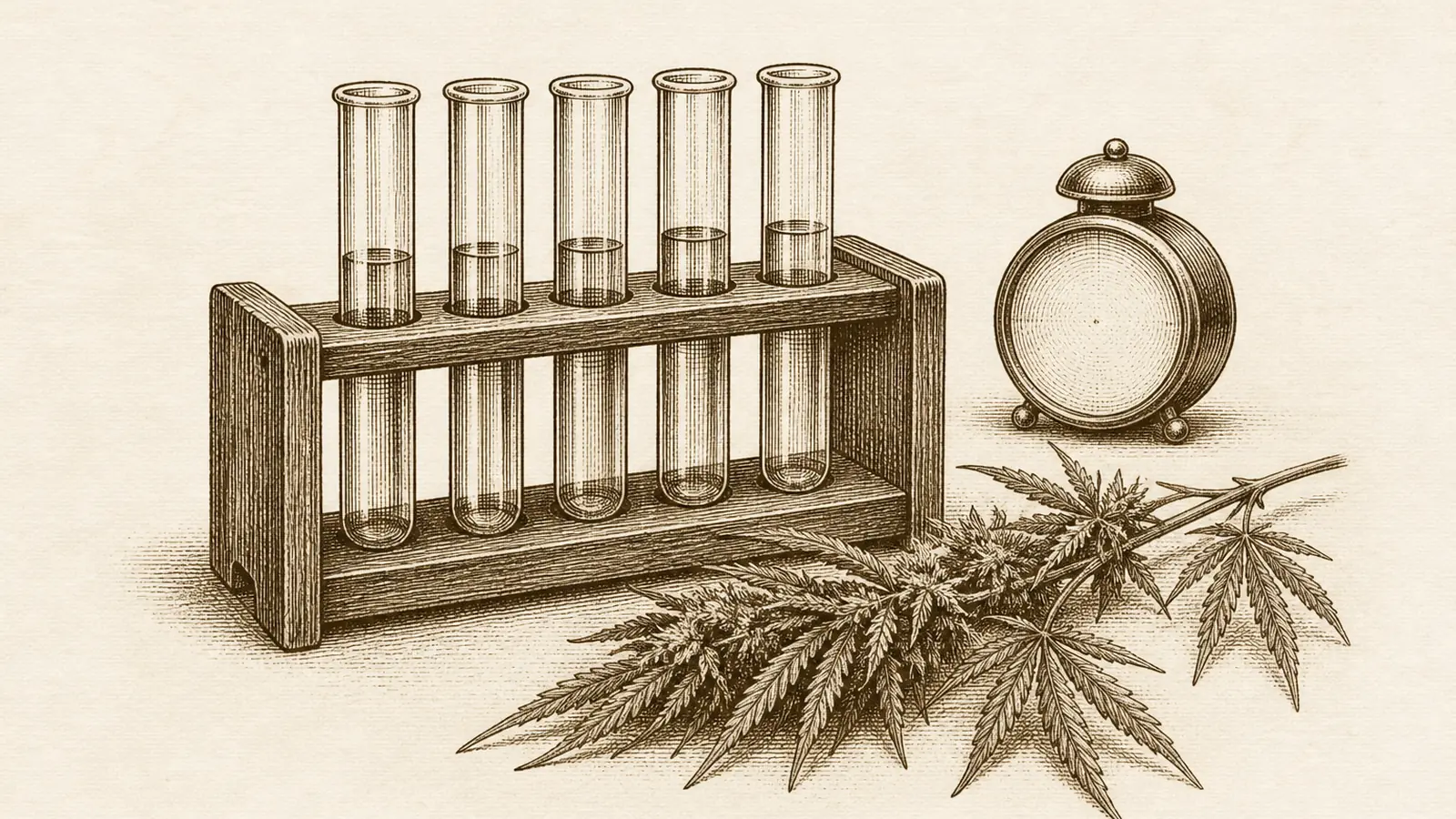
For years I filed cannabis under the gentle option. The thing you reach for instead of the second glass of wine, the wind-down that supposedly asks nothing of your body the next morning. Then a group at Oregon State measured the morning stress hormone in daily users and found the opposite of gentle: the people using cannabis to unwind were starting every day with their stress system already turned up. I stopped nodding.
Anita Cservenka’s lab at Oregon State recruited 39 frequent cannabis users and 43 non-using controls, handed everyone saliva tubes, and had them spit into the tubes at three moments across two consecutive weekdays: the instant they woke, thirty minutes later, and in the evening. Cortisol, the hormone the adrenal glands pour out under stress, shows up in saliva, and its daily rhythm is a standard way to read how the body’s stress machinery is idling. The result, published in the journal Cannabis, was narrow but specific. At the moment of waking, the cannabis users had significantly higher cortisol than the controls (p = .047), and that elevation tracked with the consequences people reported from their use (p = .007), not simply with the fact of using at all.
Here is where the data stayed quieter than the headlines. The famous “cortisol awakening response,” that surge that normally peaks about half an hour after you open your eyes, was not different between the groups (p = .23). The morning rise itself looked normal. The researchers even note they failed to replicate an earlier finding of a blunted awakening response in heavy users, and they chalk the difference up to methods and who was in the sample. I like that they said so out loud, because a team padding a story would have buried the non-replication instead of putting it in the abstract. What was elevated was the baseline, the floor the whole day gets built on. These users did not have a broken alarm. They had the volume turned up before the alarm went off.
So why would that happen? This is the question I kept chewing on, because none of the write-ups touched it, and it is the whole ballgame. Your body makes its own cannabis-like molecules, endocannabinoids, and one of their day jobs is to sit on the stress axis and keep it from over-firing. The endocannabinoid system is a negative regulator of the HPA axis, which in plain terms means the CB1 receptor works like a brake pedal on cortisol. And here is the detail that made me sit up. When researchers knock out the CB1 receptor in mice, the animals don’t get calmer. Their circadian drive on the stress axis ramps up, and their basal corticosterone, the rodent version of cortisol, runs elevated. Take the brake away and the floor rises. It is a suggestive resemblance to what Oregon State saw in people, not proof the same mechanism is running in humans, but the direction lines up unnervingly well.
Wait, so how does smoking a plant full of cannabinoids end up looking like removing a cannabinoid receptor? That was my genuine double-take. The most plausible explanation, and I want to flag it as a mechanism this study did not itself prove, is that flooding the system with THC every day is not the same as your own endocannabinoids tapping the brake when the moment calls for it. Chronic, heavy CB1 activation is thought to blunt and downregulate the receptor, so the delicate feedback endocannabinoids normally provide gets noisy and weak. If that is what’s happening, the tool you’re using to feel calm is slowly sanding down the exact circuit that lets your body calm itself. I find that genuinely strange, in the way real biology usually is.
And it points at a trap. Stress is one of the most common reasons people give for reaching for cannabis, and a separate 2026 paper found that elevated stress reactivity is itself a barrier to cutting back: the hotter your stress system runs, the harder change becomes. Line that up with the cortisol finding and you can watch the loop close. You use to take the edge off, the baseline creeps upward, the higher baseline makes the edge sharper, and the sharper edge sends you back. Cservenka’s group has been mapping these disrupted daily stress rhythms in chronic users for a couple of years, and this fits the pattern.
I want to be straight about what 82 people, measured once, cannot say. There is no timeline here, so this cannot tell us whether cannabis raised the cortisol or whether higher-cortisol people gravitate toward cannabis. The p-value on the headline difference sits a hair under the line, not a landslide. Cservenka calls the waking measurement a possible “neurobiological marker of problematic cannabis use” and a starting point, which is the right register. Worth noticing who paid for it: not a pharma sponsor, not a dispensary chain, but Oregon State itself and two of its liberal-arts arms. There is no obvious thumb on this scale, which is more than you can say for the wellness marketing running the other direction, the dispensary shelves and CBD brands selling “calm” as a product feature.
So what do I do with it. I am not going to tell you cannabis is bad, because this study can’t carry that and I wouldn’t either. But I have quietly stopped filing daily use under “harmless stress relief” in my own head. If I were reaching for it every single morning just to feel level, I would treat that reach as the signal these researchers think it is, and I would want to know what my own cortisol was doing at 7 a.m. before I called it medicine.
Sources
- Cannabis (2026) – Cservenka et al., “Subjective Stress and Diurnal Salivary Cortisol in Adults with Frequent Cannabis Use”
- ScienceDaily – “Frequent cannabis users wake up with their ‘stress hormone’ already elevated” (Oregon State)
- PubMed – Cota et al. (2007), “Requirement of cannabinoid receptor type 1 for the basal modulation of hypothalamic-pituitary-adrenal axis function”
- Neuroscience – endocannabinoid signaling and glucocorticoid-mediated negative feedback of the HPA axis
- Substance Use & Misuse (2026) – “Elevated Stress Reactivity: A Barrier to Cannabis Use Change Behavior”
- Psychopharmacology (2024) – “Multimodal examination of daily stress rhythms in chronic Cannabis users”