I had always filed the cannabis-makes-me-anxious thing under psychology. Set and setting, the wrong room, the wrong company, a head that talks itself into a corner and can’t find the door. The kind of thing you could in theory reason your way out of. So the question I did not expect to be turning over this week is a stubbornly physical one: what if a high that curdles into panic isn’t your mind spiraling at all, but a literal brake being cut in the part of your brain that runs fear?
That is what a team at Northwestern is arguing, in a study published October 2 in Nature Communications from the lab of Sachin Patel, who chairs psychiatry and behavioral sciences at the Feinberg School of Medicine. The way they got there is wonderfully blunt. They gave mice either a placebo or a synthetic cannabinoid, then exposed them to the smell of fox urine, which to a mouse is the scent of a predator in the room. The placebo mice investigated the threat, cautiously, the way an animal weighing danger does. The cannabinoid mice froze and hung back, spending less time near the scent. Dosed up, they were not braver. They were more afraid.
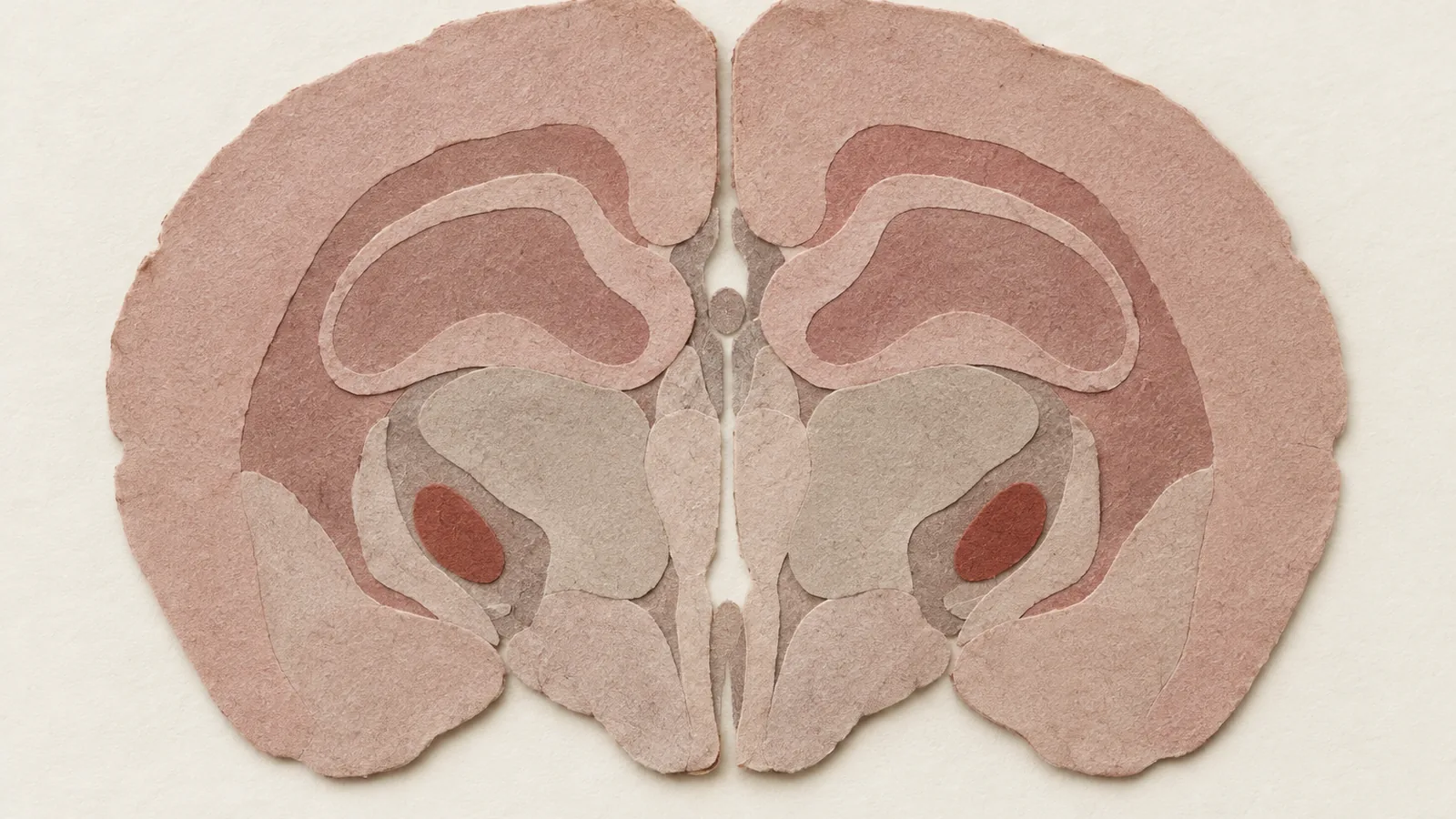
Here is where I had to slow down and read it twice. The researchers had implanted a miniature microscope into each mouse’s brain to watch, in real time, a small knot of cells in the central amygdala, a hub that processes fear and stress. The cells that lit up were somatostatin neurons, a subtype tagged by the peptide they carry. Under the cannabinoid, those neurons fired harder. And when the team went into the brain tissue to ask why, they found the drug was weakening the inhibitory input that normally keeps those fear neurons quiet, suppressing the GABA signal from the local cells whose job is to hold them down. That is the brake. The cannabinoid does not press the fear pedal. It cuts the line to the thing that was holding fear in check.
Wait, why would a cannabinoid, the kind of thing people reach for precisely to take the edge off, go after the restraint on the fear center? It flips the intuition. You would assume anything that relaxes you is quieting neurons. Here the relaxing drug is disinhibiting them, pulling the dampener off a circuit that is better left damped. And the team showed this was cause, not coincidence, the hard way: when they genetically silenced those somatostatin neurons, the dosed mice stopped avoiding the predator scent. Take the cells offline and the drug loses its power to frighten. The fear was running through that exact handful of neurons.
The detail that makes this feel true to anyone who has watched a mellow evening tip over is the timing. It was not the dose alone or the stress alone. Higher doses and a threatening environment, Patel said, “worked together to synergistically release the brake.” Put that in a human living room: the edible that was fine until the phone rang with bad news, the strong gummy at a party full of strangers. The biology here is a story about when, not just how much. “A good trip can turn bad pretty quickly,” he said, and this is the circuit-level reason why.
A mouse is not a person, and a synthetic cannabinoid dosed in a lab is not the gummy in your drawer. No human has been near this experiment. What it gives us is a mechanism, plausible and well anchored, not a clinical promise, and a mouse frozen over fox urine is a long way from a person white-knuckling the couch cushions. Hold it at that weight.
But hold it, because it lands in a moment that deserves the scrutiny. Cannabis in this country is more available and far more potent than the plant your uncle remembers, and the commercial pitch around it leans almost entirely on calm: unwind, take the edge off, sleep. The anxiety that shows up gets filed as user error, a you-problem. The epidemiology has been saying otherwise for a while. An Ontario cohort of 34,822 people who landed in an emergency room for cannabis use saw 12.3 percent go on to an anxiety disorder serious enough for hospital care within three years, against 1.2 percent of the general population, an adjusted risk nearly 3.7 times higher and almost six times higher for younger men. That is association, not proof, and it is a heavy-use ER population, not the casual Friday user. But set it beside a brake-cutting mechanism in the fear center and the two stop reading like separate stories.
There is a longer thread here. Patel’s lab has been pulling on the endocannabinoid-and-stress knot for years, and a 2023 study in PNAS found this same class of somatostatin neurons, in a different circuit, the brain’s reward hub, growing more excitable under cannabinoids and stress. Same cell-type signature, two different stress circuits, converging. Which is why Patel floats the hopeful inverse: if quieting these neurons is the “final pathway” into the anxious state, maybe they are a target for calming it on purpose, cannabis aside. That is the drug-development hope buried inside a scare story. It is also, for now, a hypothesis in a mouse.
So what do I actually do with this? I am not swearing off the idea that cannabis helps some people, because for some people it plainly does. But I am done treating “it’s just relaxing” as the whole truth, and I am done treating a high-THC product as harmless by default because it is legal and sold in a nice jar. The pleasant and the panic may not be two different drugs. They may be the same drug meeting a different moment. So if I reached for it, I would keep the dose low, and I would not touch it on a night I was already wound tight, because high dose plus high stress is exactly the pairing that pulled the brake hardest in the mouse. That is the one combination I will treat as a warning, not a vibe.
Sources
- Nature Communications: Cannabinoid modulation of central amygdala population dynamics during threat investigation (Patel lab, Oct 2, 2026)
- ScienceDaily: What happens in the brain when cannabis makes you anxious?
- GEN: Neurons involved in generating anxiety after cannabinoid exposure identified in mice
- HealthDay: ED visits for cannabis use tied to increased risk for incident anxiety disorder (Myran et al., eClinicalMedicine, 2024)
- Northwestern Feinberg: How endocannabinoids regulate the brain’s response to stress (PNAS, 2023)