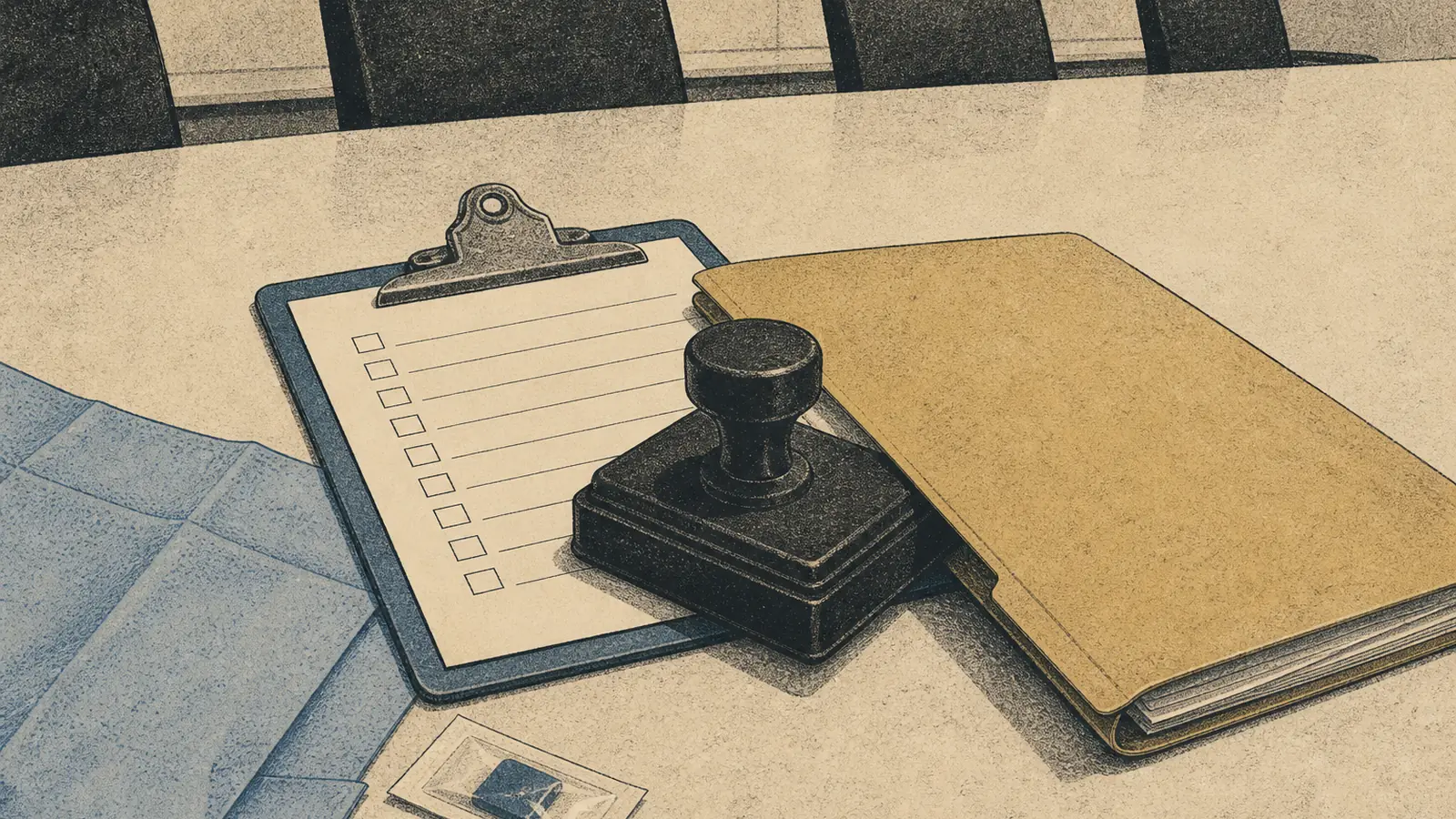
I used to think of the medical ethics board the way I think of a seatbelt. Unglamorous, occasionally annoying, obviously on my side. Someone in a room making sure a researcher never does to me what the government did to those men in Tuskegee. So the first time I read that the office charged with protecting human research subjects had ordered a study stopped, I nodded along on reflex. Then I looked at what they stopped. It was soap and a clipboard.
The checklist has five steps for putting a central line into a patient: wash your hands, drape the whole body in sterile cloth, clean the skin with chlorhexidine, skip the groin site when you can, and pull the line the moment nobody needs it. That is the whole intervention. A central line is a tube that runs into one of the big veins near your heart, which is exactly why an infection there turns dangerous so fast: you have handed bacteria a private highway into your bloodstream. Peter Pronovost, an intensive-care physician at Johns Hopkins, talked more than a hundred Michigan ICUs into following the list and writing down what happened.
What happened was startling. In the NEJM report of the Keystone project, the rate of these bloodstream infections dropped 66 percent within three months, and the median infection rate across the ICUs fell to zero. Over the following year and a half researchers credited the program with more than 1,500 lives saved. Follow-up work using Medicare claims later tied the same checklist to a roughly 10 percent drop in deaths among older ICU patients in Michigan, measured against eleven neighboring states. No new drug, no device, just soap, drapes, and a clipboard.
Then, in 2008, the federal Office for Human Research Protections ordered the effort halted. Not because the checklist had hurt anyone. It plainly did the opposite. The hospitals had simply never obtained patient consent forms or run the project past an institutional review board at each site, and what tripped the rule was not the sterile technique at the bedside. It was the counting. Recording the infection numbers to see whether the list worked turned a hospital’s own safety push into research on human subjects, and research on human subjects requires the paperwork.
Sit with that, because I had to. The same nurse doing the same five things at the bedside is fine, right up until someone gathers the infection data into a study to prove it saved your life. The moment you measure it, you are experimenting. That is the machine at work, and once you see its logic you start seeing it everywhere.
Vinay Prasad, a physician-researcher who ran the FDA’s biologics center until this spring, put the pattern in a sharp frame this week. Ethics committees, he argues, make two opposite errors at once: they block useful research, and they permit useless research. His verdict on the apparatus is not gentle. The IRB industry, he writes, is hopeless.
The blocking side is the Pronovost story multiplied. The permitting side is quieter, and just as expensive. Prasad points to Tamiflu, the flu drug governments stockpiled for a pandemic that never really came. It booked more than $18 billion in sales, roughly half of that pandemic hoarding, and when independent reviewers at Cochrane finally pried loose the full trial data, the pills shortened flu symptoms by less than a day and did nothing measurable for hospitalizations. The trials that could have shown that up front were never demanded. A review board fixated on consent-form wording will wave through a study whose design cannot answer its own question, then freeze a checklist that already answered one.
Cases are not p-values, and I want to be straight about that. No one has run a randomized trial of ethics boards. You cannot flip a coin and assign half of America’s hospitals to oversight and half to none. What you can do is look at this case, which has a body count, a halt order, and a reversal: within weeks, under public pressure, OHRP conceded the work had probably qualified for a consent waiver all along and let it continue. The fuller pattern lives in Simon Whitney’s book From Oversight to Overkill. As the City Journal review of it describes, a system built in genuine horror at Tuskegee curdled into a liability-driven bureaucracy that now delays ordinary studies by months or years and has held up progress on everything from kidney stones to heart attacks to premature birth.
The boards cannot even agree on what their own rules mean. In 2013 OHRP went after a landmark trial called SUPPORT, which had randomized extremely premature babies to higher or lower oxygen targets and surfaced a brutal trade-off: more severe retinopathy, the eye damage that can blind a preemie, in the higher-oxygen group, and more death before discharge in the lower-oxygen group. The office ruled the consent forms had failed to spell out those risks. Then more than forty bioethicists and the director of the NIH himself publicly rejected that ruling, warning it would chill exactly the research that keeps these babies alive. When the guardians are this divided over their own standard, “we are protecting patients” starts to sound less like a description and more like a slogan.
I keep circling back to the incentive underneath all of it, because that is where the biology brain in me goes looking for the mechanism. A review board cannot be sued for the infection it quietly prevented. It can absolutely be blamed for the consent form it let someone skip. So the system optimizes for the thing that can hurt the system, missing paperwork, and not the thing that hurts you, a bacterium loose in your central line. That is not villainy. It is an organism reading its environment, and its environment pays it to say no.
None of this argues for tearing down human-subject protections. The men in Tuskegee, the patients dosed without knowing, those were crimes, and the reflex to prevent them is right. But a protection that halts a study saving 1,500 people while shrugging at billions spent on pills that shorten a flu by less than a day is not protecting patients anymore. It is protecting itself.
So this is my conclusion. If I am ever the one in an ICU with a tube in a vein near my heart, I do not want the committee that guards the clipboard. I want the checklist, and I want the people at my bedside allowed to keep counting whether it worked. I would sign whatever form they put in front of me. What I would not accept, quietly, is a rule that treats the counting itself as the danger.
Sources
- Dr. Vinay Prasad – “Medical ethics and IRB committees make two errors” (2026)
- New England Journal of Medicine – Pronovost et al., Keystone central-line checklist trial (2006)
- Baltimore Sun – federal office halts, then clears, the Michigan infection program (2008)
- American Medical News – HHS shuts down Michigan patient-safety study (2008)
- Johns Hopkins Gazette – safety checklist tied to a 10 percent drop in deaths (2011)
- City Journal – review of Simon Whitney, From Oversight to Overkill (IRB overreach)
- New England Journal of Medicine – “In Support of SUPPORT,” NIH leadership on the preemie-oxygen consent ruling (2013)
- NPR – NIH chief rejects ethics critique of premature-infant study (2013)
- Cochrane Library – Jefferson et al., neuraminidase inhibitors (Tamiflu) for influenza (2014)
- STAT – Vinay Prasad to depart FDA’s CBER (2026)