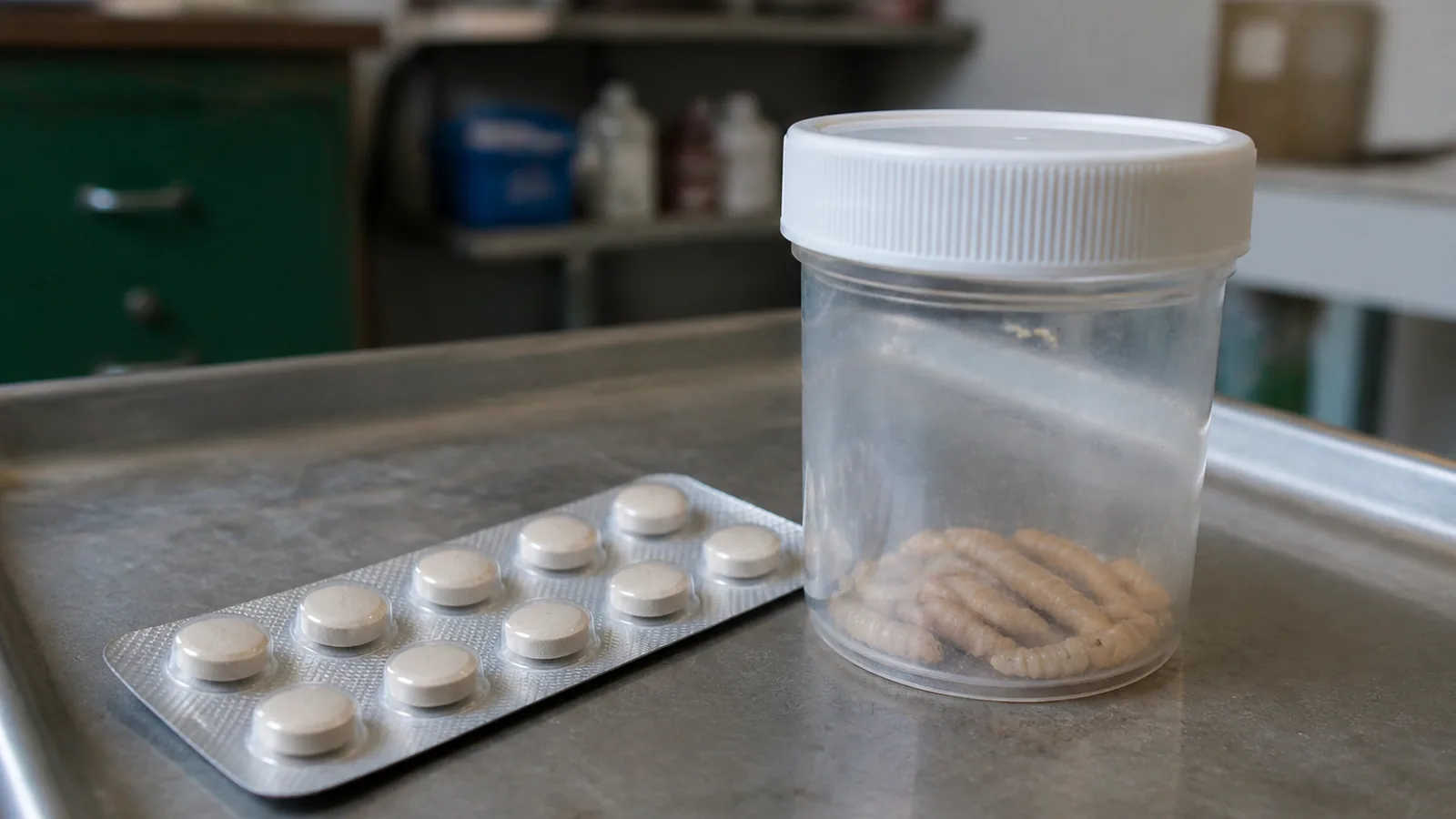
Most maggots are nature’s cleanup crew. They eat dead tissue, leave the living alone, and are harmless enough that surgeons have used them to clean wounds for more than a century. The New World screwworm is the one that earned its Latin name, Cochliomyia hominivorax, the man-eater. A female lays a few hundred eggs at the rim of an open wound on any warm-blooded animal, and the larvae burrow down into living flesh, feeding as they widen the wound and giving off a scent that draws still more females to lay still more eggs. A healthy steer can be dead in under two weeks. America beat this animal once, and it did it without a single drug.
So it is worth sitting with what the FDA did on August 13. The agency issued an Emergency Use Authorization for Simparica Trio, the Zoetis chewable already sold for heartworm prevention and flea, tick, and worm control, clearing veterinarians to use it against screwworm infestations in dogs and puppies. It is the newest entry in a rolling series of emergency drug authorizations Washington has leaned on since the fly came back. And the thing worth saying at the top, before the press release talks you into the drug, is that the pill is not what beat the screwworm. Watch the sterile flies, not the pharmacy.
Here is how the country actually won the first time, because the method is the whole argument. In the 1950s and 1960s two USDA entomologists, Edward Knipling and Raymond Bushland, turned a quirk of the fly’s biology into a weapon. The female screwworm mates once in her life. Flood a region with millions of male flies sterilized by radiation, let the wild females mate with them, and the eggs never hatch. Do it relentlessly, generation after generation, and the population does not just thin, it collapses. The United States was declared free of the screwworm in 1966. It was one of the cleanest victories applied biology has ever produced, and it never depended on a medicine cabinet.
- 1966US declared free of screwworm
- 2023fly breaches the Panama barrier
- 2025federal emergency declared
- 2026first case on US soil
The win held for six decades because it was defended. Rather than let the fly walk back north, the U.S. and its partners kept a living wall across the Darién Gap in Panama, breeding and dropping sterile flies to pin the species south of Central America. For a generation, most Americans never had to think about the screwworm, because the wall did the thinking for them. Then, starting around 2023, the barrier gave way and the fly began marching back up through Central America and into Mexico.
The numbers since then are hard to look at. Across Mexico and Central America, the CDC counts more than 209,400 animal cases and 2,440 human infections; Mexico alone has confirmed 412 human cases, with the weekly count accelerating through early 2026. On June 3, 2026, the USDA confirmed the first case on U.S. soil, a three-week-old calf in La Pryor, Texas, in Zavala County near the border. The trade fallout had already started a year earlier, when Agriculture Secretary Brooke Rollins shut U.S. southern ports of entry to live cattle, horses, and bison from Mexico as the fly moved north. A containment strategy that worked flawlessly for sixty years came apart in about three.
Which brings us back to the Zoetis pill, and to a distinction the announcement does not dwell on. This authorization rests on emergency powers, not the ordinary approval process, and the two are not the same standard. On August 18, 2025, the federal government declared a screwworm emergency under section 564 of the Food, Drug, and Cosmetic Act, the same statute that governed the COVID-era authorizations. That declaration opened a door, and the FDA has been walking animal drugs through it ever since, including four cleared in a single April Federal Register notice and more since. An EUA lowers the evidence bar by design. It lets a product onto the market once the agency decides it is reasonable to believe the drug “may be effective” against the emergency threat, which is a deliberately softer test than the proof of effectiveness a full approval demands.
So the fair question is what proof exists that this pill kills screwworm larvae, and the honest answer from the paperwork is that the announcements do not show it. Zoetis’s own investor release quotes a company executive calling the authorization “an important new tool in the fight against New World screwworm” and stressing how it “builds on Zoetis’ expanding, multi-species set of solutions.” What the release does not contain is a single efficacy trial, a case series, or a number. The commercial framing runs louder than the clinical one. The authorization hands Zoetis an expanded market for a product it already sells, with no published trial showing the pill kills screwworm larvae, and for a publicly traded animal-health company watching a natural disaster become a new use for an existing chewable, that is not a small thing to notice.
We have watched where the emergency reflex leads when the evidence underneath it is thin. That same section 564 was used to push the monoclonal antibody bamlanivimab into arms during COVID, and its authorization was later revoked as variants rendered it ineffective, a sequence pharmacists documented in detail. The medical literature has been blunt enough to run papers titled “The Red Flag of Emergency Use Authorization.” None of this proves Simparica Trio fails against screwworm. Sarolaner belongs to a drug class that is genuinely lethal to a lot of arthropods. It means the public is being asked to take the working on trust, from an agency and a manufacturer that both have reason to look decisive right now.
There is also a safety cost that an emergency does not erase. Sarolaner is an isoxazoline, the parasiticide class the FDA itself has warned can trigger neurologic reactions in dogs, including muscle tremors, loss of coordination, and seizures, sometimes in animals with no prior history. That warning was written for routine flea-and-tick use. An outbreak that pushes more dogs onto the drug, in more frightened households, does not make it any less true.
Strip away the confidence and the shape of the moment is clear. What held the screwworm back was never a pill. It was a sixty-year commitment to an elegant piece of biology and a factory in Panama that let the fly’s own reproduction defeat it. That defense was allowed to erode, and the answer arriving now is a stack of emergency drug labels for a threat that only a rebuilt sterile-fly program can actually end.
So watch the flies. The USDA has completed a sterile-fly dispersal facility at Moore Air Base in Edinburg, Texas and has started aerial drops over the border zone, with a domestic production plant still to come. The number that will tell you whether this is contained is not how many drugs get an EUA this fall. It is how far north APHIS’s confirmed case line moves before sterile-fly output catches up to it, and whether the phased reopening of the Douglas, Arizona port later this month holds or gets reversed by the next detection. If the barrier gets rebuilt, the screwworm goes back to being a footnote. If it does not, expect more emergency authorizations, more thinly evidenced than the last, from a public-health apparatus that keeps reaching for a drug label when the job was always to defend the wall.
Sources
- FDA – Emergency Use Authorization for Simparica Trio in dogs and puppies (Aug 13, 2026)
- Zoetis / StockTitan – Zoetis receives EUA for Simparica Trio for New World screwworm
- Federal Register – Declaration of emergency for New World screwworm under the FD&C Act (Aug 2025)
- Federal Register – Authorization of emergency use for four animal drugs for screwworm (Apr 17, 2026)
- CDC – New World Screwworm outbreak situation summary
- CDC – About New World Screwworm (biology and myiasis)
- Texas Tribune – First U.S. screwworm case confirmed in South Texas
- USDA – Completion of sterile-fly dispersal facility in Texas (Feb 9, 2026)
- USDA – Secretary Rollins suspends live animal imports along the southern border (May 11, 2025)
- FDA – Animal Drug Safety Communication: neurologic risks of isoxazoline flea and tick products
- The Golden Goose Award – Knipling, Bushland, and the sterile insect technique
- American Journal of Health-System Pharmacy – Consequences of the rush to EUA of bamlanivimab
- World Affairs – “The Red Flag of Emergency Use Authorization”