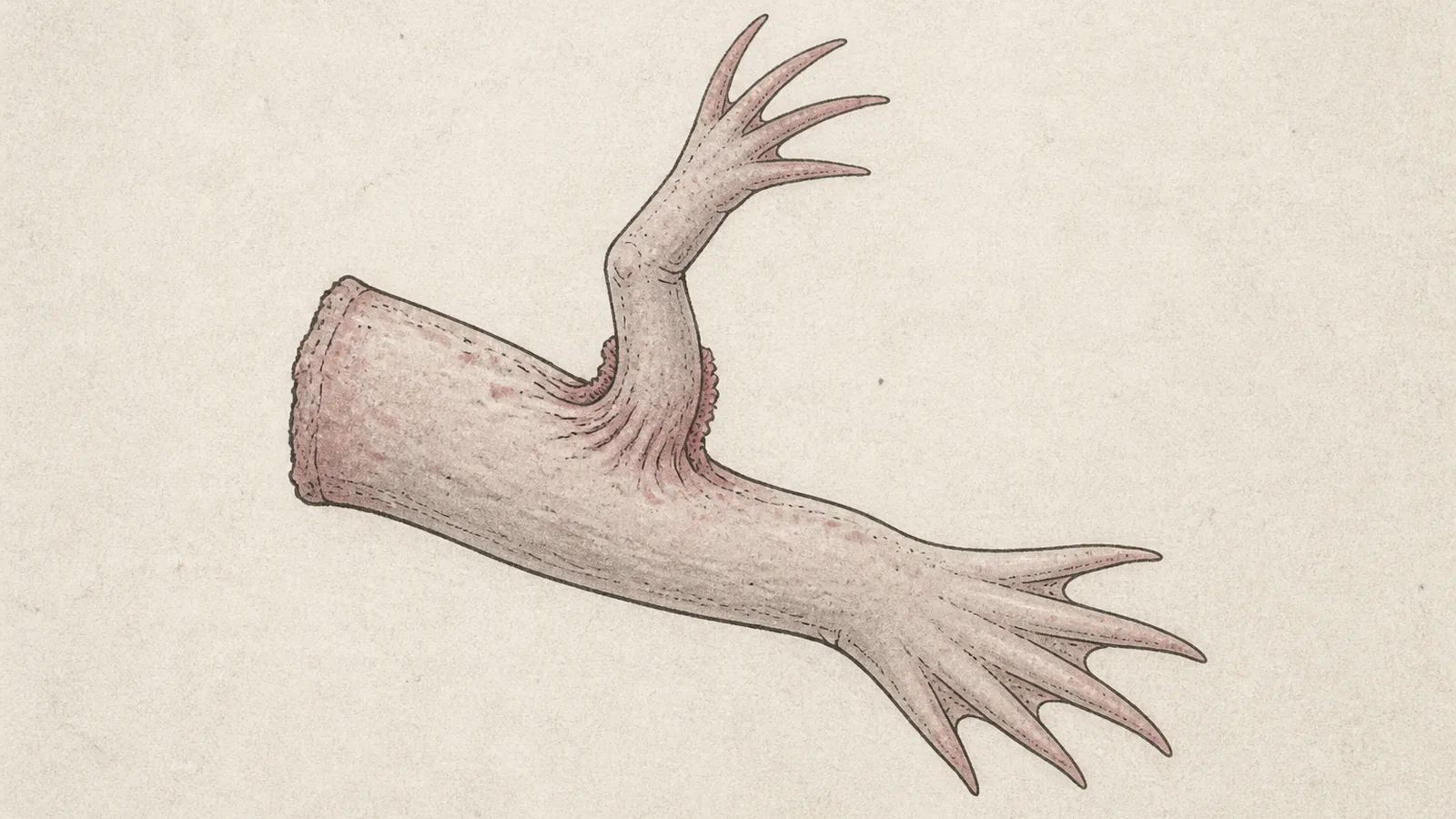
In a Northeastern University lab, James Monaghan’s team cut an axolotl’s arm off near the hand, flooded the stump with a form of vitamin A, and watched it grow back wrong. Not a hand. A second elbow, a second forearm, a whole redundant limb budding out of a wound that should have produced a few fingers. The animal had been handed the biochemical equivalent of bad directions, and it followed them faithfully, building an arm from a point where no arm belonged.
The overshoot is elegant, and it pins down how a salamander knows what to rebuild. Reported in Nature Communications last year by Timothy Duerr and colleagues in Monaghan’s lab, the work turns on a gradient of retinoic acid, the active metabolite of vitamin A, running the length of the limb: high at the shoulder, low at the hand, tuned by an enzyme called CYP26B1 that chews the molecule up wherever it isn’t wanted. To a regenerating cell, the local concentration is an address. High retinoic acid says shoulder, rebuild everything below me. Low says hand, you’re almost done. As Monaghan put it, the cell reads the cue and decides, “I’m at the elbow, and then I’m going to grow back the hand.”
The team proved it two ways. Dosing the hand with excess retinoic acid, or using a drug called talarozole to block the enzyme that clears it, told distal cells they were proximal, and they dutifully built the extra limb segments. Then the team went looking for what the acid switches on and found a gene called Shox. Knock it out with CRISPR and the axolotls grew stunted arms with normal hands, which is precisely the deformity that SHOX mutations cause in people. Same gene, same job, in a salamander and in you.
And there is the sentence that launched a thousand headlines. The coverage leapt from “salamander” to “humans could regrow limbs” on cue, because we carry the same toolkit: the retinoic acid, the enzyme, the Hox genes, SHOX. The axolotl grew the limb back. The paper that produced it proposed no way to regrow yours.
The study made no such promise. It is basic developmental biology, funded by the National Institutes of Health and the National Science Foundation, not a therapeutics program, and its authors offered no treatment. The promise is supplied, as it always is, by everyone downstream of the lab. The “prospects for humans” framing now circulating in the wellness and pharma-skeptic press recurs on a schedule roughly synced to the axolotl publication cycle, and it survives contact with the science by never quoting the part where the science stops.
The people who actually tried to cash that promise are worth watching. The Pentagon has been funding human limb regeneration since 2008, when it stood up the Armed Forces Institute of Regenerative Medicine to rebuild soldiers coming home from Iraq and Afghanistan missing arms, legs, and faces. It budgeted $250 million for the first five years alone, and Wake Forest’s institute has run the consortium of academic labs ever since. Eighteen years and more than 20 clinical studies later, that money has bought a great deal: better burn grafts, reconstructive techniques, engineered tissue for wounds that used to be untreatable. It has not bought a regrown limb, or a hand, or a finger past the fingertip that nature already regrows on its own.
Because nature does do the job, once, briefly, and then quits. A young child who loses a fingertip above the last knuckle can regrow it, nail and all, and so can a mouse. That is the entire mammalian repertoire. The reason the talent stops there is coming into focus, and it is not a missing gene. Work summarized in Scientific American this year points to how our tissue is built and how it breathes: Stanford’s Byron Mui found that mice with more hyaluronic acid in their wound matrix regrew fingertips with less scarring, while Georgios Tsissios found that regeneration ran better in low oxygen, the aquatic condition amphibian larvae develop in and a mammal never sees. Harvard’s Jessica Whited puts the question plainly: not how salamanders do it, but why mammals are limited. We are not missing the instructions. We are wired to heal fast, and fast healing means scar. A scar is the body choosing a sealed wound over a rebuilt one, and it makes that choice every time.
Which is why the honest near-term payoff of all this axolotl work is not a limb. It is scar. The same salamander logic is being borrowed to coax bone to regrow and, further out, to nudge a human wound toward regeneration instead of fibrosis. The cellular choreography of even a salamander’s regrowth, which cells wake up, dedifferentiate, and rebuild in what order, is still being mapped, and a human arm is a far harder object: vessels, nerves, patterning, and immune control all solved at once, at scale, without the thing going wrong the way that dosed axolotl’s arm went wrong.
The demand is not hypothetical, and that is what the hype gets right for the wrong reasons. Roughly 1 in 10 adults worldwide has diabetes, and diabetic foot ulcers remain a leading road to lower-limb amputation. The line of people who would take a regrown foot is long, and it grows every year. They are not being served by another press cycle announcing that salamanders have shown us the way.
| Measure | Value |
|---|---|
| Count | 1 of 10 adults worldwide has diabetes |
The animal in the Northeastern tank will regrow its arm again this year, indifferent to the coverage it keeps generating. It has the genes for it. So do you. The difference is that it still uses them.
Sources
- Nature Communications (via PMC) – Duerr et al., retinoic-acid breakdown and CYP26B1 in axolotl limb positional identity (2025)
- Northeastern Global News – inside Monaghan’s axolotl limb-regeneration work, with quotes and the Shox/CRISPR result (2025)
- Scientific American – why mammals can’t regenerate limbs: hyaluronic acid, oxygen sensing, and scarring
- Wake Forest Institute for Regenerative Medicine – AFIRM consortium management since 2008, funding, and clinical-study record
- The O&P EDGE – DoD budgets $250 million for AFIRM’s first five years (2008)
- eLife – The cellular logic of limb regeneration (2026)
- Bioactive Materials – an axolotl limb-regeneration-inspired strategy to enhance alveolar bone regeneration (2025)
- Sensors – systematic review on diabetic foot ulcers and lower-limb amputation risk (2023)
- TrialSite News – Ronald Kostoff, “Limb Regeneration: Prospects for Humans” (2026)