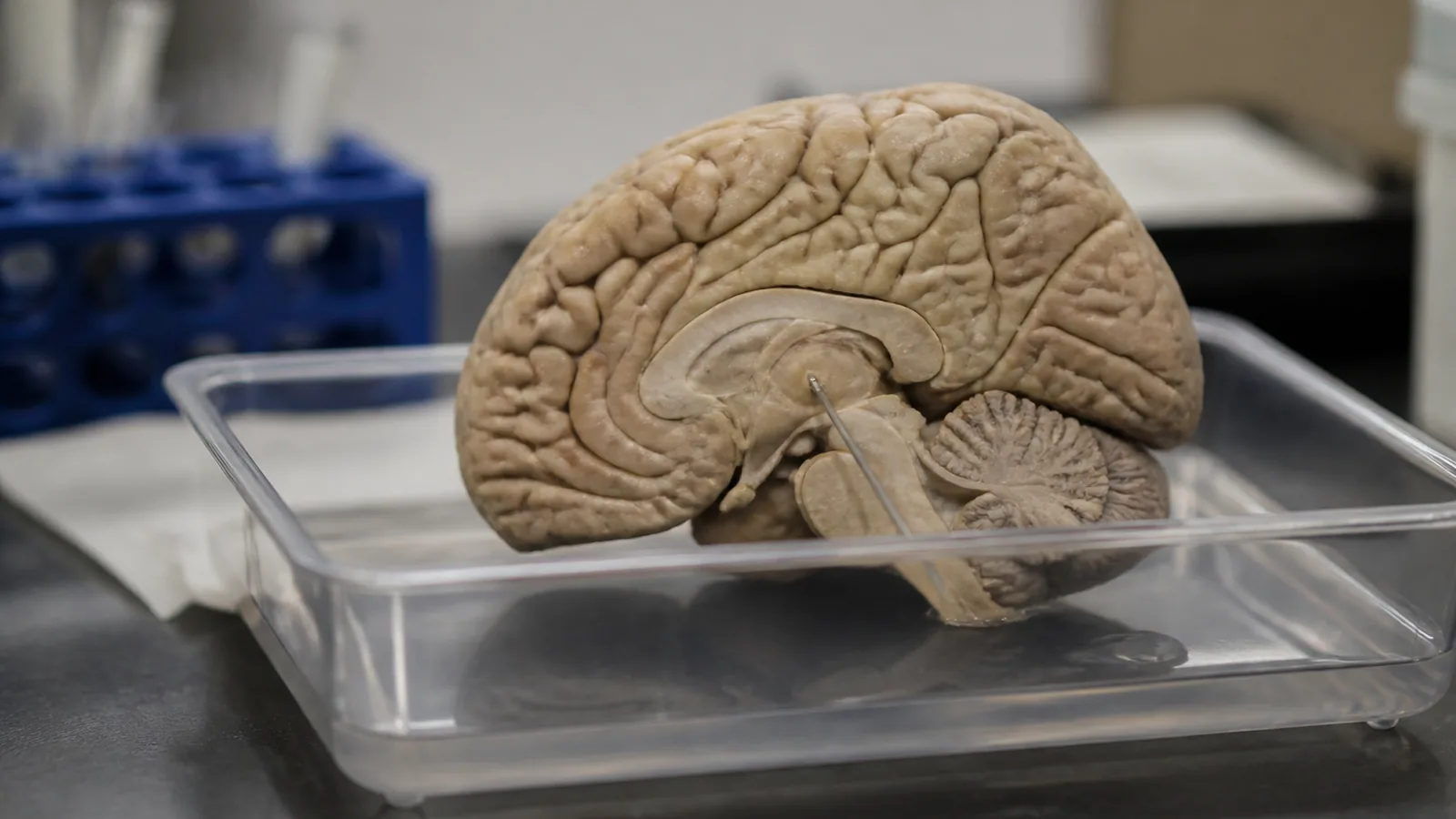
For years the most-studied fear patient in neuroscience was a woman who could not feel afraid. Researchers at the University of Iowa and Caltech knew her in the literature as S.M., a woman whose amygdala, the pair of almond-shaped structures buried deep in each temporal lobe, had been destroyed on both sides by a rare genetic condition called Urbach-Wiethe disease. Handed snakes, walked through a haunted house, shown the horror-film footage that makes the rest of us flinch, she registered curiosity where other people register dread. Shown photographs of frightened faces, she could not reliably tell that they were frightened. Ralph Adolphs, the Caltech neuroscientist who spent years documenting her case, had something close to a clean experiment of nature: knock out the amygdala, and fear, both the feeling and the reading of it in others, comes apart.
That finding made Adolphs one of the people you call to learn where emotion lives in the brain, which is why it matters that he now spends his time warning about machines that claim to read it. Out this week on Andrew Huberman’s podcast, Adolphs is making the case that runs through his last decade of work: emotions are not neat, not localized to a single spot, and not written on the face in any language a machine can decode. That is not an academic quarrel. A multibillion-dollar industry already scans the faces of job candidates, students, and call-center workers on the bet that inner feeling reads out cleanly on the surface, and Adolphs’ own research says the bet is bad.
The amygdala story cracked first. In 2013 Justin Feinstein, working with Adolphs and Daniel Tranel, had S.M. and two other patients with the same bilateral amygdala damage breathe a single lungful of 35 percent carbon dioxide. Everything the field thought it knew predicted calm. Instead all three gasped, clawed at their masks, and had full-blown panic attacks, more readily than the healthy volunteers tested alongside them. The amygdala was not the seat of fear so much as one alarm among several. Threats from the outside world, a snake, an angry face, route through it. A threat rising from inside the body, the suffocating signal of too much CO2 in the blood, does not, which led the authors to suggest the amygdala may even hold that internal alarm in check rather than set it off. We had treated the structure as the origin of fear. It behaves more like a switchboard, and it handles only some of the calls.
Keep that in mind, because it scales up. If one brain structure resists the label “the fear part,” the human face resists it far more. In 2019 Adolphs joined the psychologist Lisa Feldman Barrett and three other researchers on the least glamorous and most necessary job in science: reading the entire literature to ask whether the popular claim survives contact with the data. The claim is the one we all absorbed from childhood posters and airport-security seminars alike, that specific feelings produce specific faces, a scowl for anger, a wide-eyed gape for fear, and that a trained observer or a good algorithm can run the film backward from face to feeling. Their review in Psychological Science in the Public Interest found the evidence does not support it.
The numbers are what should stop a vendor cold. When people are genuinely angry, they scowl only about 30 percent of the time, Barrett has summarized from the underlying studies. The rest of the time anger wears other faces, or none. And a scowl, when it shows up, is a poor flag for anger, because people also scowl while concentrating, while squinting into the sun, while sitting through a bad joke. Push the test across cultures and the mapping frays further: in one remote society the proposed universal “fear face” was read not as fear but as a threat, the look of someone about to attack. Facial movements, the review concluded, are not diagnostic of emotional states across context, person, and culture. The face is a low-signal, high-noise channel. Sometimes it broadcasts, often it stays dark, and from the outside you cannot tell which is happening.
| Measure | Value |
|---|---|
| of the time | 30% |
That is the science the market has decided to ignore. “Emotion AI” and “affective computing” are sold today to companies that scan candidates during video interviews, to schools piloting attention-monitoring, to call centers grading the empathy of their staff, to security vendors claiming to flag deception, a business analysts already size in the billions and expect to keep climbing. Every one of those products assumes what the review rejects. The software is not measuring feelings. It is measuring facial-muscle movement and then guessing, with a confidence the underlying science never earned.
Regulators in Europe read the same literature and drew the obvious line. Since February 2025, under the first wave of prohibitions in the EU’s AI Act, Article 5(1)(f) bans using AI to infer emotions in workplaces and schools, with narrow carve-outs for medical and safety uses. The Act’s own recital gives the reason, and it is blunt: the “lack of scientific basis” for these systems, their poor reliability, the risk of discriminatory outcomes, and the power imbalance when the person being scanned is an employee or a student who cannot refuse. Breach it and the penalties reach 35 million euros or 7 percent of a company’s global revenue, the steepest in the entire Act. A regulator has effectively said out loud that a whole product category does not work.
The United States has drawn no such line. Emotion-recognition tools stay on the market here, still sold into hiring and monitoring, still marketed with the certainty the research spent a hundred pages dismantling. So watch two things. Whether the EU’s first enforcement actions under Article 5(1)(f) actually pull these systems out of European workplaces, and whether any U.S. agency, now handed a peer-reviewed literature and a foreign statute built on it, decides that selling software to read faces it cannot read is a claim worth investigating. The neuroscientist who found the brain’s fear alarm has told us the alarm is quieter and stranger than anyone assumed. The switchboard was never wired the way the vendors think.
Sources
- Barrett, Adolphs, Marsella, Martinez & Pollak – “Emotional Expressions Reconsidered: Challenges to Inferring Emotion From Human Facial Movements,” Psychological Science in the Public Interest (2019)
- Association for Psychological Science – summary of the 2019 emotional-expressions review
- AAAS – “Facial-Recognition Technology Cannot Read Emotions, Scientists Say”
- Feinstein et al. – “Fear and panic in humans with bilateral amygdala damage,” Nature Neuroscience (2013)
- Adolphs Lab (Caltech) – lesion studies of amygdala-damaged patients
- Future of Privacy Forum – the EU AI Act’s prohibition on emotion recognition in workplaces and schools (Article 5(1)(f))
- Grand View Research – Affective Computing Market size and growth analysis
- Andrew Huberman – episode with Dr. Ralph Adolphs on the neuroscience of emotions