On August 19, the Physicians Committee for Responsible Medicine walked a complaint into the federal courthouse in Washington and asked a judge to strike the government’s advice on what Americans should put on their plates. The suit, filed in the U.S. District Court for the District of Columbia against the Department of Health and Human Services and the Department of Agriculture, wants the 2025-2030 Dietary Guidelines withdrawn and the whole process started over.
Neal Barnard, the group’s president, put the charge in a single line. The government, he said, “allowed the meat and dairy industries to ghostwrite the Dietary Guidelines.” It is a good line. Coming from this particular plaintiff, it is also a small marvel of nerve.
Here is what the record shows. A 20-member Dietary Guidelines Advisory Committee, appointed under the Federal Advisory Committee Act, worked in public for the better part of two years and delivered its scientific report in December 2024. That committee leaned plant-forward: more beans and lentils, less red meat, a wary eye on saturated fat, water over milk. Then, the complaint alleges, HHS and USDA quietly stood up a second body, gave it under three months, and let its work surface only when a “scientific foundation” document appeared online on January 7, 2026, the same day the final guidelines dropped. Of its 9 members, the lawsuit says, 8 carried financial ties to the beef, dairy, egg, and pork industries, among them the National Cattlemen’s Beef Association and the National Dairy Council.
| Measure | Value |
|---|---|
| Count | 8 of 9 members with industry ties |
The advisory committee met in public. The panel that redrew its conclusions did not.
That is the part of the case worth taking seriously, and worth saying so plainly rather than waving off because the outcome happened to please people tired of being told to build every dinner on bread and cereal. A shadow panel stacked with industry-tied members, assembled on a stopwatch, its existence disclosed the morning the results went live, is exactly the kind of process the wellness world spent a decade learning to distrust when the industry in the room was pharma. That the industry here is red meat and whole milk does not change the shape of the maneuver. If you cheered when RFK Jr.’s HHS promised to drain the capture out of federal health advice, a nine-person committee working in the dark is not the look you were promised.
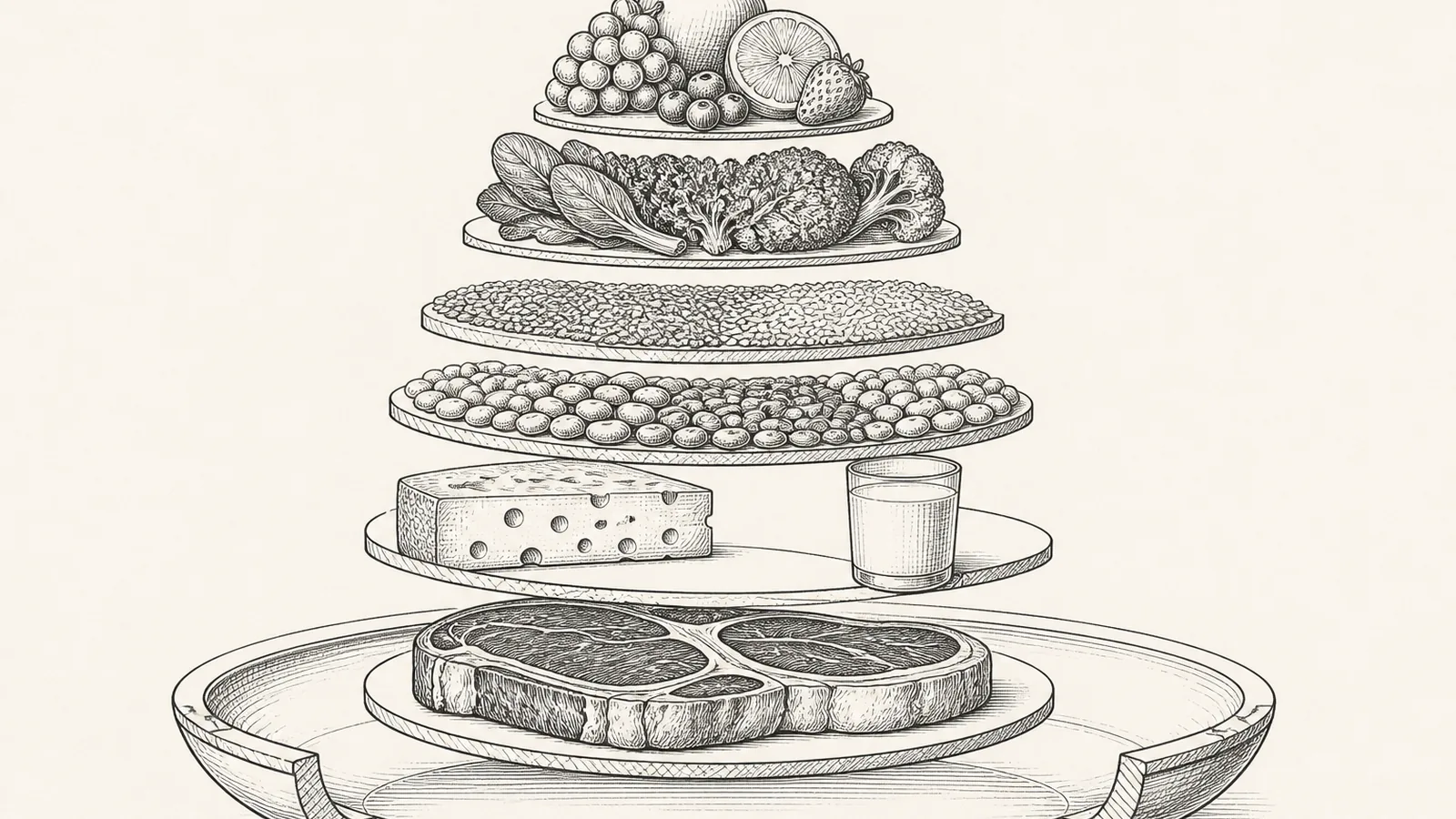
What the panel produced is a separate question from how it was produced, and on the substance the guidelines are harder to caricature. The 2025-2030 edition turned the food pyramid upside down, retiring the decades-old base of bread and cereal and moving protein, dairy, and fats up alongside vegetables and fruit. It urges Americans toward full-fat dairy and more meat and names ultraprocessed food as the thing to cut. For anyone who watched two generations build dinner on the low-fat, grain-heavy orthodoxy that presided over a generation of rising obesity and diabetes, that is not an outrage. It is a correction that arrived late.
The document is not clean. It keeps the longstanding cap on saturated fat at 10 percent of daily calories while pushing people toward whole milk and beef, two of the most efficient ways to blow past it, a contradiction the text never bothers to resolve. The lawsuit adds that the final guidelines halve recommended fruit and vegetable servings, drop daily alcohol limits, and wave through fad diets, though those are the plaintiff’s characterizations, and the plaintiff has a long-declared preference for the plate it lost.
Because there is another half to this, the half the press releases skip. The Physicians Committee for Responsible Medicine is not a neutral college of doctors who wandered in from clinic. It is a vegan advocacy organization founded by Barnard, who served as a medical adviser to People for the Ethical Treatment of Animals and sat on the board of its foundation. In PCRM’s first dozen years, PETA and the affiliated Foundation to Support Animal Protection steered more than $850,000 into it, a bankroll the group rarely volunteers. It presents as a physicians’ committee, but doctors are a small fraction of its rolls; the group has long put the physician count near 17,000 of a membership many times larger. The plant-forward report it now wants a federal judge to reinstate is the product it has spent forty years lobbying for.
So the fight is not, whatever the filing suggests, capture versus science. It is one set of interests that lost a rulemaking asking a court to hand the win to the committee whose conclusions it prefers. The Dietary Guidelines have been a lobbying cage match since the first pyramid went up in 1992, meat on one side, plants and grain on the other, each side certain the other bought the result. The genuinely new thing in 2026 is which lobby was standing when the music stopped. When a group demands “independent science” and means the panel that reached its preferred conclusion, the word carrying the weight is not “independent.”
None of which makes the secrecy defensible. The honest reading is that RFK Jr.’s agencies handed their opponents a real procedural weapon, a shadow panel a judge may well find broke the plain terms of the advisory-committee law, and that the guidelines would have survived legal daylight better had they been written in it. The vulnerability was never the MAHA instinct to eat real food and distrust the ultraprocessed aisle. It was the way the agencies went about writing it down.
Barnard wants his committee reinstated, the plant-forward one whose report reads like the diet he has preached since 1985. He has wanted that outcome for forty years. A panel working in the dark just handed him the standing to demand it in court.
Sources
- PCRM – Physicians Sue Government to Withdraw Dietary Guidelines for Americans (2026)
- STAT – Physician group sues Trump administration over dietary guidelines process (2026)
- MedPage Today – Physicians Sue U.S. Government Over New Dietary Guidelines (2026)
- The Hill – RFK Jr. unveils new ‘upside down’ food pyramid (2026)
- Scientific American – RFK Jr. Upsets Food Pyramid, Urging Americans to Eat More Meat (2026)
- Harvard Nutrition Source – Dietary Guidelines for Americans 2025-2030 (2026)
- Quackwatch – Physicians Committee for Responsible Medicine
- Wikipedia – Neal D. Barnard