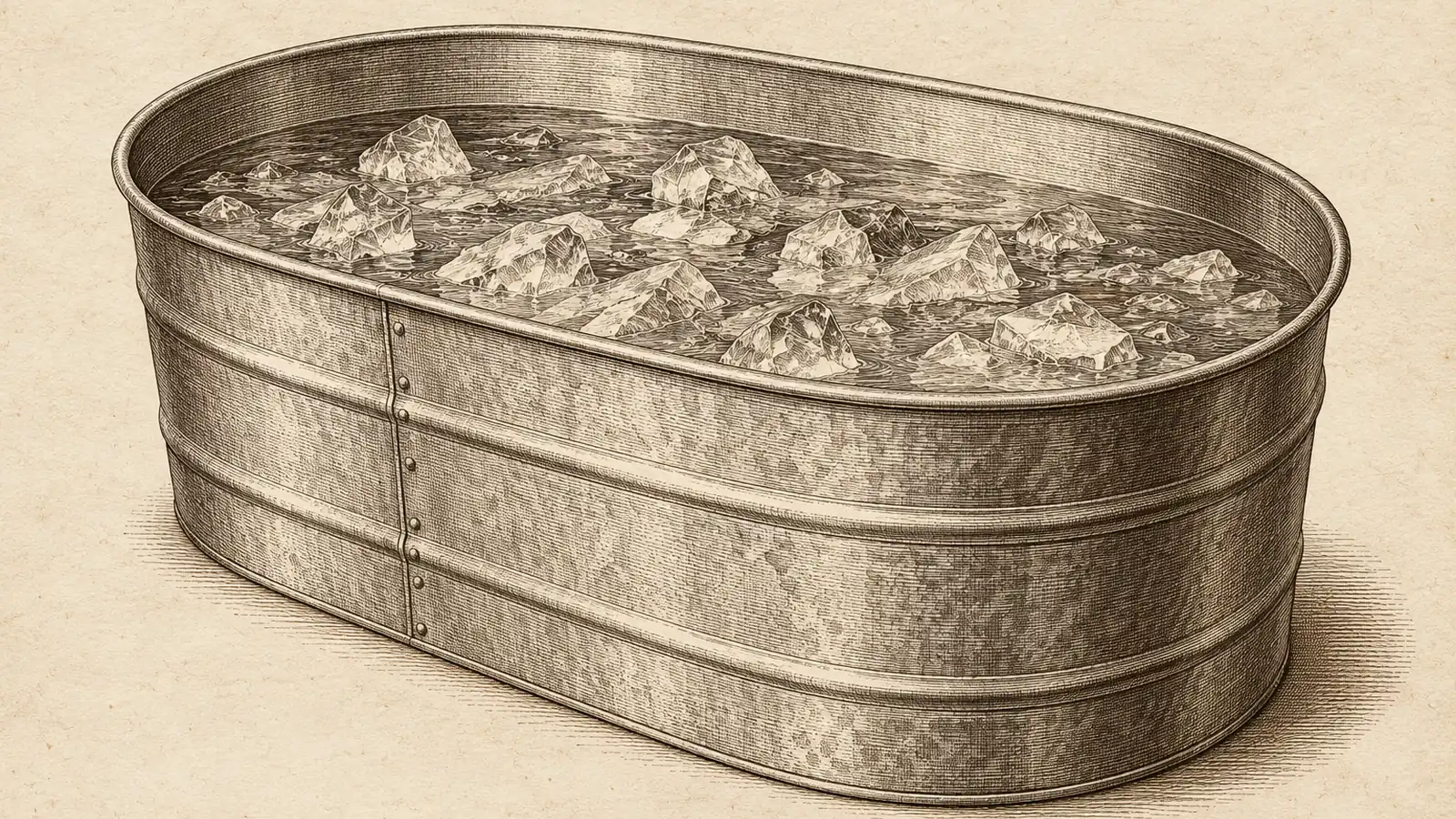
I’d always filed the ice bath under virtue. It was the miserable, teeth-chattering part of training that proved you took recovery seriously. So I wasn’t ready for this result. In one 12-week strength trial, men who sat in cold water after every session added 103 grams of quadriceps muscle on average, while men who spent the same 10 minutes on an easy bike ride added 309.
That trial underpins a blunt piece that Max Davis, a postgraduate researcher at the University of Bath’s Centre for Nutrition, Exercise and Metabolism, wrote for The Conversation. ScienceDaily republished it on October 14. Davis walks down the recovery aisle (ice baths, massage, compression garments, whey, BCAAs, tart cherry juice, fish oil) and finds that most of it helps you feel less sore while doing far less to restore what your muscles can actually do. Ice baths, he argues, may cost you some of the gains you trained for. Recovery, he concludes, “cannot be bottled and sold.”
Ten minutes at 10°C
Llion Roberts, Truls Raastad and colleagues ran the trial and published it in The Journal of Physiology in 2015. Twenty-one men completed 12 weeks of lower-body strength training, twice a week. After every session, half of them sat waist-deep for 10 minutes in water at about 10°C. The other half did 10 minutes of easy cycling. Note what the comparison was: cold water against light pedaling, not against doing nothing. The cyclists put an average of 309 grams of lean mass on their quadriceps. The cold-water group put on 103, about a third as much. Under the microscope, the cyclists’ fast-twitch type II fibers grew 17% and gained 26% more myonuclei, the nuclei a fiber needs to support a bigger body. In the cold-water group, neither change reached statistical significance.
Wait, how do ten minutes in a cold tub, twice a week, reach into the fibers themselves? The team ran a second experiment to find out. They put nine men through a single training session and took muscle biopsies over the next two days. When the men cycled afterward, their satellite cells (the muscle’s resident stem cells, tagged by a protein called Pax7) climbed 21% by 24 hours and 48% by 48 hours. After cold water, the count never rose significantly at any time point. A growth-signaling switch called p70S6K fired 3.6-fold two hours after active recovery and only 2.2-fold after the plunge.
Davis explains it through inflammation. “While inflammation causes soreness, it also triggers adaptations that build muscle,” he writes, so damping one may damp the other. Roberts’s team pointed instead to plumbing and temperature. Cold narrows blood vessels, which could mean fewer amino acids reach the muscle, and a chilled muscle may run its growth machinery more slowly. They also admitted the responsible factors were “not immediately obvious.” I trust that admission more than I’d trust a neat story. What they measured is that the repair crew arrived late and understaffed, and nobody has yet pinned down which signal the cold muffled.
A trial of 21 men could be a fluke, so the pooled evidence matters. In a 2024 meta-analysis in the European Journal of Sport Science, Alec Piñero and colleagues, with Brad Schoenfeld as corresponding author, gathered eight randomized studies covering about 116 mostly young men. All of them had people sit in water between 10 and 15°C within roughly 15 minutes of lifting. Training alone produced a standardized gain in muscle size of 0.36. Training plus cold water produced 0.14, with an interval that crossed zero. The head-to-head difference was −0.22 standardized units, with a credible interval from −0.47 to 0.04 and a 95.7% probability that cold water’s true effect on growth is negative. The authors rated the underlying studies fair to poor and chose their words carefully: immersion right after training “may modestly attenuate gains in muscle hypertrophy.”
That evidence covers cold water straight after lifting and says nothing about your morning cold shower. Davis doesn’t call for a ban, either. “It’s best to only use them when rapid recovery is vital,” he writes.
The vitamin aisle produced this same pattern first. In a double-blind trial from the Norwegian School of Sport Sciences, Gøran Paulsen’s team gave 54 young men and women either 1,000 mg of vitamin C plus 235 mg of vitamin E or a placebo through 11 weeks of mostly running-based endurance training. According to Paulsen, the supplements “blunted the endurance training-induced increase of mitochondrial proteins.” Maximal oxygen uptake improved regardless, so the effect showed up in the cells rather than on the stopwatch. His advice was that high doses “should be used with caution, especially if you are undertaking endurance training.” Tart cherry juice is sold on the same antioxidant and anti-inflammatory chemistry. Davis finds small-to-moderate reductions in soreness in what he calls an emerging area of research. Whether a concentrated dose taken for months mutes adaptation the way those vitamins did is a question the cherry soreness trials weren’t designed to answer.
Soreness is where nearly all of this research lives. A 2018 meta-analysis in Frontiers in Physiology by Dupuy and colleagues pooled 99 studies. Massage posted the biggest effects, a Hedges’ g of −2.26 for soreness and −2.55 for perceived fatigue. Compression came in at −0.92 for soreness and water immersion at −0.47, or −0.62 when the water was 15°C or colder. Stretching did nothing for soreness. The authors didn’t evaluate performance at all, they examined only a single recovery session, and because nobody can be blinded to a massage, they couldn’t rule out placebo. Davis’s version: massage “might ease the discomfort of training, but don’t expect miraculous performance restoration.”
Who paid for the “not placebo” headline
Compression deserves the hardest look. Davis cites a 2022 study in which tights improved circulation and muscle blood flow while a placebo pill did not. That’s O’Riordan and colleagues in Scientific Reports, and its title says the benefits “are not due to the placebo effect.”
Read the paper and the claim gets much smaller. Twenty-two resistance-trained adults finished the study. Seven wore compression tights, eight took sugar-free tablets they had been told were an L-arginine recovery supplement, and seven did nothing. The abstract states that no significant differences were seen between the groups, so the case rests on effect sizes. The belief ratings tell their own story. On a 0 to 5 scale, the tights group started out rating their tights 3.0 and ended at 3.9, while the placebo group slid from 3.9 to 3.0. The paper’s discussion cites only the starting gap, as evidence that the deception worked. Maybe belief followed a benefit people felt, or maybe it helped create one. A trial this size can’t tell those apart.
Then there’s the funding section: four of the authors “received a research grant from compression manufacturer 2XU Pty Ltd,” which also supported two of them. The paper says 2XU had no input into the design, analysis or writing, and I’ll take that at face value. Still, the tights arm had seven people, there was no significant difference between groups, a tights maker supplied the grant, and the title declares the tights aren’t a placebo. Even Davis, who cites the study favorably, says compression is “unlikely to directly restore muscle function” and may mainly help people feel more recovered.
Sleep moves the numbers no product claims to
Davis’s list of what works is cheap. Get 7 to 9 hours of sleep. Eat 20 to 40 grams of protein after training, with enough carbohydrate to refill your energy stores. Allow rest days between sessions and challenge yourself “a bit more each time.” He prefers whole food to supplements and notes that BCAAs fall short of complete protein, because repair needs all the essential amino acids, not three of them.
I’d underline the sleep. In a randomized crossover study in Physiological Reports, Séverine Lamon’s group kept 13 healthy young adults awake for one night. The next day their muscle protein synthesis fell 18%, cortisol rose 21%, and testosterone dropped 24%, and none of them had trained. One lost night did that to the machinery recovery products claim to support.
The recovery aisle is tested, and sold, on soreness, because soreness is what you notice the next morning. Muscle growth shows up over 12 weeks on a scan, and on that measure the cold tub lost.
I won’t be getting into cold water after lifting. I’ll pedal for ten easy minutes, eat a proper serving of protein, and get to bed on time, and I’ll save the ice for the rare week I have to perform hard twice in two days.
Sources
- ScienceDaily / The Conversation: Max Davis, University of Bath, on why workout recovery tricks can backfire (2026)
- The Journal of Physiology: Roberts et al., post-exercise cold water immersion attenuates anabolic signalling and long-term adaptations to strength training (2015)
- European Journal of Sport Science: Piñero et al., meta-analysis of post-exercise cold water immersion and resistance-training hypertrophy (2024)
- Scientific Reports: O’Riordan et al., compression, blood flow and the placebo effect after resistance exercise (2022)
- Frontiers in Physiology: Dupuy et al., meta-analysis of recovery techniques on soreness, fatigue, muscle damage and inflammation (2018)
- Physiological Reports: Lamon et al., acute sleep deprivation, muscle protein synthesis and the hormonal environment (2021)
- ScienceDaily: release on the Paulsen vitamin C and E trial (2014)